Thinking Process
PHASE 1: VISUAL DECONSTRUCTION
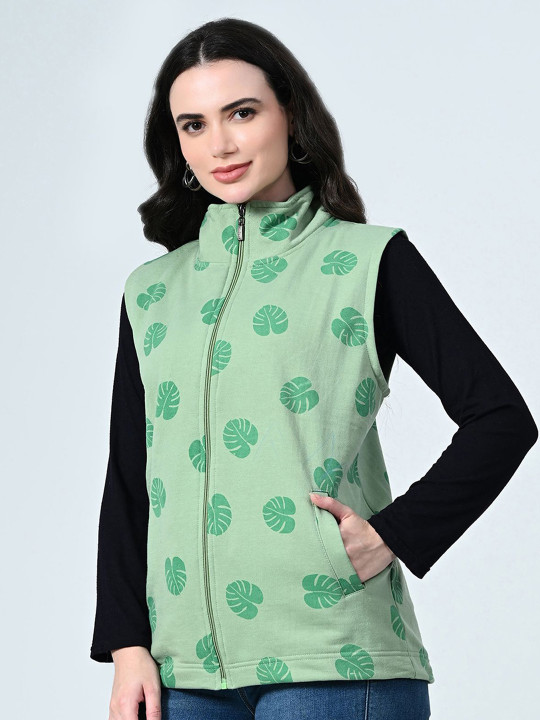
- **Fabric Physics:** The source garment is a fleece or thick cotton-blend vest (gilet). It possesses high structural integrity and thickness, meaning it has low elasticity and will not cling tightly to the body like the current t-shirt. It has a matte finish with low specularity (absorbs light). The material creates soft, bulky folds rather than sharp creases.
- **Key Features:**
- **High Stand-up Collar:** This must maintain its vertical structure around the neck and not collapse into a crew neck shape.
- **Zipper Mechanism:** The center vertical zipper (green tape with metal pull) provides a rigid spine that must be preserved.
- **Monstera Leaf Pattern:** The scale and orientation of the green leaf print must wrap around the torso volume correctly without warping.
- **Armhole Binding:** The hem at the sleeveless armholes must be distinct and raised.
- **Pocket Detail:** The welt pocket slit on the lower front must remain visible.
PHASE 2: FIT & DRAPE SIMULATION
- **Body Mapping:**
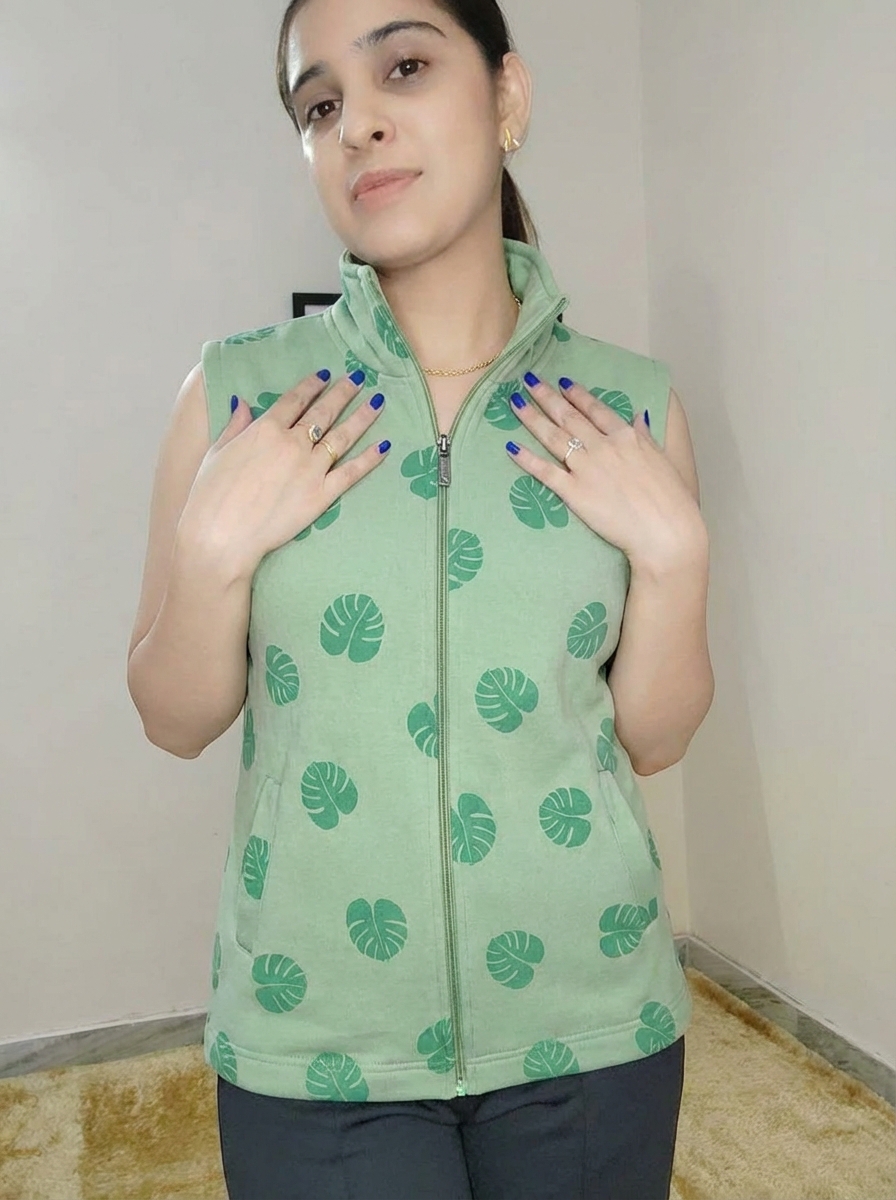
- **Torso Volume:** Unlike the user's current fitted t-shirt, this vest adds bulk. The simulation must expand the silhouette slightly at the waist and chest to account for the fleece thickness.
- **Chest Compression:** The user's hands are pressing against her upper chest. The virtual fabric must show slight compression/deformation directly under the palms to simulate physical contact, disrupting the straight line of the zipper slightly at the sternum.
- **Shoulder Anchoring:** The vest structure is stiff; the shoulders should sit slightly higher than the skin line to represent the garment's padding.
- **Occlusion Handling:**
- **Hands & Fingers:** This is the critical failure point. A pixel-perfect mask must be generated for both hands, including the rings and blue fingernails. These elements must be layered *on top* of the new vest.
- **Necklace:** The gold chain sits close to the neck. Depending on the height of the vest collar, the necklace must either be occluded by the collar or layered over the zipper if the collar is open.
- **Hair:** The ponytail resting on the user's left shoulder (viewer's right) must drape *over* the vest material.
PHASE 3: ENVIRONMENT & LIGHTING
- **Light Match:**
- **Source:** Soft, diffuse indoor lighting coming from the front-left (relative to the camera).
- **Shadow Casting:** The user's hands must cast contact shadows onto the green fleece vest. Without these shadows, the hands will look like they are floating.
- **Drop Shadow:** The vest must cast a shadow onto the user's bare arms at the armhole boundaries to emphasize material thickness.
- **Color Calibration:** The source image is high-contrast studio lighting (cool white). The user image has warmer, yellowish indoor tones. The green of the vest must be color-graded (warmed slightly) to match the ambient temperature of the room so it doesn't appear fluorescent or superimposed.
PHASE 4: IDENTITY PROTECTION
- **Facial Lock:** The region from the chin upwards, including the jawline, ears, and entire hair volume, is a strict exclusion zone. No pixels in the face region may be altered.
- **Body Integrity:** The user's arm thickness and shoulder width must be preserved. While the garment adds bulk, the underlying skeletal structure and pose (arms raised) must not be warped or slimmed to fit the clothing model. The user's skin tone on the arms and neck must remain untouched.