Thinking Process
PHASE 1: VISUAL DECONSTRUCTION
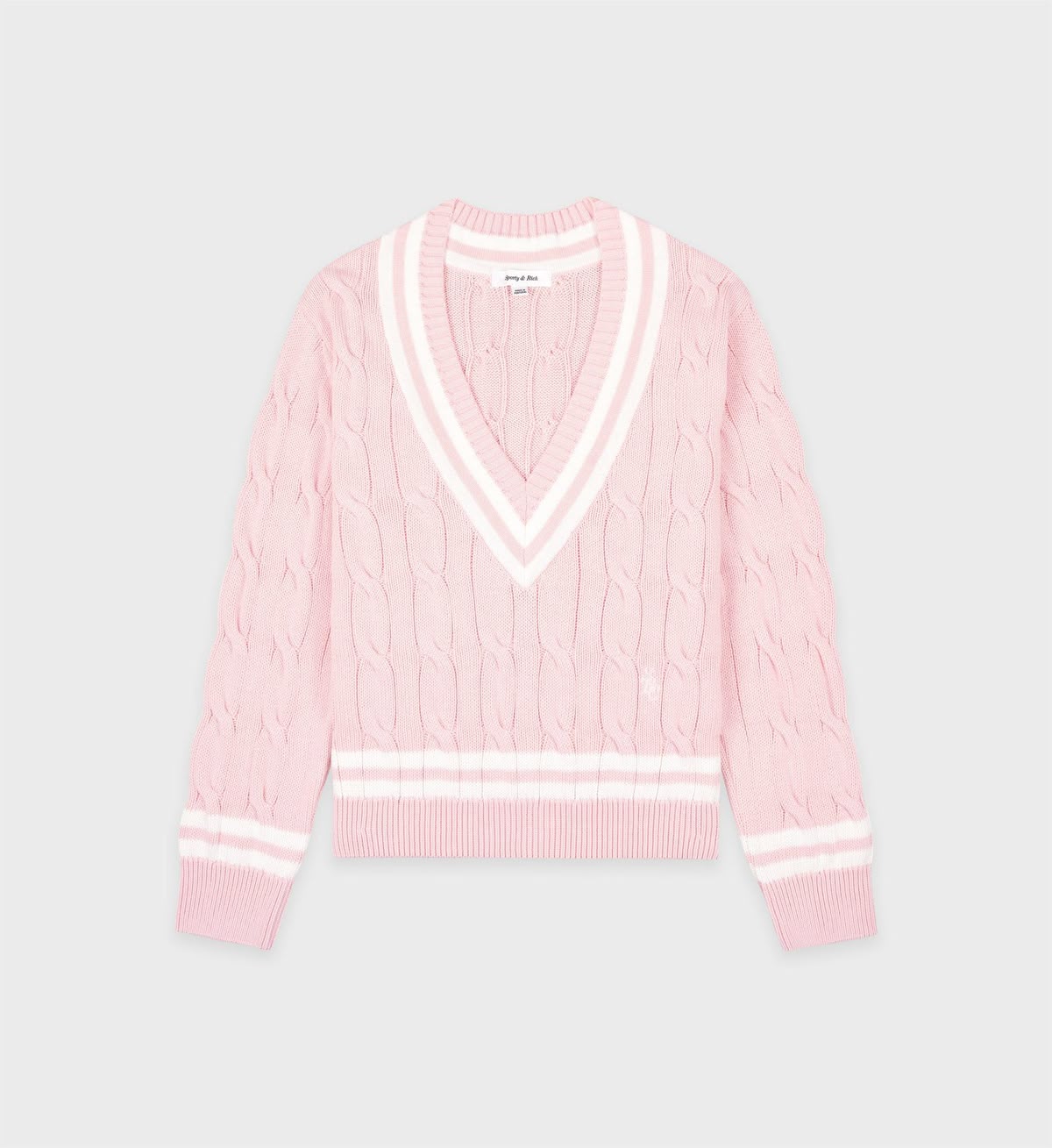
- **Fabric Physics:** The source garment is a heavy-gauge cable knit (cotton or wool blend). Unlike the user's current thin, clingy jersey top, this material has significant structural volume and thickness. It has a matte finish with high surface roughness; it should not reflect light sharply but rather absorb it, creating soft self-shadowing within the cable patterns.
- **Key Features:** The deep V-neckline with dual white stripes is the primary focal point. The specific cable-knit texture (braided vertical patterns) must be preserved via normal mapping to maintain depth. The ribbed elastic cuffs and hemline structure are rigid and must retain their shape rather than stretching linearly like spandex.
PHASE 2: FIT & DRAPE SIMULATION
- **Body Mapping:**
- **Torso:** The sweater has a "relaxed fit," meaning it will not cling to the bust or waist like the current brown top. It should drape vertically from the bust line, leaving a gap between the fabric and the midriff.
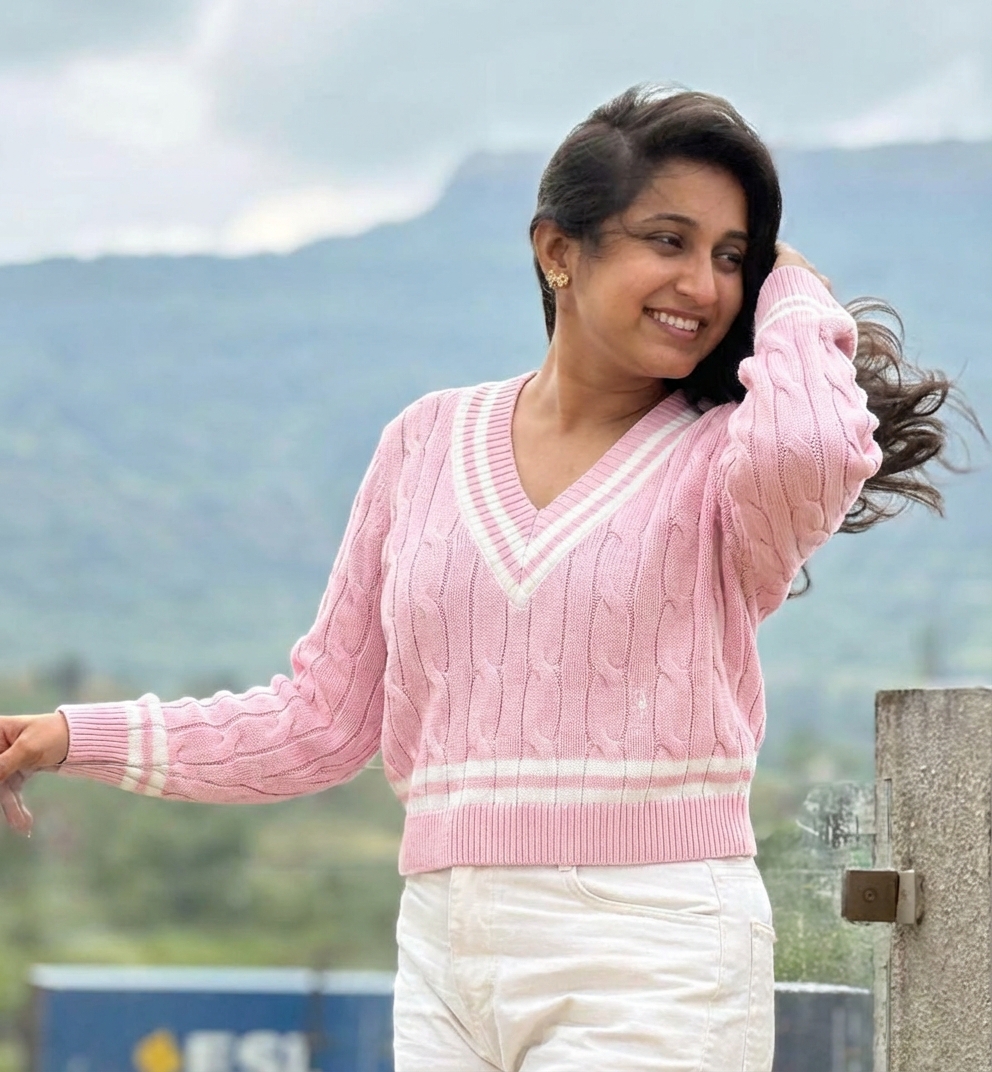
- **Left Arm (Raised):** Due to the raised arm, gravity will pull the sleeve down toward the elbow. Significant bunching/folding must occur at the inner elbow and shoulder joint. The armpit area will experience tension lines.
- **Right Arm (Resting):** The fabric must compress against the glass railing. The sleeve cuff should bunch slightly at the wrist or push up the forearm depending on the sleeve length relative to the user's arm.
- **Occlusion Handling:**
- **Hair:** The user's loose hair falling over the left shoulder and back is a critical occlusion layer. A precise segmentation mask must place the hair strands *over* the heavy knit texture.
- **Railing:** The glass railing cuts across the lower torso. The garment simulation must account for this collision, ensuring the sweater does not clip through the railing.
- **Waistband:** The sweater should naturally overhang the waistband of the white jeans, obscuring the belt loops currently visible.
PHASE 3: ENVIRONMENT & LIGHTING
- **Light Match:** The environment is an outdoor scene with overcast, diffused skylight. Lighting is soft and omnidirectional with low contrast. The sweater requires ambient occlusion rendering to darken the deep crevices of the cable knit. Shadows should be soft-edged and cool-toned to match the cloudy atmosphere.
- **Color Calibration:** The source image is lit by neutral studio light. To integrate into the scene, the pink hue must be slightly desaturated and shifted towards a cooler (bluish) temperature to match the ambient outdoor lighting and the background mountain haze.
PHASE 4: IDENTITY PROTECTION
- **Facial Lock:** The user's entire head, including the hairline, jawline, and neck pose, must remain pixel-perfect frozen. The V-neck of the sweater will expose the upper chest/clavicle area; the skin tone here must perfectly match the user's facial skin tone.
- **Body Integrity:** Strict prohibition on warping the user's underlying skeletal mesh. While the sweater adds bulk due to fabric thickness, the user's shoulder width, arm volume, and hip placement must remain unaltered. Do not slim the torso to fit the garment; fit the garment to the torso.