
Thinking Process
PHASE 1: VISUAL DECONSTRUCTION
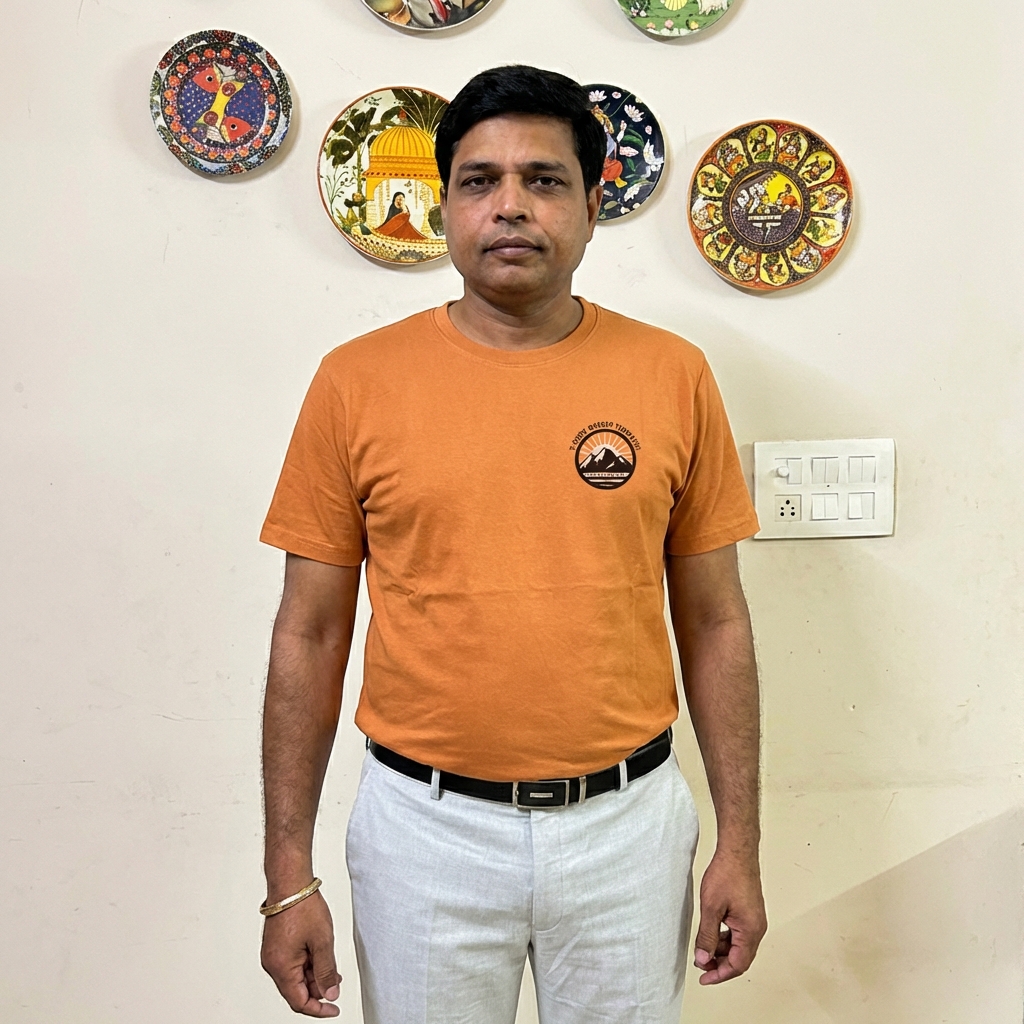
- **Fabric Physics:** The source garment is a standard cotton jersey knit. It possesses a high friction coefficient (matte finish) and low specularity (no shine). Unlike the user's current stiff woven dress shirt, the cotton jersey must exhibit "soft body" dynamics, allowing for micro-wrinkles rather than sharp, rigid creases. Light absorption should be uniform.
- **Key Features:**
- **Logo:** The circular "The Vector Lab" mountain graphic on the wearer's left chest must be preserved without warping.
- **Neckline:** The ribbed crew neck collar structure must replace the existing sharp collar.
- **Sleeves:** Short sleeve hem stitching details must be visible.
- **Texture:** The subtle vertical grain of the cotton weave must be maintained.
PHASE 2: FIT & DRAPE SIMULATION
- **Body Mapping:**
- **Shoulder Anchor:** The garment must anchor at the user's trapezius muscles, draping vertically.
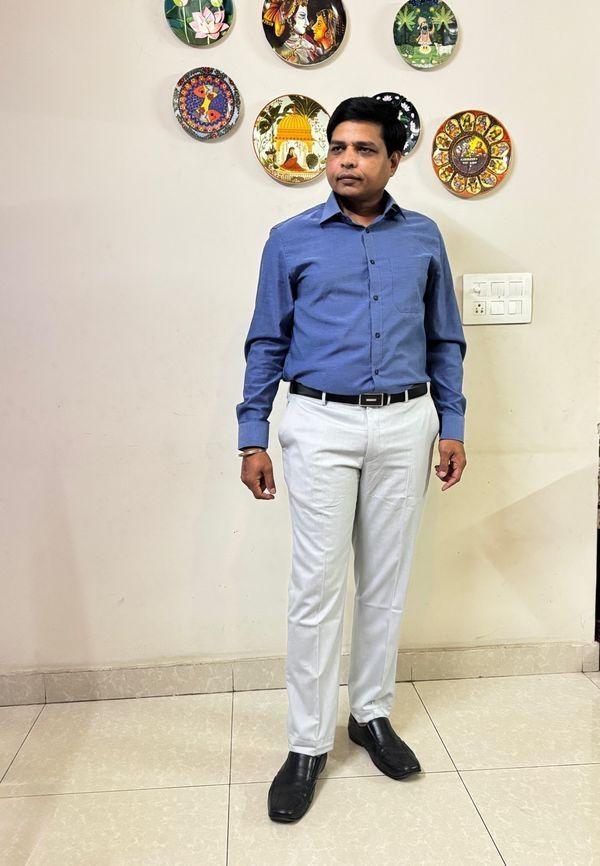
- **Waist Interaction:** The user currently wears a tucked-in shirt. The target T-shirt should ideally be simulated as **untucked** for realism. The fabric physics engine must simulate gravity pulling the hem past the belt line, creating a slight "tenting" effect over the stomach area rather than adhering tightly to the torso.
- **Arm Transition:** As the target is switching from long sleeves to short sleeves, the physics model implies exposure of the forearms. In-painting will be required to generate skin texture for the forearms consistent with the user's face and hands.
- **Occlusion Handling:**
- **Hands:** The user's hands are clear of the torso, requiring no complex masking.
- **Accessories:** The bracelet/watch on the user's right wrist must be layered *over* any generated forearm skin.
- **Belt:** If simulated untucked, the t-shirt fabric must occlude the belt and the top inch of the trousers.
PHASE 3: ENVIRONMENT & LIGHTING
- **Light Match:**
- **Direction:** The user is illuminated by a strong overhead source (likely ceiling LED), casting downward shadows (evident under the chin and wall plates). The new shirt must cast a shadow onto the user's neck and have a natural shadow gradient darkening towards the bottom hem.
- **Highlighting:** The shoulders should receive the highest luminance, fading downward.
- **Color Calibration:**
- **White Balance:** The user image has a slightly cool/neutral indoor tone, while the cloth image is warm/studio lit. The orange saturation of the t-shirt must be slightly desaturated and shifted cooler to match the ambient room lighting and avoid looking like a "sticker."
- **Noise Integration:** Gaussian noise must be added to the smooth vector-style t-shirt to match the ISO grain of the user's photo.
PHASE 4: IDENTITY PROTECTION
- **Facial Lock:** The user's entire head (hair, forehead, eyes, nose, mouth, chin) and neck up to the Adam's apple must remain pixel-perfectly frozen.
- **Body Integrity:** The user's shoulder width and torso volume must be preserved. The simulation must **not** apply a "slim fit" morph; the t-shirt must conform to the user's actual build, preserving the natural posture and body mass index. Do not alter the skin tone of the face or hands.