Thinking Process
PHASE 1: VISUAL DECONSTRUCTION
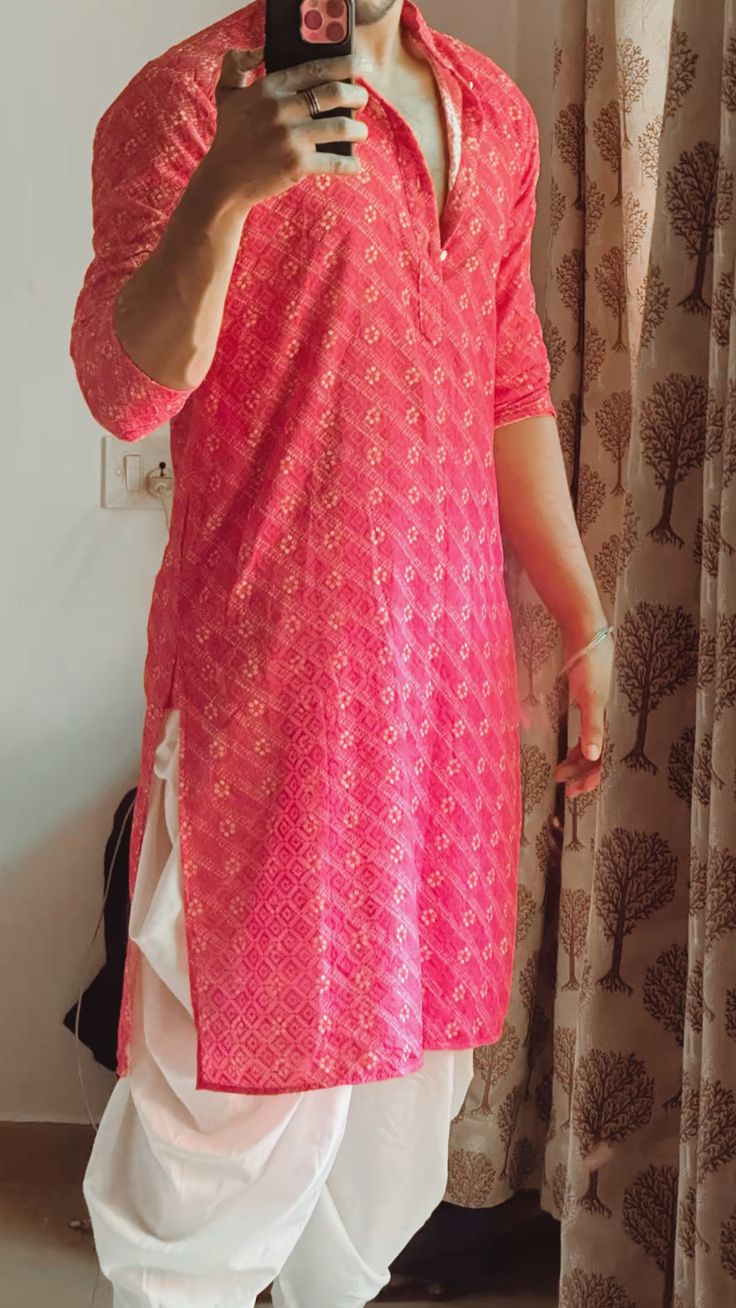
- **Fabric Physics:** The source garment is a lightweight, printed cotton or cotton-silk blend kurta. It exhibits a semi-rigid drape typical of starched fabrics, meaning it holds creases (as seen in the sleeves) rather than flowing like fluid silk. It has a matte finish with a very subtle sheen on the geometric gold/light-colored pattern, which should exhibit anisotropic reflection properties.
- **Key Features:** The repeating diamond/geometric pattern is critical and must not be distorted. The deep placket/neckline structure, the side slits (vents) visible near the thigh, and the specific magenta/salmon hue must be preserved. The rolled-up sleeve aesthetic from the source should be adapted to the target's arm length.
PHASE 2: FIT & DRAPE SIMULATION
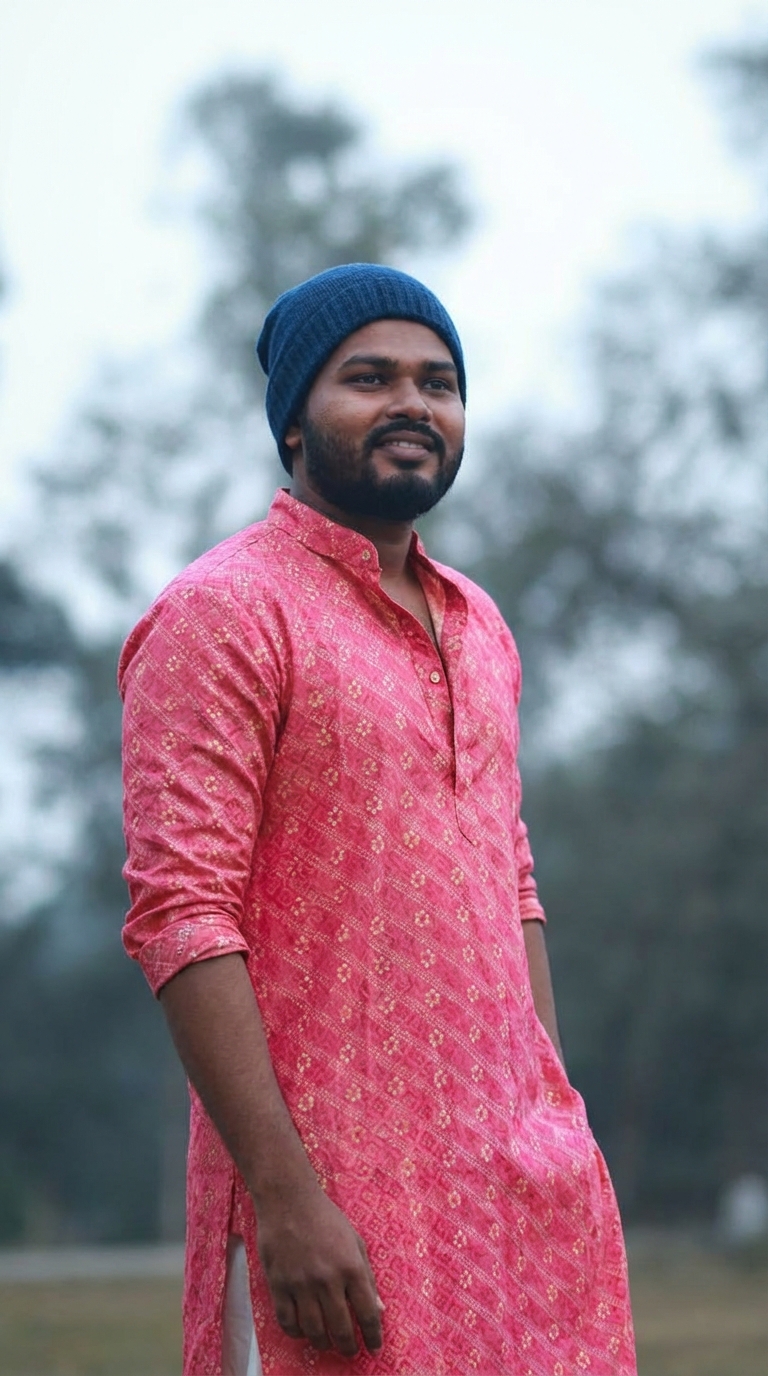
- **Body Mapping:** **CRITICAL:** The target user is wearing a high-volume puffer jacket. The simulation must virtually "de-layer" the user to estimate the true anatomical shoulder and torso width beneath the jacket. The kurta must **not** be mapped over the puffer jacket's bulk; it must drape closer to the skin, dropping vertically from the natural shoulder line. The silhouette must transition from the rounded, puffy shape to a straighter, rectangular tunic silhouette.
- **Occlusion Handling:** The user's beard overlaps the collar area and must be segmented and layered *over* the new kurta neckline. The user's hands appear to be inside the jacket pockets or obscured by the jacket hem; the simulation should generate the kurta's hem falling naturally past the wrist, or reconstruct the hands if the hemline is shorter than the arm length. The beanie should remain, but the jacket's hood surrounding the head must be removed.
PHASE 3: ENVIRONMENT & LIGHTING
- **Light Match:** The target environment features cool, diffuse, overcast outdoor lighting (soft shadows, low contrast). The source garment has warm, directional indoor lighting with hard highlights. The kurta must be re-lit to match the flat, bluish ambient light of the outdoor scene. Specular highlights on the fabric must be dampened.
- **Color Calibration:** The source magenta is highly saturated due to indoor warmth. It requires color grading to slightly desaturate and cool down the tones to blend with the grey/blue outdoor palette. The white balance of the pattern must shift from warm cream to neutral white/grey.
PHASE 4: IDENTITY PROTECTION
- **Facial Lock:** The user's entire face, including the beard, skin texture, and the beanie hat, must be frozen. The eyes and expression are strictly immutable.
- **Body Integrity:** While the artificial bulk of the puffer jacket is removed, the user's underlying anatomical scale (shoulder width, neck thickness) must be maintained. Do not slim the user's actual biological frame; only remove the garment volume.