Thinking Process
PHASE 1: VISUAL DECONSTRUCTION
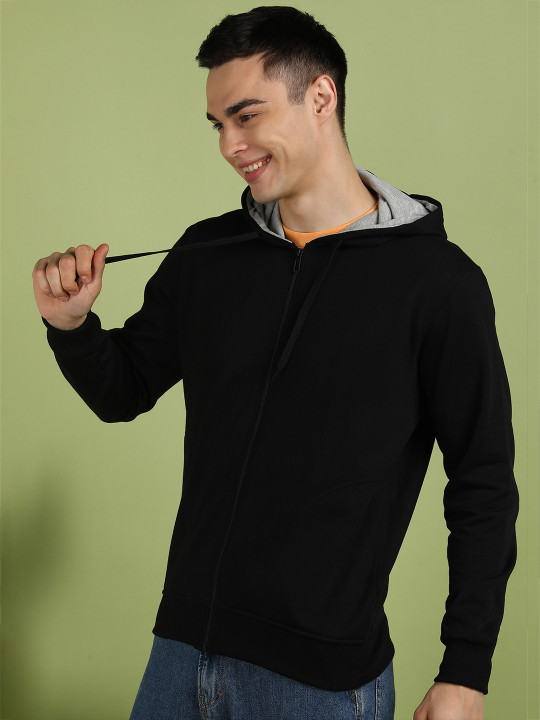
- **Fabric Physics:** The source garment is a cotton-blend fleece hoodie. It has a high-density matte finish with low specularity (it absorbs light rather than reflecting it). The material has moderate stiffness, particularly around the zipper, hood, and ribbed cuffs, meaning it will create softer, wider folds compared to the intricate knit pattern of the user's current sweater.
- **Key Features:**
- **Central Zipper:** Must remain straight but follow the curvature of the user's torso.
- **Hood Architecture:** The grey inner lining of the hood is a critical contrast element and must be visible at the neck area.
- **Drawstrings:** These must be physically simulated to hang vertically due to gravity, ignoring the dynamic "held" pose in the source image.
- **Ribbing:** Distinct texture on the wrist cuffs and bottom hemline must be preserved.
PHASE 2: FIT & DRAPE SIMULATION
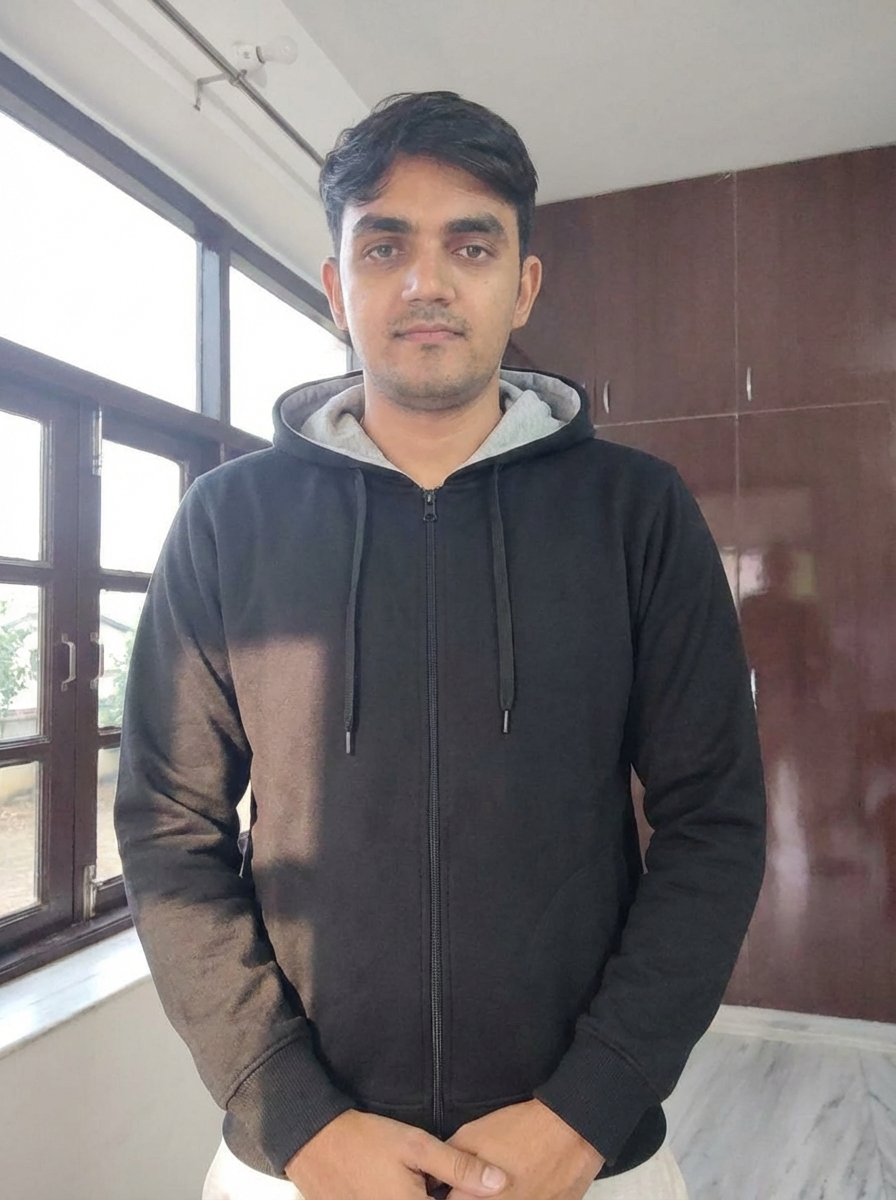
- **Body Mapping:** The user is currently wearing a thick, textured knit sweater. The simulation must estimate the user's true body volume *beneath* this sweater to prevent the new hoodie from looking artificially bulky or "puffy." The hoodie should sit naturally on the shoulders, with the sleeves tapering slightly toward the wrists. The shoulders are slightly rounded; the hoodie seam must align with the acromion bone, not the current sweater's dropped seam.
- **Occlusion Handling:**
- **Hands:** The user's hands are clasped in front of the groin/waist area. The bottom hem of the hoodie will likely interact with the thumbs/wrists. The hands must be segmented out and layered *over* the bottom hem of the hoodie.
- **Necklace:** The user wears a gold chain. Given the high neck of the zip-up hoodie, the necklace should be visually occluded (covered) by the new garment, or removed entirely to prevent physics glitches.
PHASE 3: ENVIRONMENT & LIGHTING
- **Light Match:** The user is illuminated by a strong, cool daylight source from a window on the viewer's left (User's right).
- **Highlight:** The left side of the black hoodie (viewer's left) must be rendered in a lighter charcoal tone to reflect this light source.
- **Shadow:** The right side (viewer's right) must fall into deep shadow, consistent with the shading on the user's current face and pants.
- **Color Calibration:** The source image has warm/studio lighting. The grey inner hood lining must be desaturated and cooled slightly to match the ambient blue/white temperature of the user's room. The black black point should be lifted slightly to match the contrast levels of the user's dark hair.
PHASE 4: IDENTITY PROTECTION
- **Facial Lock:** Absolute freeze on the entire head region from the chin up. The user's jawline must remain sharp and distinct from the hoodie collar. The specific hair tuft standing up on the crown of the head must remain untouched.
- **Body Integrity:** Do not morph the user's torso to match the slimmer, turned silhouette of the source model. The user's frontal stance and waist width must be preserved. Do not slim the arms; maintain the volume implied by the user's current stance.