Thinking Process
PHASE 1: VISUAL DECONSTRUCTION
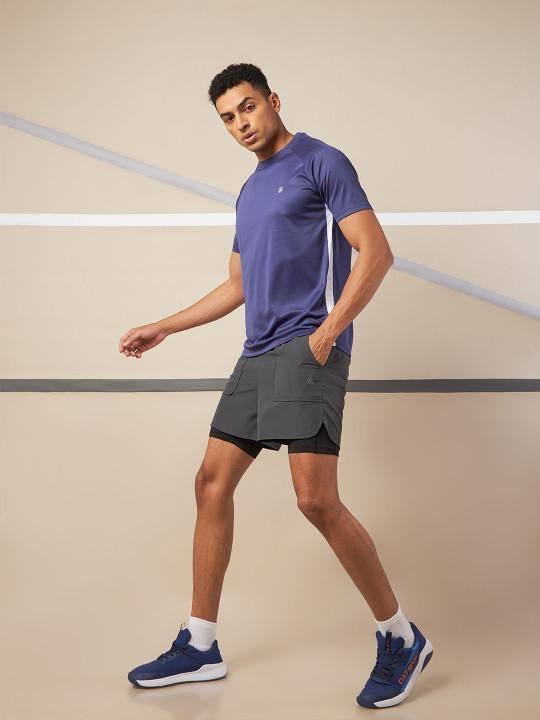
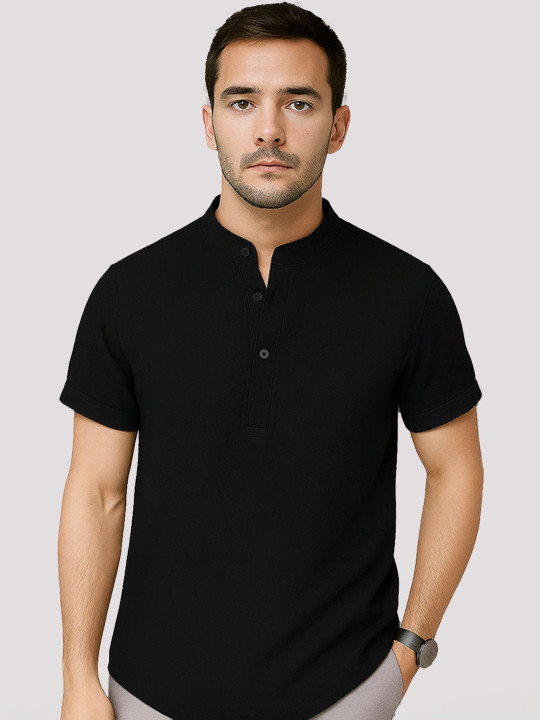
- **Fabric Physics:** The source garment is a textured knit, likely a cotton pique or waffle blend, typical of Henley or polo shirts. Unlike the target's current smooth, reflective athletic polyester, this material has high light absorption and a matte finish. It possesses medium weight and moderate stiffness, meaning it will not cling as tightly as the spandex blend currently worn, but will bridge small gaps between muscle groups rather than vacuum-sealing to them.
- **Key Features:** The Mandarin (band) collar is the defining structural element and must replace the current crew neck seamlessly. The deep three-button placket, the specific waffle-knit texture map, and the rolled/cuffed sleeve hems must be preserved. The garment is solid black; texture preservation via normal mapping is critical to prevent it from looking like a flat black void.
PHASE 2: FIT & DRAPE SIMULATION
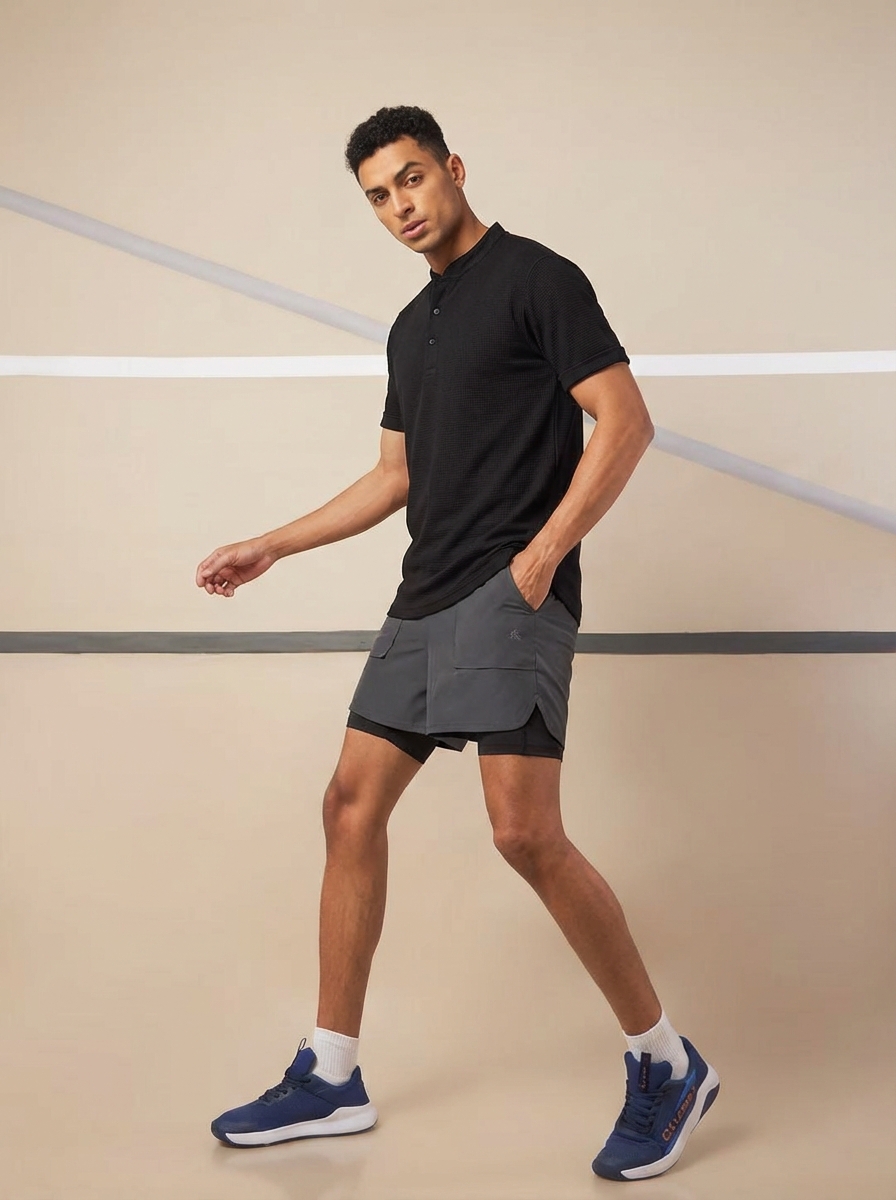
- **Body Mapping:** Due to the user's dynamic side-step pose and torso rotation, gravity must pull the fabric vertically down relative to the *ground*, not the body axis. There will be tension wrinkles radiating from the left axilla (armpit) across the chest due to the backward extension of the left arm. On the user's right side, the fabric should hang slightly looser as the torso leans away. The hemline must accommodate the wide stance, likely flaring slightly or bunching at the hips.
- **Occlusion Handling:** The user's right hand is partially inserted into the shorts pocket. The new garment's hemline must naturally drape *over* the wrist area or bunch slightly above the pocket entry, mirroring the physics of the original blue shirt. The user's neck geometry must be masked precisely to accommodate the V-opening of the Henley placket without exposing the underlying original blue collar.
PHASE 3: ENVIRONMENT & LIGHTING
- **Light Match:** The target environment features a strong, somewhat hard light source coming from the upper-left (viewer's perspective), casting distinct shadows to the right. The black fabric must show diffuse highlights on the left shoulder and pectoral region to reveal texture. Deep shadows must be generated on the right side of the torso and under the cuffed sleeves to match the scene's ambient occlusion.
- **Color Calibration:** The user's environment has warm, beige undertones. The absolute black of the source garment must be color-graded with a subtle warm tint in the highlight areas to integrate with the room's ambient light, preventing it from looking like a synthetic "cut-and-paste" element.
PHASE 4: IDENTITY PROTECTION
- **Facial Lock:** The user's entire head, including hair, facial structure, and neck area above the thyroid cartilage, is a strict "freeze zone." The skin tone on the arms and visible legs must remain unaltered.
- **Body Integrity:** The user has an athletic, muscular build. The simulation is strictly forbidden from applying "slimming" or "fashion model" morphs. The garment must deform to fit the user's broad shoulders and chest dimensions, preserving the original volumetric silhouette of the user's torso.