Thinking Process
PHASE 1: VISUAL DECONSTRUCTION
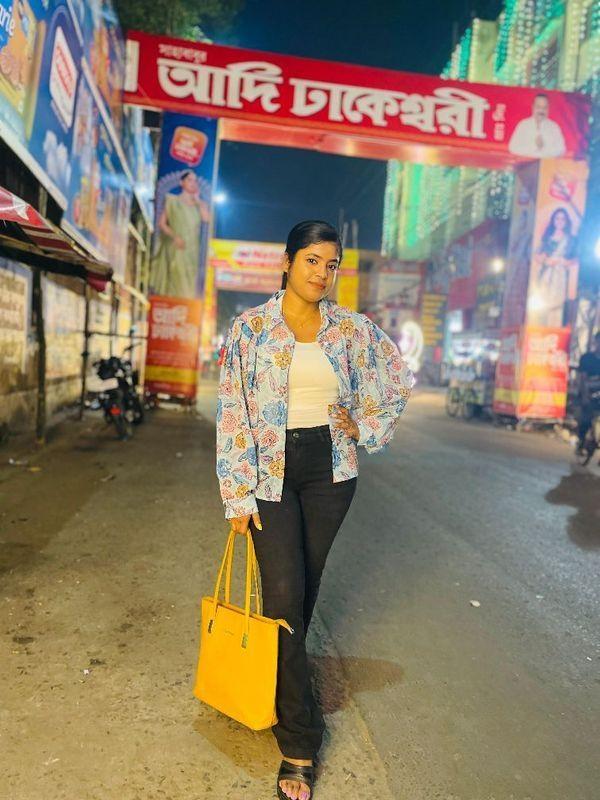
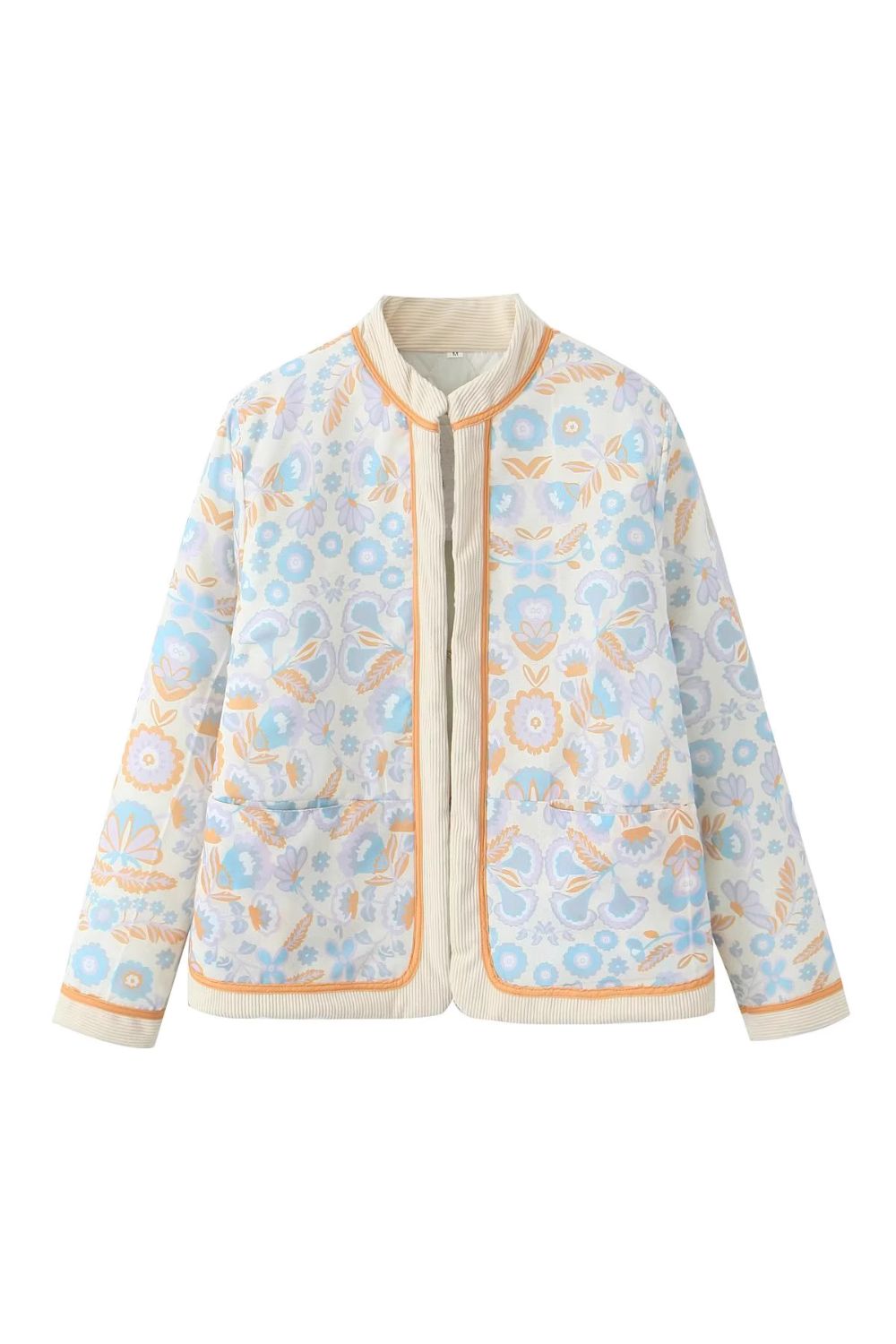
- **Fabric Physics:** The source garment is a quilted jacket with a corduroy or heavy cotton texture on the trim. It possesses high structural rigidity and thickness compared to the user's current lightweight shirt. It should exhibit diffuse reflectivity (matte finish) with no specular highlights. The "puffiness" of the quilting requires a volumetric render; it must not look flat or painted on.
- **Key Features:** The orange piping along the hems, collar, and cuffs is a high-contrast boundary that must remain sharp. The patch pockets on the front lower panels and the specific vertical quilting lines on the trim must be preserved. The floral pattern density must remain consistent, scaling only with perspective, not warping excessively across the chest.
PHASE 2: FIT & DRAPE SIMULATION
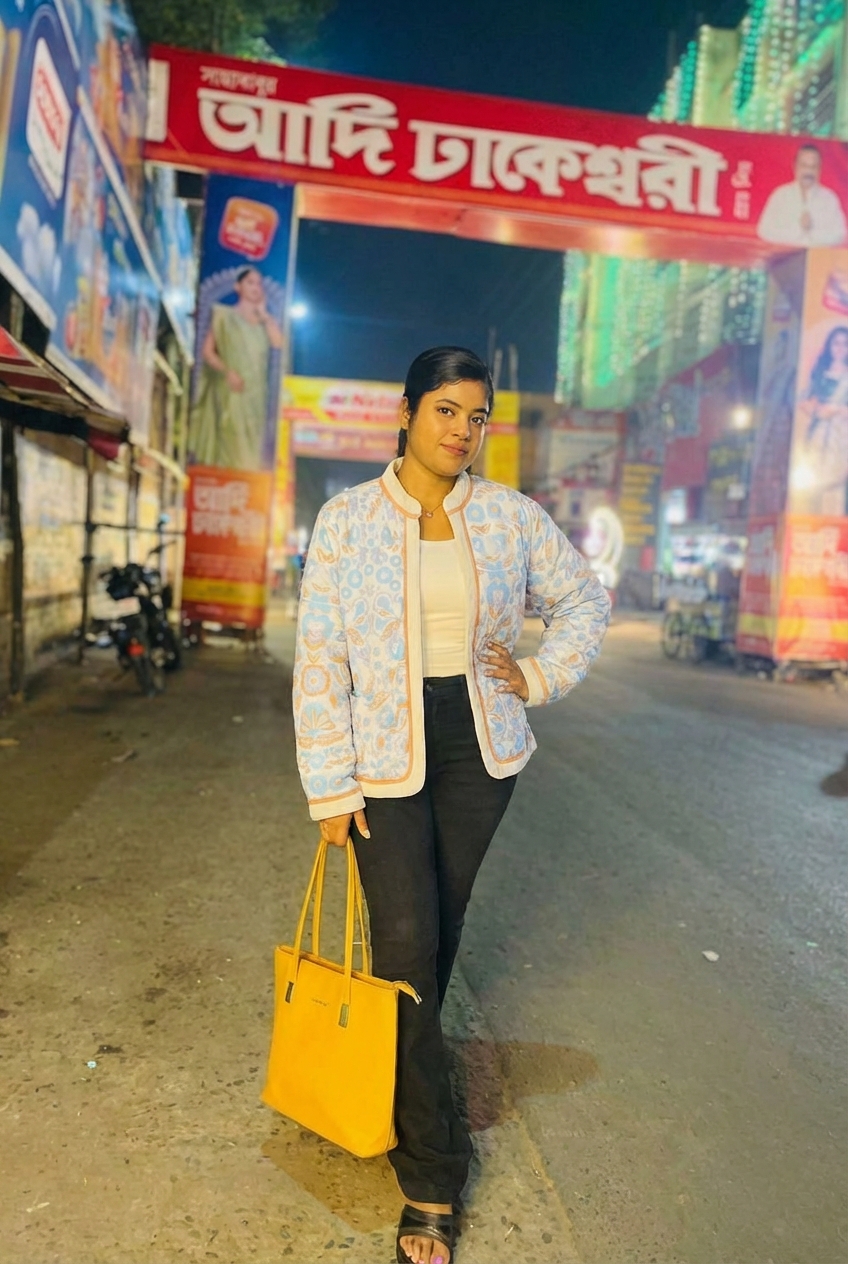
- **Body Mapping:** Due to the user's "hand-on-hip" pose (left side), the left sleeve of the jacket must bunch significantly at the elbow inner fold and flare slightly at the wrist. Unlike the current flowy shirt, this quilted jacket will maintain a stiffer silhouette and will not drape vertically against the torso; it should stand slightly away from the body at the waist. The jacket should be simulated as "open-front" to match the user's current styling, exposing the central vertical axis (preserving the white inner top or generating a neutral base).
- **Occlusion Handling:** The user's left hand (resting on the hip) is the primary occlusion layer; the jacket sleeve must pass *behind* this hand and wrist. The yellow tote bag handle in the right hand sits low, but the jacket hemline must not clip through the bag straps. The necklace should be layered *over* the jacket if the collar sits low enough, otherwise, the jacket collar occludes the neck base.
PHASE 3: ENVIRONMENT & LIGHTING
- **Light Match:** The scene utilizes a strong, frontal artificial light source (likely a camera flash or bright street lamp) in a night setting, creating hard shadows directly behind the subject. The new garment must be illuminated brightly from the front-center, casting self-shadows into the quilt creases. The shadows *inside* the open jacket (near the torso) must be deep to suggest the garment's thickness.
- **Color Calibration:** The background contains warm, festive street lighting (yellows/reds), but the foreground subject is lit by a cooler, white light source. The jacket's pastel blues and creams must maintain their cool temperature to match the flash lighting on the user's face, avoiding an unnatural yellow tint from the background ambiance.
PHASE 4: IDENTITY PROTECTION
- **Facial Lock:** The user's entire head, including the hairline, face shape, and neck skin up to the collarbone, must be frozen and masked out of the generation.
- **Body Integrity:** Strictly forbid any slimming algorithms. The user's hip width and stance must remain unaltered. The simulation must account for the added bulk of the quilted material, meaning the silhouette of the upper body will naturally look slightly wider than the original image; this volumetric increase is physically accurate and must be maintained.