Thinking Process
PHASE 1: VISUAL DECONSTRUCTION
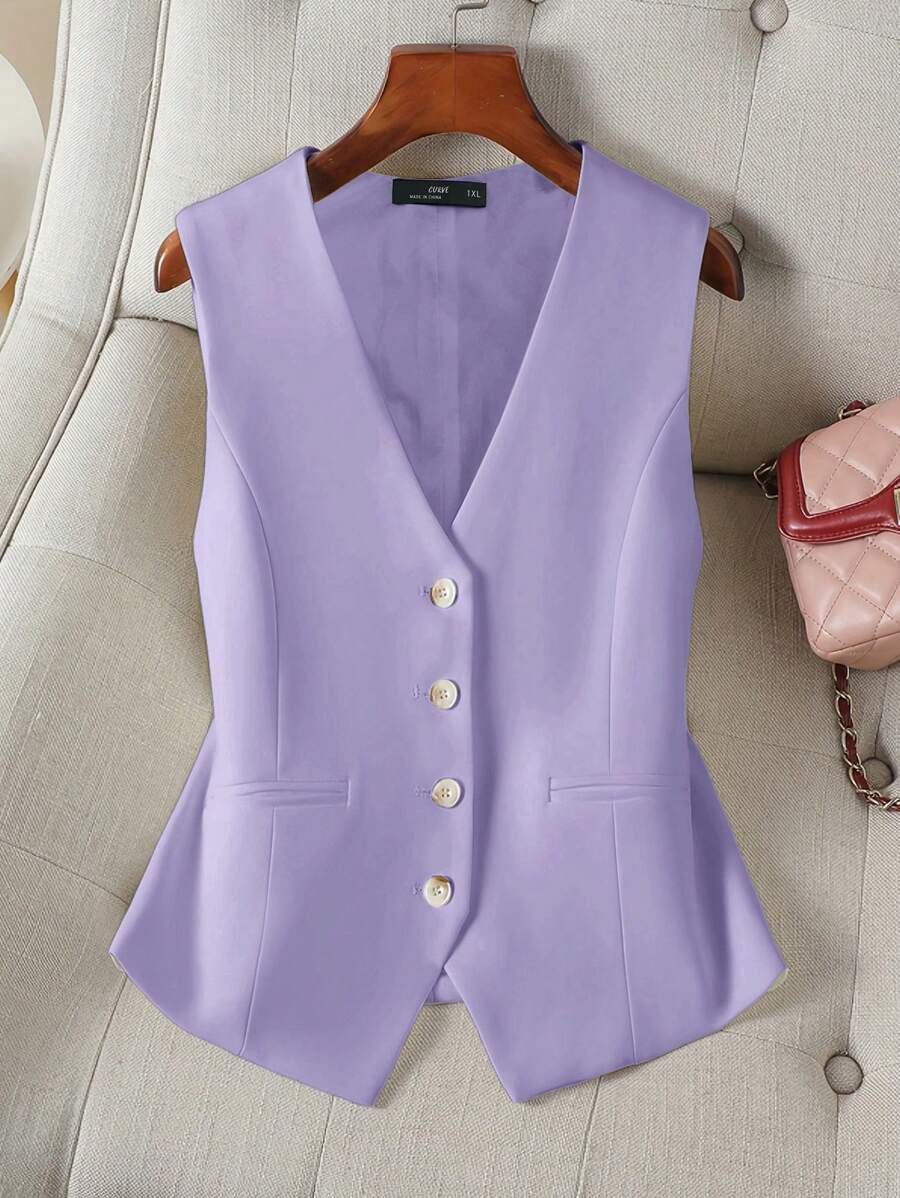
- **Fabric Physics:** The source garment is a structured, woven suiting fabric (likely a polyester/viscose blend) with medium stiffness. It possesses a matte finish with low specularity; it should not shine like satin but needs to show subtle sheen on the structural curves (breast, waist). The material has little elasticity, meaning it should hold its tailored shape rather than clinging tightly to skin contours like jersey knit.
- **Key Features:**
- The deep V-neckline structure.
- Four pearlescent/white shank buttons (must retain 3D shading).
- Vertical "princess seams" running down the front torso which dictate the tailored fit.
- Two horizontal welt pocket details at the hip level.
- The slight "peplum" flare at the bottom hemline.
PHASE 2: FIT & DRAPE SIMULATION
- **Body Mapping:**
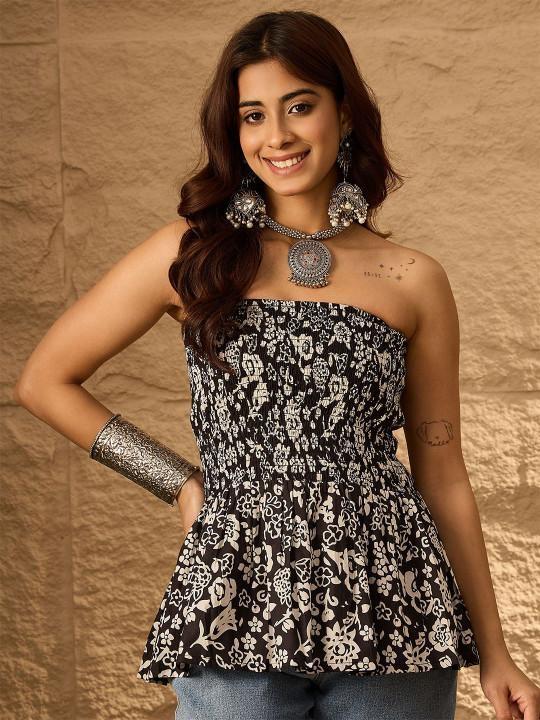
- **Shoulder Construction:** Since the user is currently wearing a strapless top, the simulation must generate the vest's shoulder straps sitting naturally on the user's trapezius muscles, bridging the gap between the chest and the back.
- **Torso Fit:** The vest is tailored. It must cinch slightly at the user's natural waist and flare out over the upper hips.
- **Gravity & Pose:** The user's right hip is slightly elevated. The hem of the vest must follow this angle, hanging slightly higher on the user's right side. The fabric should remain relatively taut across the chest due to the button closure, with minimal folding/wrinkling compared to a loose t-shirt.
- **Occlusion Handling:**
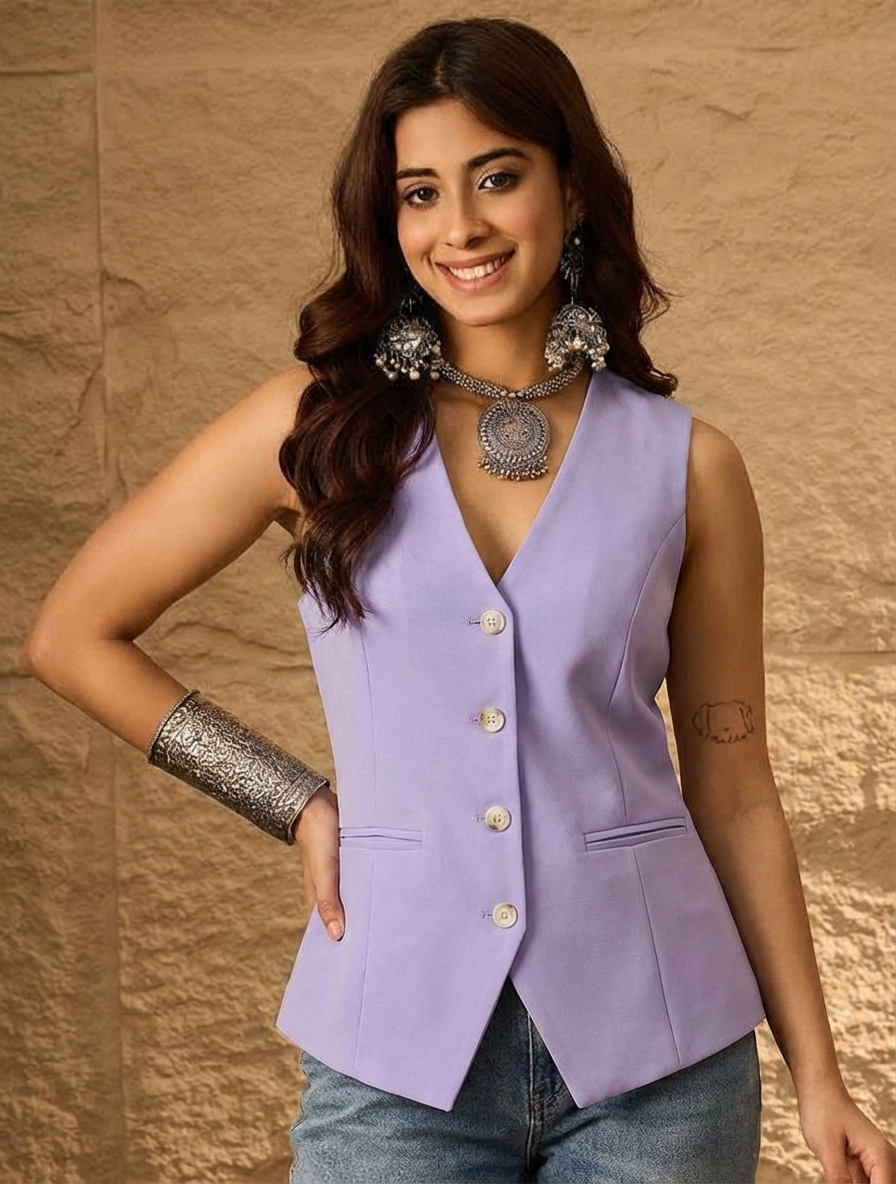
- **Hair:** The user's long, wavy hair falls significantly over the left shoulder and right clavicle area. The vest must be rendered *underneath* these hair strands. Detailed alpha masking is required to preserve individual hair strands over the new purple fabric.
- **Jewelry:** The heavy silver choker necklace sits high on the neck. Depending on the V-neck depth, the vest may sit below it, but if they overlap, the necklace must be layered *over* the garment. The silver arm cuff is separate and remains untouched.
- **Arms/Skin:** The vest is sleeveless; the user's arms must remain completely visible.
PHASE 3: ENVIRONMENT & LIGHTING
- **Light Match:**
- **Direction:** The target environment has strong, warm, directional lighting coming from the upper-left (viewer's perspective).
- **Shadows:** The vest needs to cast a self-shadow onto the user's right side (under the right arm and right hip). The buttons should cast small drop shadows downward and slightly to the right.
- **Texture Integration:** The smooth texture of the vest must contrast with the rough, textured wall background.
- **Color Calibration:**
- The User Image has a warm, yellow/golden tint (tungsten lighting). The Source Garment is lit with cool/neutral studio light.
- **Correction:** The lavender/purple of the vest must be color-graded with a warm filter to harmonize with the user's skin tone and the background. The highlights on the vest should shift from cool white to warm cream.
PHASE 4: IDENTITY PROTECTION
- **Facial Lock:** The user's entire head (eyes, smile, jawline, makeup, earrings) is a strict "no-touch" zone.
- **Body Integrity:** The user's arm thickness, shoulder width, and waist proportions must remain exact. Do not apply "slimming" filters. The skin tone on the arms and upper chest (above the vest neckline) must remain unaltered and consistent with the original image.