Thinking Process
PHASE 1: VISUAL DECONSTRUCTION
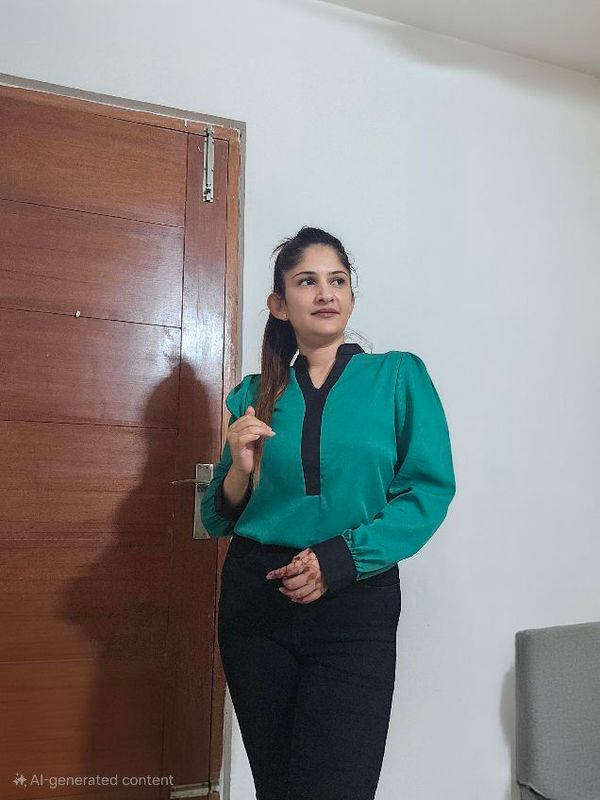
- **Fabric Physics:** The source garment appears to be a synthetic blend, likely polyester crepe or a matte satin. Unlike the user's current tight ribbed knit, this material has low elasticity and medium weight. It features a subtle sheen that creates soft, diffuse specular highlights rather than sharp reflections. It is "drape-heavy" and will not cling to the skin.
- **Key Features:**
- **Contrast Trim:** The black V-neck placket/collar and black wrist cuffs are structural focal points that must remain distinct.
- **Sleeve Construction:** The shoulders appear to have slight gathering/puffing at the sleeve head (gigot style), which must maintain volume and not flatten against the user's deltoids.
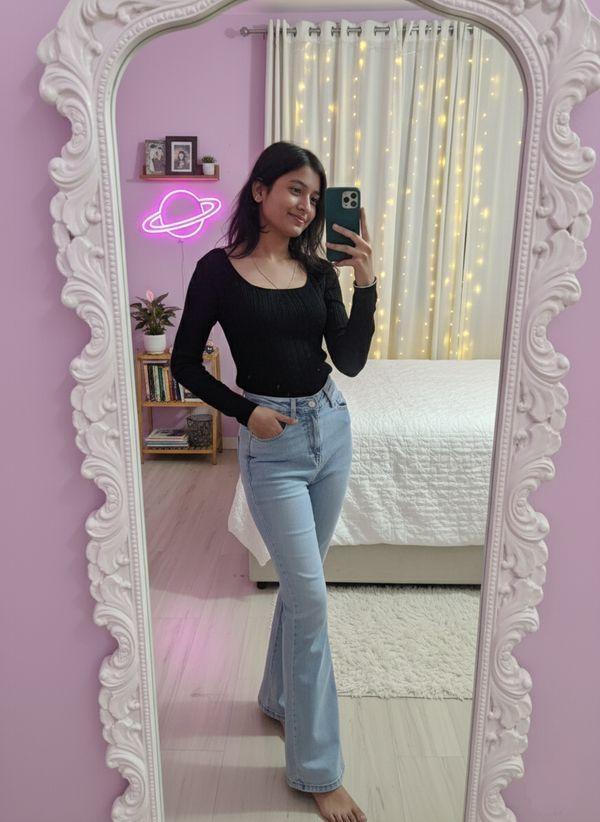
- **Silhouette:** The garment is a blouse/tunic fit (loose), distinct from the fitted bodice of the source image.
PHASE 2: FIT & DRAPE SIMULATION
- **Body Mapping:**
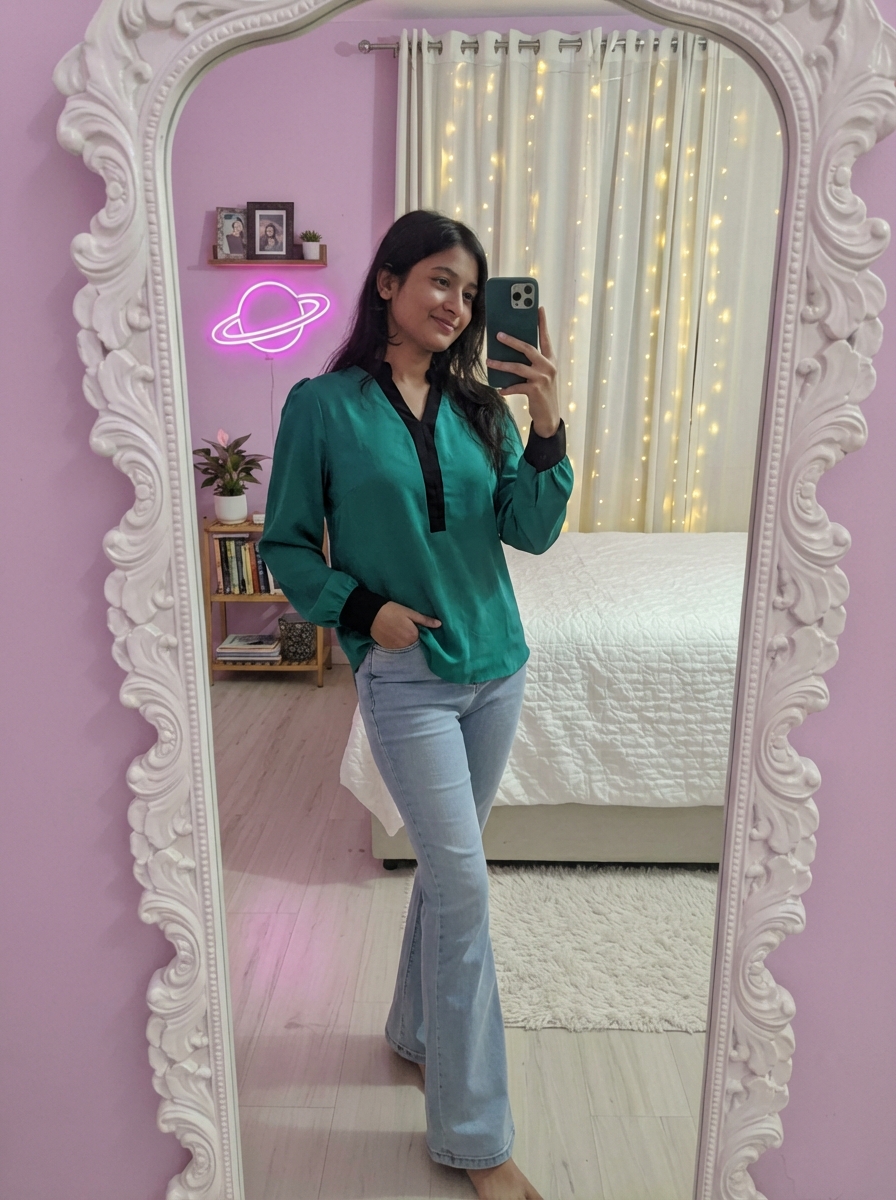
- **Volumetric Change:** The simulation must replace the user's tight black silhouette with a looser, billowing fit. The fabric should hang vertically from the bust points rather than contouring under the bust.
- **Arm Articulation:** On the right arm (holding the phone), the non-stretch woven fabric must create deep, sharp fold bunching at the inner elbow (antecubital fossa), significantly more than the current knit top.
- **Waist Interaction:** Since the user's left hand is inside the jeans pocket, the simulation must render the new top as "tucked in" or gently draped *behind* the wrist to preserve the hand-in-pocket geometry.
- **Occlusion Handling:**
- **Hair:** The user's long dark hair falls over both shoulders and the chest. A hard segmentation mask is required to layer the hair *over* the green fabric.
- **Phone & Hand:** The phone and the holding hand cover the center chest/sternum area. This creates a "dead zone" where the black trim of the new shirt will be occluded; the trim must visually connect logically above and below the phone.
PHASE 3: ENVIRONMENT & LIGHTING
- **Light Match:** The user's room has warm, soft, omnidirectional lighting with pink/purple ambient reflections from the neon sign and fairy lights. The source garment (currently in cool/neutral white light) must be warmer in temperature. The green fabric must reflect the pinkish hue of the room in its highlights.
- **Color Calibration:** The emerald green must be desaturated slightly and shifted towards a warmer tone to avoid looking like a "sticker" in the soft-lit bedroom environment. Shadows cast by the phone onto the chest must be re-projected onto the green fabric.
PHASE 4: IDENTITY PROTECTION
- **Facial Lock:** The visible portions of the face (forehead, eyes, mouth not covered by phone) and the user's specific skin tone must remain completely frozen.
- **Body Integrity:** Do not alter the width of the user's hips or the fit of the light blue jeans. The user's waistline definition must remain consistent with the jeans' waistband, ensuring the new looser top does not falsely widen the user's perceived waist size. The hand holding the phone must retain its original geometry and skin texture.