Thinking Process
PHASE 1: VISUAL DECONSTRUCTION
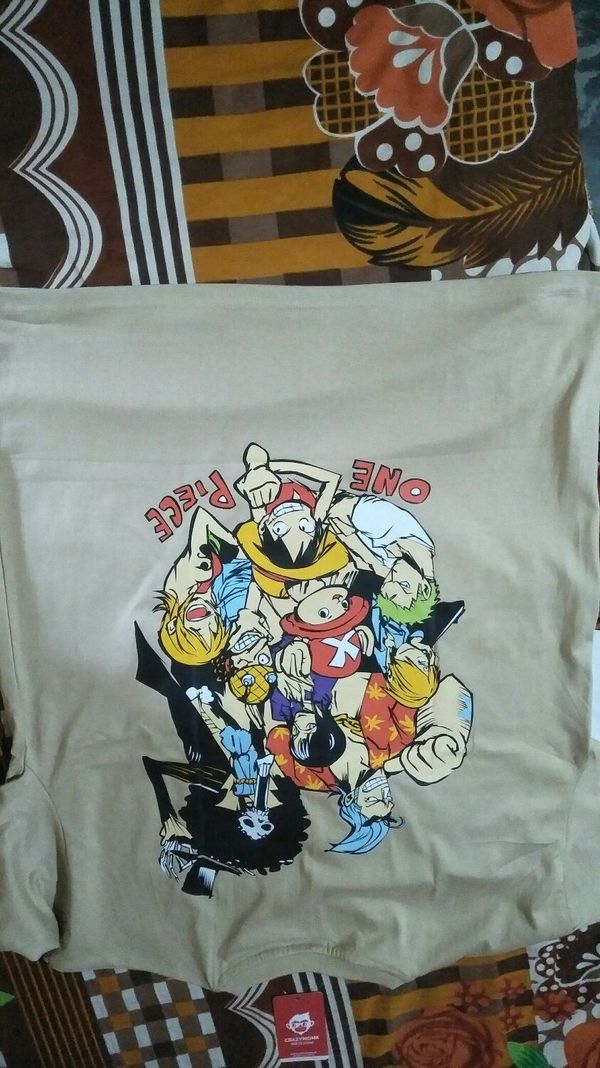
- **Fabric Physics:** The source garment is a medium-weight cotton jersey. It possesses a matte finish with high light absorption and low reflectivity. The simulation must render soft, pliable folds rather than rigid creases. Unlike the user's current synthetic puffer jacket, this fabric will not have specular highlights; it must appear soft and breathable.
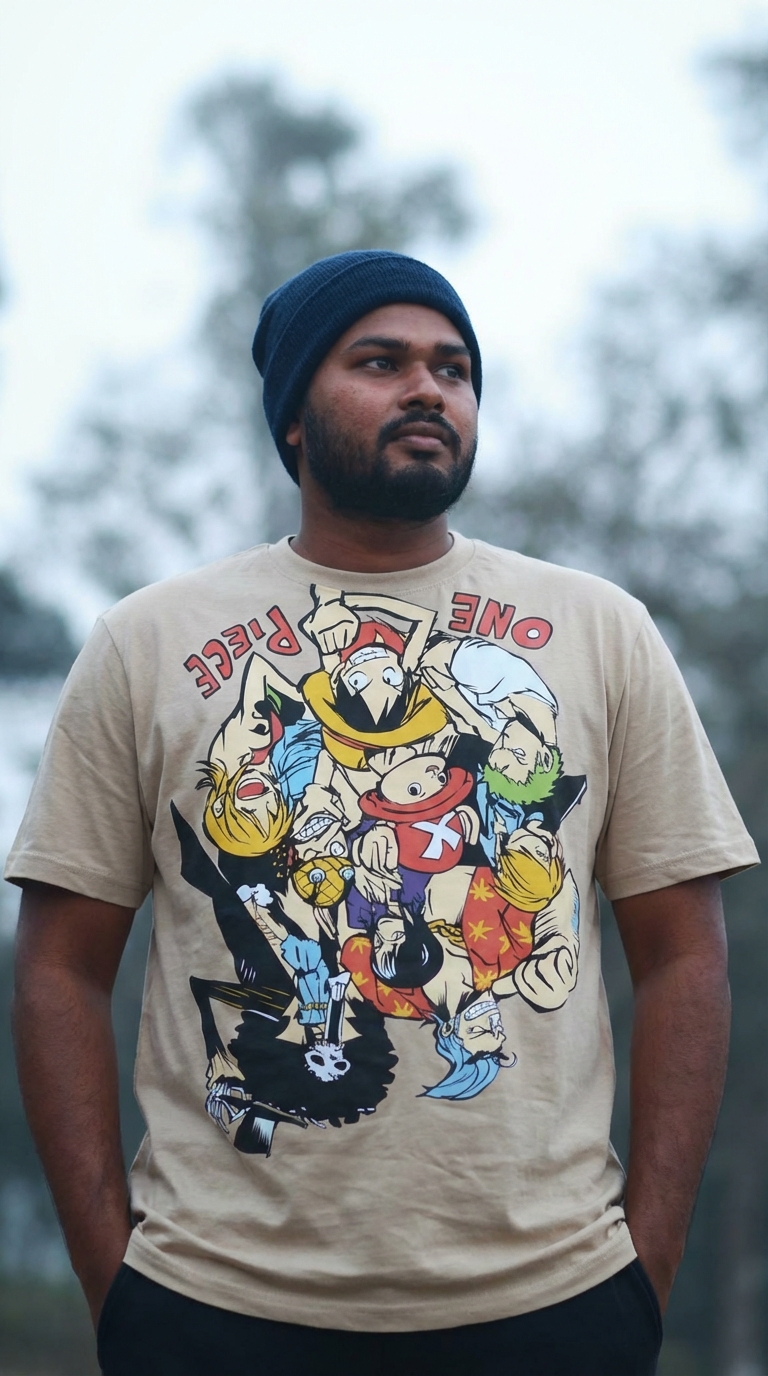
- **Key Features:** The central "One Piece" anime character graphic is the critical visual anchor; its orientation must be corrected (rotated 180 degrees if the source photo is inverted) to ensure the text "ONE PIECE" is readable and characters are upright. The crew neckline and the specific beige/tan colorway must be preserved. The red hem tag (visible at the bottom of the source image) should be included if visible in the final crop.
PHASE 2: FIT & DRAPE SIMULATION
- **Body Mapping:** This is a high-complexity transfer involving "digital undressing." The simulation must estimate the user's true torso volume underneath the bulky puffer jacket. The T-shirt must drape much closer to the body than the current silhouette, following the shoulders and chest naturally. Gravity will cause the fabric to hang straight from the pectorals, gathering slightly at the waist where the hips widen. The loose fit of the T-shirt means it should not cling tightly to the midsection.
- **Occlusion Handling:** The user's beard overlaps the neck region and must be layered *over* the new T-shirt's collar. The hands appear to be in pockets or resting low; if the jacket removal exposes the wrists/forearms, skin texture inpainting will be required. The beanie (headwear) is a hard occlusion layer and must remain strictly on top of the simulation area.
PHASE 3: ENVIRONMENT & LIGHTING
- **Light Match:** The user is in an outdoor environment with cool, diffused, overcast lighting (soft blue/grey tones). The source cloth was photographed in warm, indoor artificial light (yellow/orange cast). The simulation must strip the warm tungsten cast from the T-shirt and apply a cool, desaturated color grade to match the outdoor ambient light. Shadows should be soft and spread (ambient occlusion) rather than hard or directional, focusing on the underarms and neck.
- **Color Calibration:** Significant white balance correction is required. The beige T-shirt must be color-graded towards a cooler, neutral tan to integrate with the blueish environmental light, preventing it from looking like a "sticker" pasted onto the scene.
PHASE 4: IDENTITY PROTECTION
- **Facial Lock:** The user's entire face, facial hair (beard/mustache), and the dark blue beanie must be absolutely frozen and masked out of the generation process.
- **Body Integrity:** While the total silhouette volume will decrease because a T-shirt is thinner than a puffer jacket, the user's underlying anatomical structure (shoulder width, chest breadth) must not be slimmed or altered. The T-shirt should fit a medium-broad build, preserving the user's perceived physical size minus the jacket's padding.