Thinking Process
PHASE 1: VISUAL DECONSTRUCTION
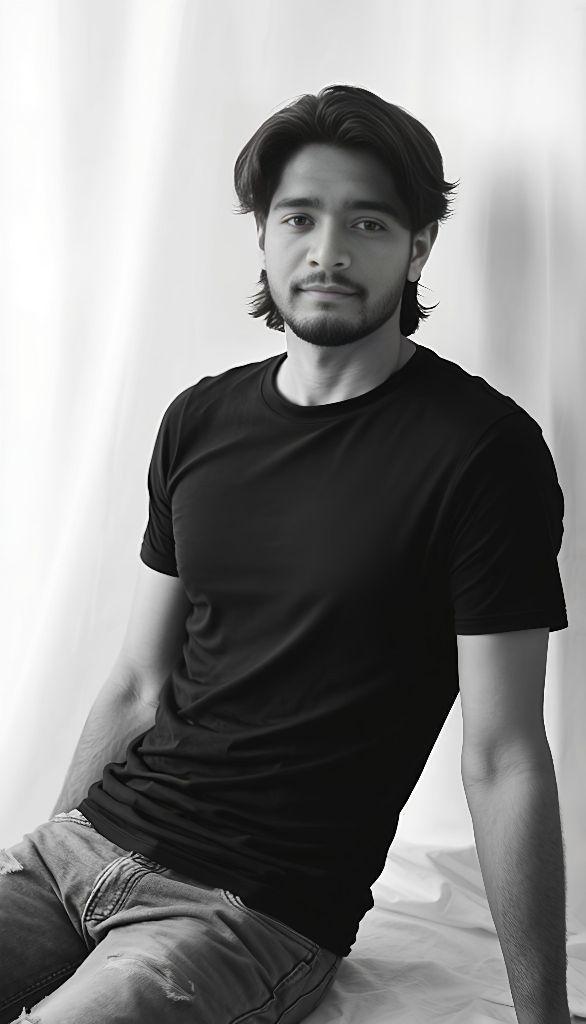
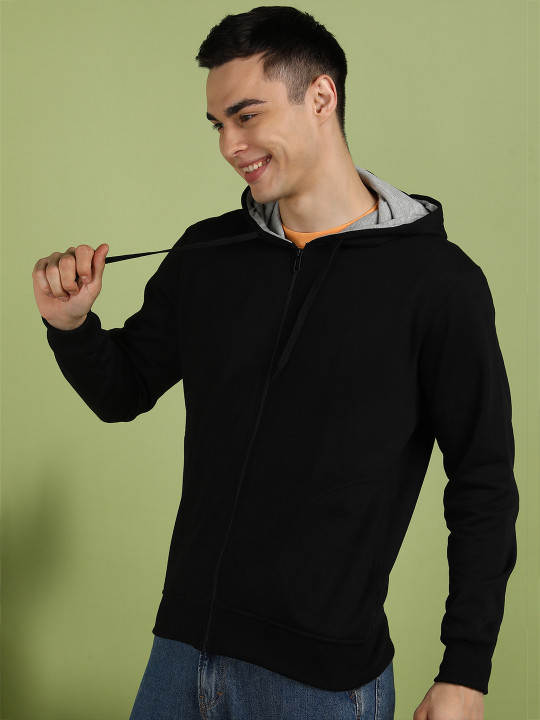
- **Fabric Physics:** The source garment is a heavyweight cotton-blend fleece or French terry. Unlike the user's current thin, clinging t-shirt, this material has structural rigidity. It should not reveal muscle definition but rather create a smoother, bulkier silhouette. Light reflection should be matte with soft falloff, absorbing light rather than reflecting it, except on high-tension folds.
- **Key Features:** The central metal zipper and the contrasting grey inner hood lining are critical for visual definition. The ribbed cuffs and hemband must be preserved. The drawstrings, currently held taut in the source image, must be simulated as loose and affected by gravity. The kangaroo pockets must be rendered with slight opening volume, not flattened completely.
PHASE 2: FIT & DRAPE SIMULATION
- **Body Mapping:**
- **Shoulders/Chest:** The user is leaning back on his arms; the hoodie shoulders must rise slightly to reflect this skeletal position.
- **Torso/Abdomen:** Since the user is seated, the hoodie must bunch horizontally across the midsection and pool slightly where it meets the lap/jeans. It must drape *away* from the lower back, not cling to the spine.
- **Sleeves:** The source is long-sleeved while the target is short-sleeved. The simulation must generate realistic sleeve crumpling at the elbow joint (inner elbow) and some stacking at the wrists, masking the user's bare forearms.
- **Occlusion Handling:**
- **Hair:** The user's longer hair at the nape and sides must layer *over* the hood/collar area of the new garment.
- **Drawstrings:** The source image shows hands interacting with drawstrings. These must be re-simulated to hang vertically down the chest, following the gravity vector of the target image, removing the "held" tension.
- **Hands/Forearms:** The user's hands are planted; the ribbed cuffs must end at the wrist bone, ensuring the hands remain the top layer if they overlap the sleeve end.
PHASE 3: ENVIRONMENT & LIGHTING
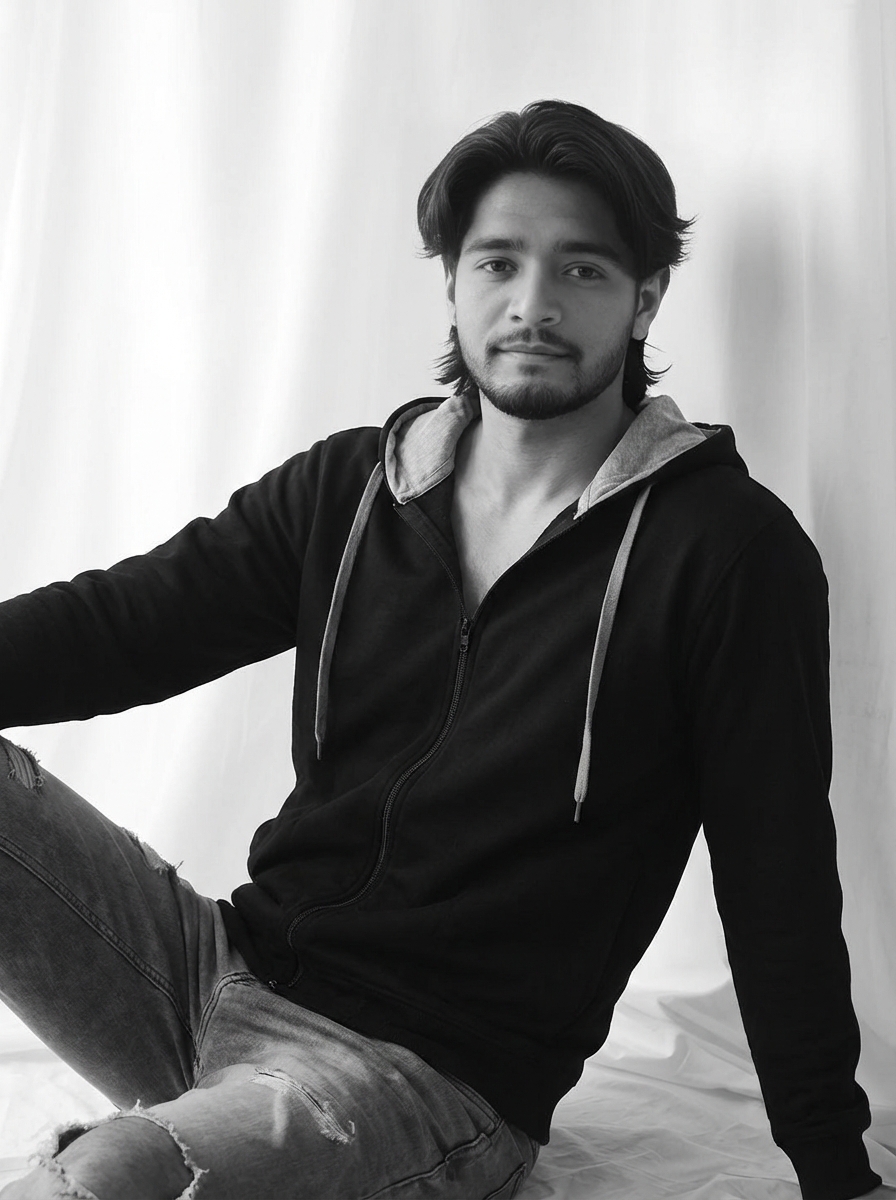
- **Light Match:** The target image is monochrome (Black & White) with a strong, soft light source coming from the left (viewer's perspective). The hoodie must be rendered in grayscale. Highlights should appear on the left shoulder and left arm folds. Deep, high-contrast shadows must be cast on the right side of the torso and under the open hood area to match the dramatic noir style of the target.
- **Color Calibration:** Complete desaturation is required. The "Black" of the hoodie must be mapped to the specific dark grey/black tonal range of the user's current t-shirt to maintain scene consistency. The inner grey hood lining must provide a mid-tone contrast against the dark outer shell.
PHASE 4: IDENTITY PROTECTION
- **Facial Lock:** The user's facial structure, including the beard, jawline, and eyes, must remain absolutely frozen. The hair geometry must be preserved exactly, only masking where the hoodie collar sits behind it.
- **Body Integrity:** The user's broad shoulder width and seated posture must be maintained. Do not slim the torso; in fact, the silhouette must expand slightly outward to account for the thickness of the fleece material compared to the skin-tight t-shirt.