
Thinking Process
PHASE 1: VISUAL DECONSTRUCTION
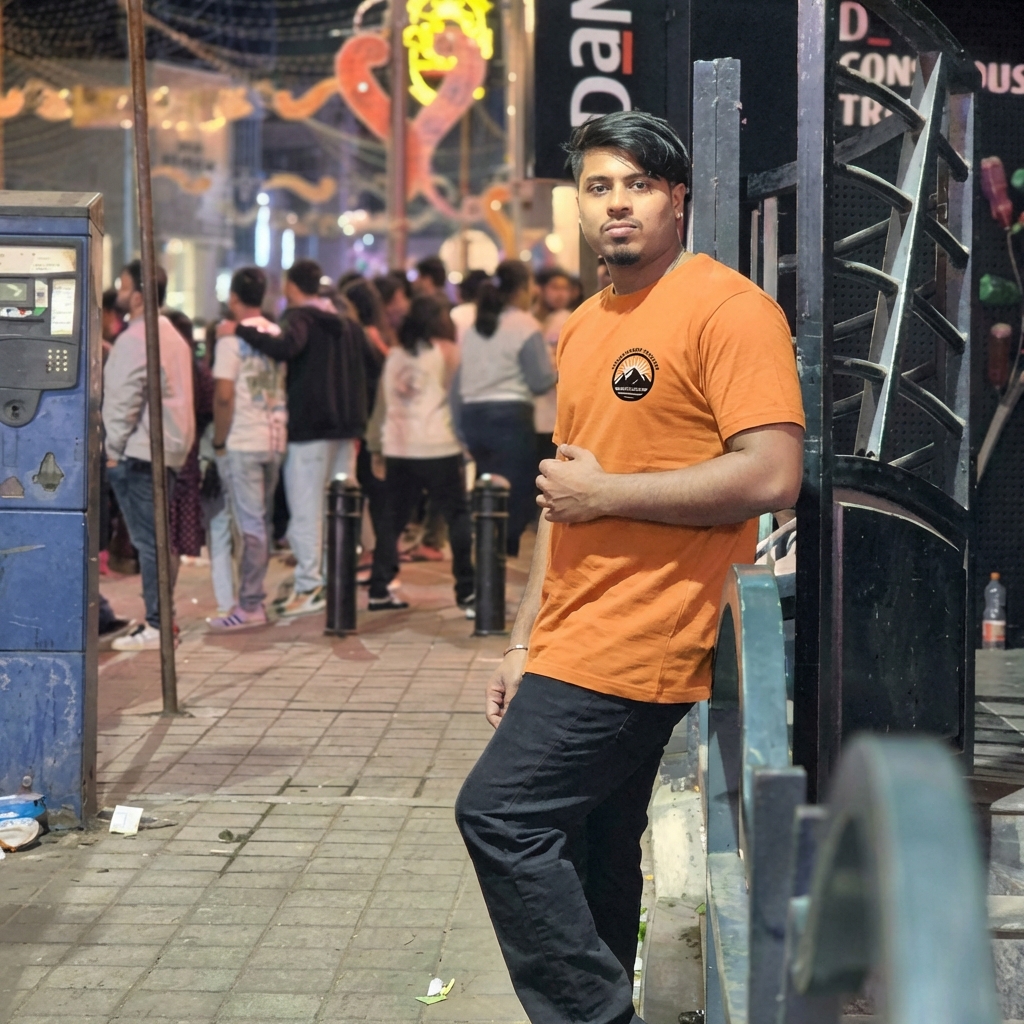
- **Fabric Physics:** The source garment is a standard cotton jersey t-shirt. Unlike the stiff, voluminous synthetic puffer jacket currently worn, the target physics must simulate a lightweight, pliable material with a matte finish. It should absorb light rather than reflect it, showing soft diffused scattering rather than the specular highlights seen on the current jacket's nylon shell.
- **Key Features:** The "The Vector Lab" mountain logo on the left chest is the primary anchor point; it must distort appropriately with the chest angle but remain legible. The ribbed crew neckline and the hem stitching must be preserved. The existing vertical drape folds in the source image should be largely reset to adapt to the new pose, though the fabric's tendency to form soft, gravitational waves must remain.
PHASE 2: FIT & DRAPE SIMULATION
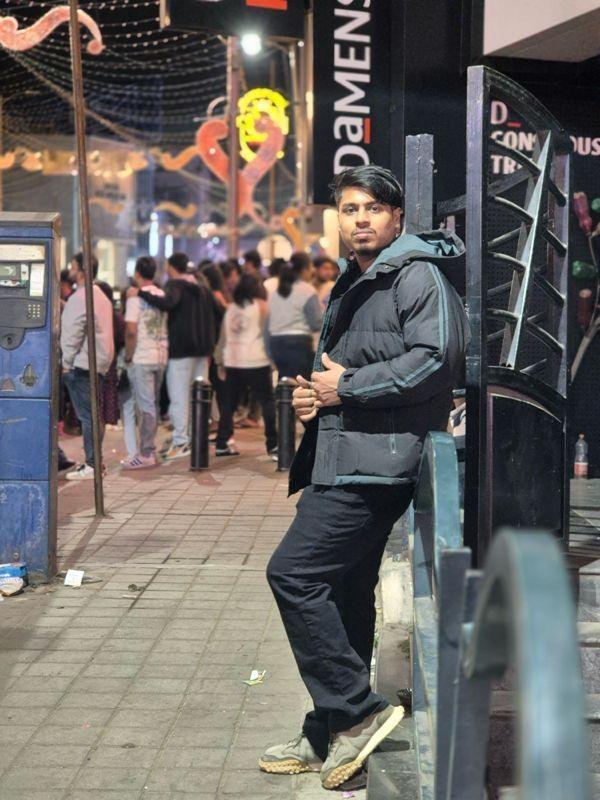
- **Body Mapping:** The user is leaning back against a railing with the torso angled slightly away from the camera. The current puffer jacket adds significant artificial volume that must be computationally removed to estimate the underlying torso skin. The t-shirt fits much closer to the body; therefore, the silhouette will shrink significantly compared to the puffer. The fabric must stretch slightly across the right pectoral due to the arm position and bunch at the right waist where the torso bends.
- **Occlusion Handling:** This is a high-complexity occlusion scenario.
1. **The Right Hand:** The user's right hand (thumb and fingers) is currently gripping the jacket flap. This hand must be masked out and layered *over* the new t-shirt.
2. **The Railing:** The user's left side (shoulder and arm) is partially obscured by the metal structure/fence. The t-shirt texture must be generated *behind* these metal bars, not pasted over them.
PHASE 3: ENVIRONMENT & LIGHTING
- **Light Match:** The target scene is a night environment with mixed artificial lighting. The primary light source appears to be a cool-white street lamp from above/front-right, creating highlights on the face. The t-shirt, currently lit by flat studio light, must be darkened significantly. We need to introduce a high-contrast shadow gradient, where the left side of the shirt (closest to the railing) falls into deep shadow, while the right chest catches the street light.
- **Color Calibration:** The bright orange of the source cloth is too saturated for the low-light user image. A "Night-Mode" filter must be applied to the fabric texture, shifting the orange slightly cooler and desaturating it to match the ambient noise and grain of the target photo. The texture requires added grain to match the high-ISO noise of the photograph.
PHASE 4: IDENTITY PROTECTION
- **Facial Lock:** The user's entire head region—including the hairstyle, facial hair, jawline, and neck connection point—must be frozen and pixel-preserved.
- **Body Integrity:** While the total visual volume will decrease because a t-shirt is thinner than a puffer jacket, the underlying biological measurements of the user (shoulder width, chest depth) must remain unaltered. Do not slim the waist or arms beyond the natural reduction caused by removing the padded outerwear.