Thinking Process
PHASE 1: VISUAL DECONSTRUCTION
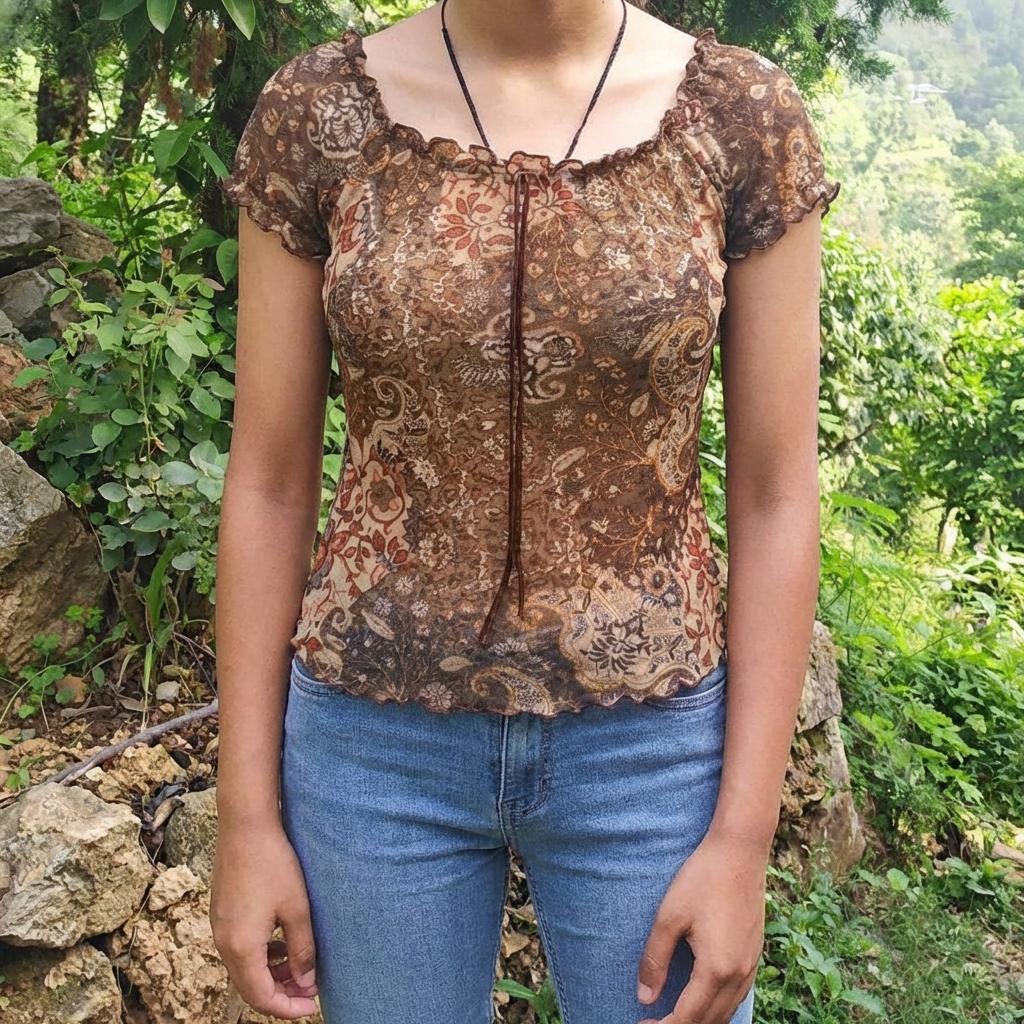
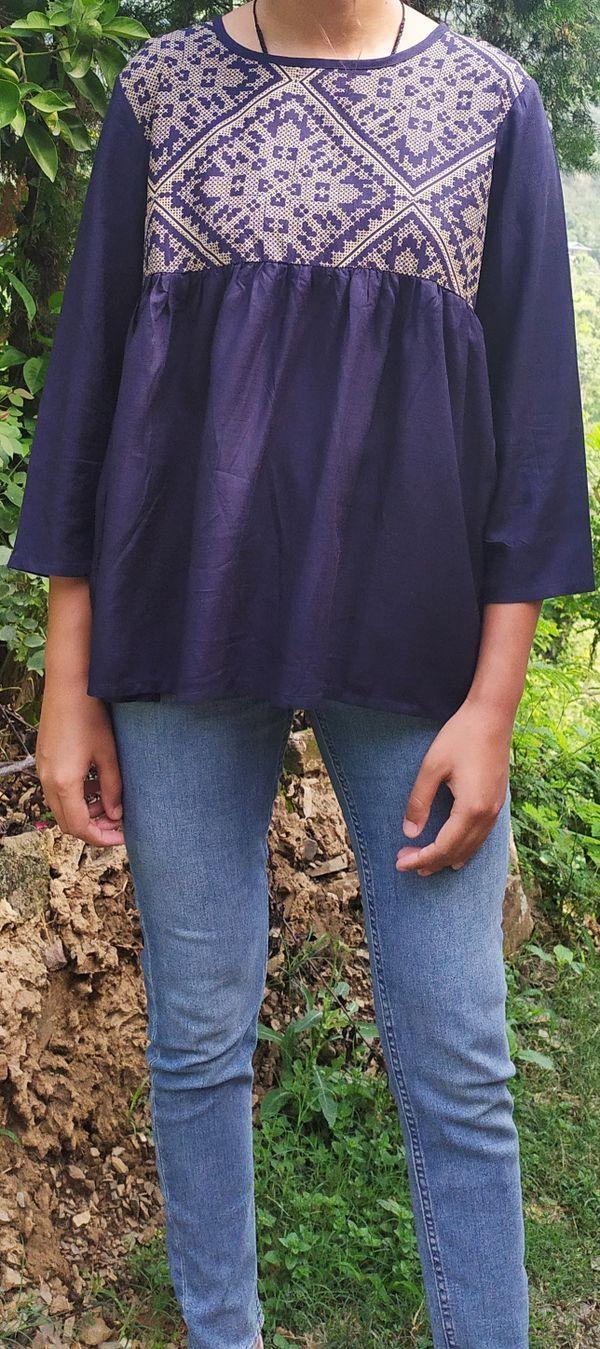
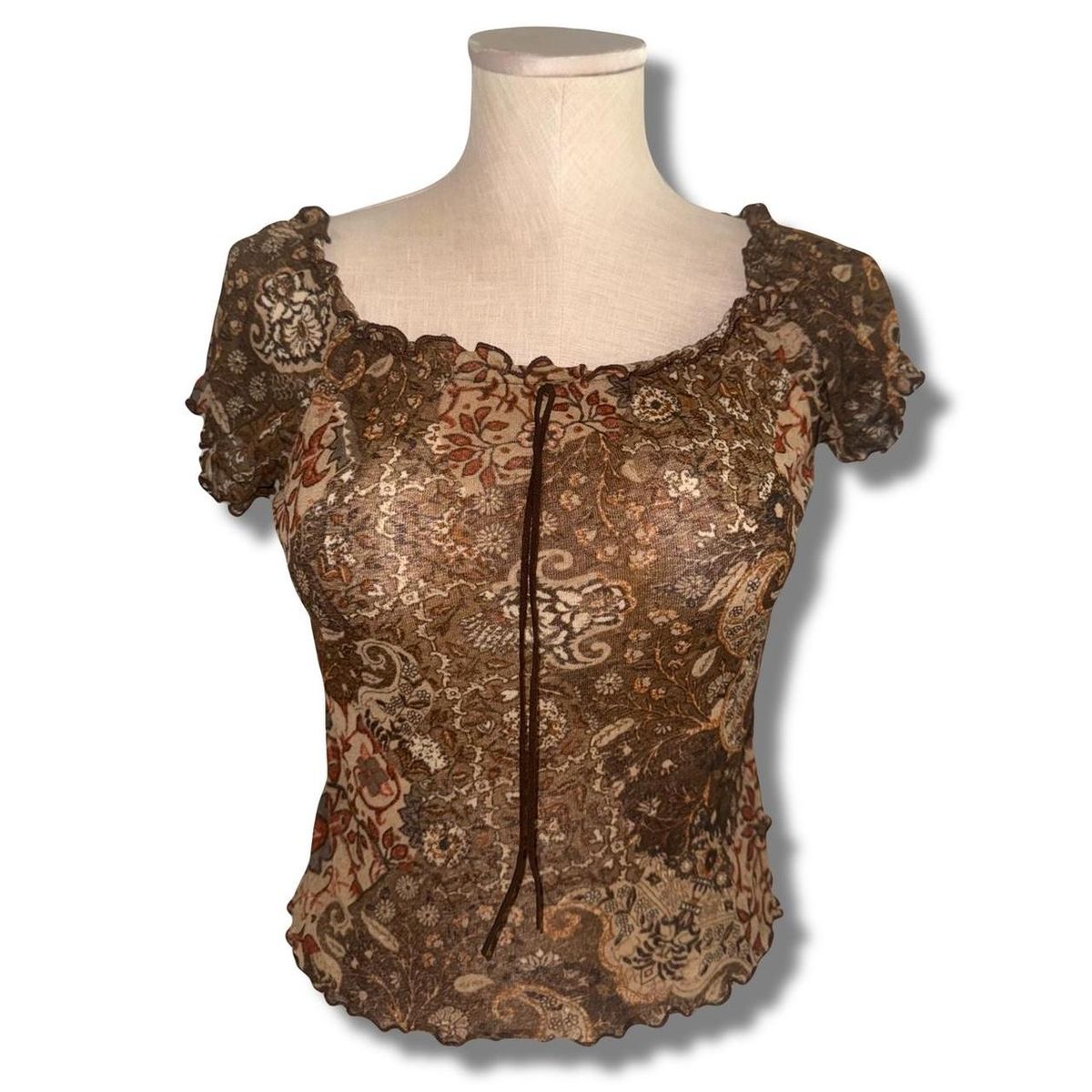
- **Fabric Physics:** The source garment appears to be a lightweight, semi-sheer mesh or tulle blend (likely polyester/nylon). It possesses high elasticity and a "clingy" drape characteristic of stretch-mesh. Unlike the user's current rigid cotton/linen tunic, this fabric absorbs light with a matte finish but will exhibit subsurface scattering due to its semi-transparency.
- **Key Features:** The "lettuce-edge" (ruffled) hemline on the sleeves, neckline, and bottom hem must be preserved with its wavy geometry. The central vertical drawstring/tie detail is a rigid body element that must dangle subject to gravity. The complex paisley/floral pattern density must adapt to the stretch across the bust.
PHASE 2: FIT & DRAPE SIMULATION
- **Body Mapping:** The source garment is form-fitting, whereas the current user garment is an A-line/empire waist loose tunic. The simulation must ignore the volume of the blue tunic and map the mesh top closer to the user's estimated dermal boundary. The new short cap sleeves will terminate high on the deltoid; the simulation requires skin generation/inpainting for the user's forearms which are currently covered by long blue sleeves. The bodice should contour tight to the torso, avoiding the "tenting" effect of the current garment.
- **Occlusion Handling:** The black necklace cord around the neck is a hard occlusion and must be segmented to layer *over* the new scoop neckline. The hands are positioned low and likely below the new garment's hemline, but any intersection near the hip area requires the fabric to collide and fold behind the wrist/hand.
PHASE 3: ENVIRONMENT & LIGHTING
- **Light Match:** The user is in an outdoor environment with diffuse, soft natural daylight (likely shade or overcast). The lighting is omnidirectional with soft ambient occlusion. The high-contrast studio lighting of the source garment (with its bright highlights) must be flattened and softened to match the lower-contrast, natural lighting of the outdoor scene.
- **Color Calibration:** The source garment's warm brownish tones must be color-graded to reflect the cool ambient hues of the surrounding greenery. The saturation levels should be slightly reduced to match the organic palette of the user's environment.
PHASE 4: IDENTITY PROTECTION
- **Facial Lock:** The user's neck, chin, and visible lower face geometry must remain pixel-perfectly frozen. The skin tone on the neck must be sampled to ensure the newly generated skin on the arms (due to sleeve length change) matches perfectly.
- **Body Integrity:** While the silhouette will reduce in volume because the new top is tighter than the old one, the user's underlying shoulder width, waist width, and arm thickness must not be warped or slimmed. The skeletal structure must remain invariant.