Thinking Process
PHASE 1: VISUAL DECONSTRUCTION
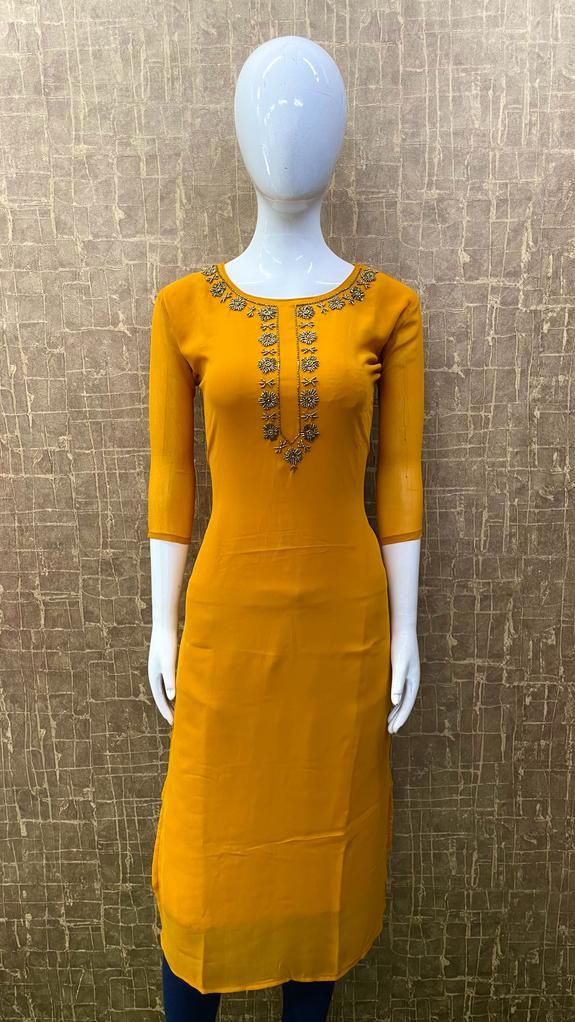
- **Fabric Physics:** The source garment is a mustard yellow Kurta/tunic, appearing to be a medium-weight cotton or rayon blend. It possesses a matte finish with low specularity (no shine). The physics simulation must account for a semi-structured drape that falls vertically with gravity but allows for soft folding, unlike the rigid stiffness of the mannequin. The sleeve ends appear to have a sheer or lighter texture band that must be rendered delicately.
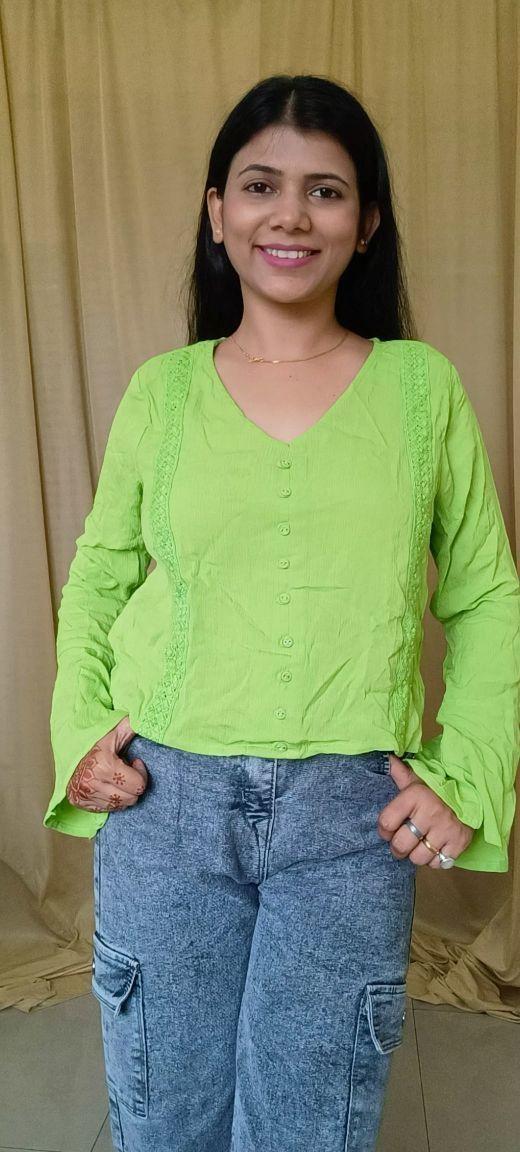
- **Key Features:** The intricate embroidered neckline (gold/bronze geometric and floral motifs) is the primary focal point and must be preserved with high resolution. The neckline shape (round with a vertical slit) must replace the current V-neck. The garment length is a tunic cut; it must extend past the waistline, covering the hips, unlike the current tucked-in shirt.
PHASE 2: FIT & DRAPE SIMULATION
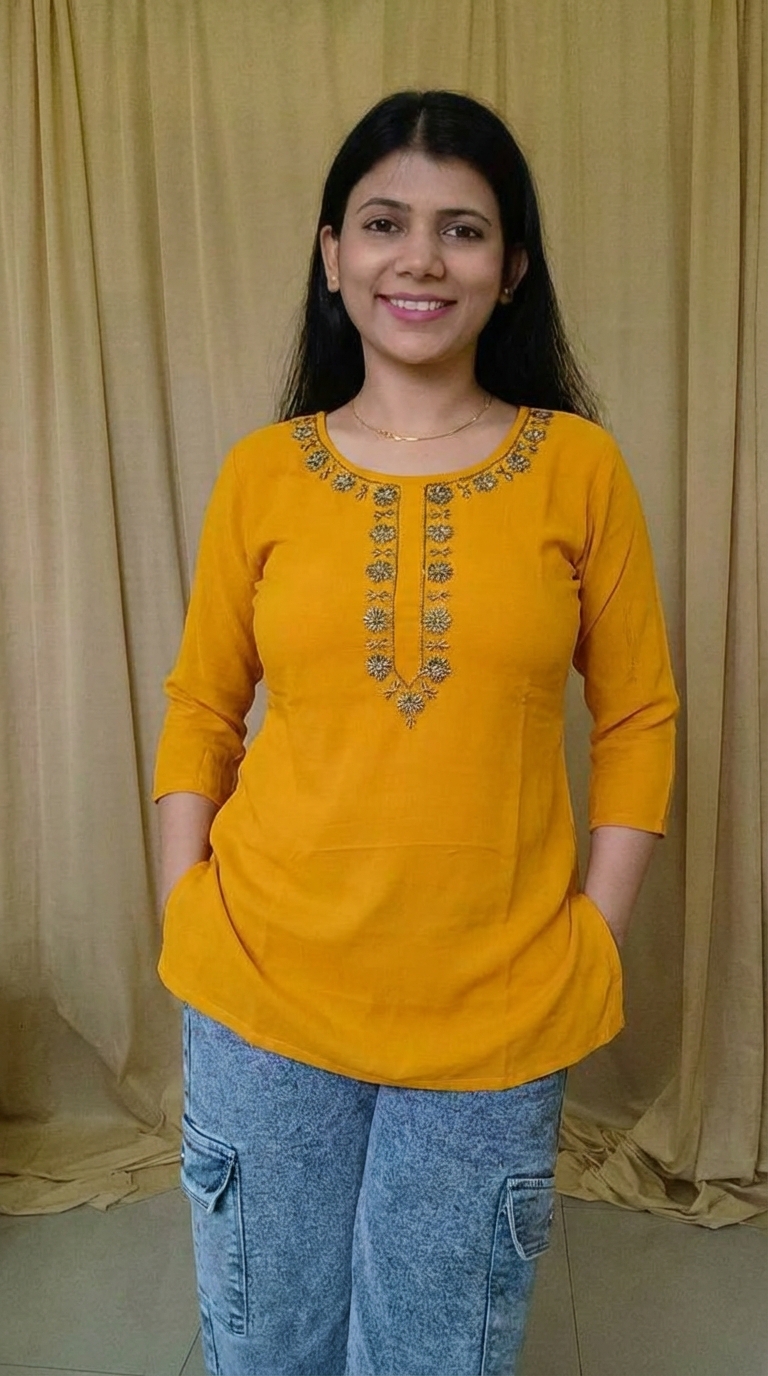
- **Body Mapping:** The user has her hands inside her pant pockets. This creates a critical tension point at the hips. The Kurta, being a long garment, must drape *over* the waist area but bulge slightly outward around the wrists and forearms where the hands push the fabric volume out. The fabric should not clip through the wrists but rather settle naturally around the interaction point where the arms enter the pockets. The sleeves (approx. 3/4 length) should hang naturally on the upper arm, stopping before the wrist.
- **Occlusion Handling:**
1. **Hair:** The user's long dark hair rests on both shoulders and the upper back. The new garment must be rendered on a layer *beneath* the hair strands.
2. **Necklace:** The thin gold chain on the user's neck must be segmented and layered *over* the new garment if the new neckline sits lower, or properly occluded if the new neckline covers it.
3. **Hands/Wrists:** The entry point of the hands into the jeans pockets must be preserved; the garment fabric must drape *around* this occlusion, not cover the hands completely or flatten the volume created by the hands.
PHASE 3: ENVIRONMENT & LIGHTING
- **Light Match:** The user's environment features soft, diffuse, warm-toned indoor lighting with minimal hard shadows. The source garment (currently under harsh, glossy mannequin lighting) must be relit to match this softness. Shadows should generate naturally under the bust and within fabric folds, consistent with the light source coming from the front/slightly overhead.
- **Color Calibration:** The mustard yellow of the Kurta must be color-graded to match the warm beige background of the user's photo. The saturation should be slightly dampened to match the realistic, less contrast-heavy dynamic range of the user's camera sensor compared to the source image.
PHASE 4: IDENTITY PROTECTION
- **Facial Lock:** The user's entire head (hairline to chin), facial expression (smile, eyes), and neck skin must remain pixel-perfect and frozen. No warping is permitted above the clavicle.
- **Body Integrity:** Strictly forbidden to apply "slimming" filters or alter the user's shoulder width or arm volume. The silhouette of the user's torso must define the shape of the garment, not the other way around. The volume of the legs/jeans visible below the new hemline must remain untouched.