Thinking Process
PHASE 1: VISUAL DECONSTRUCTION
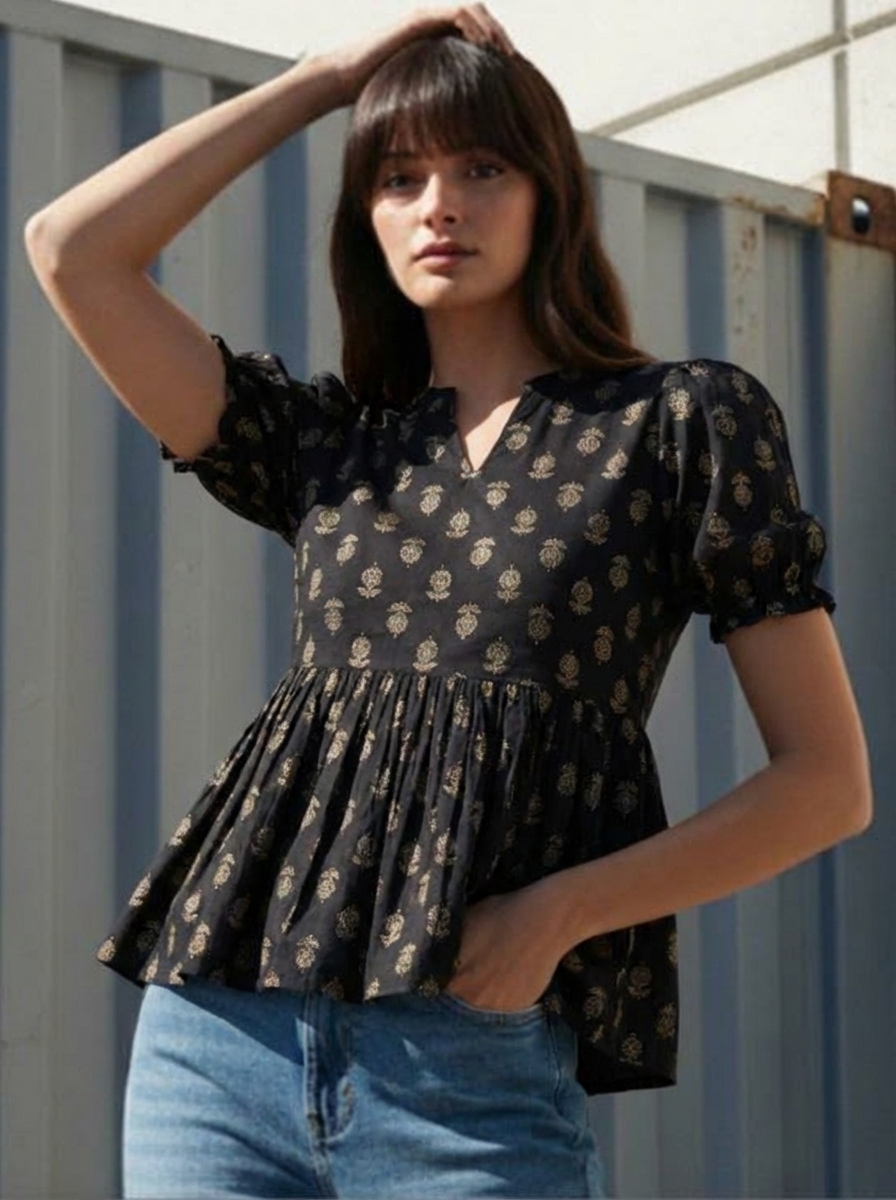
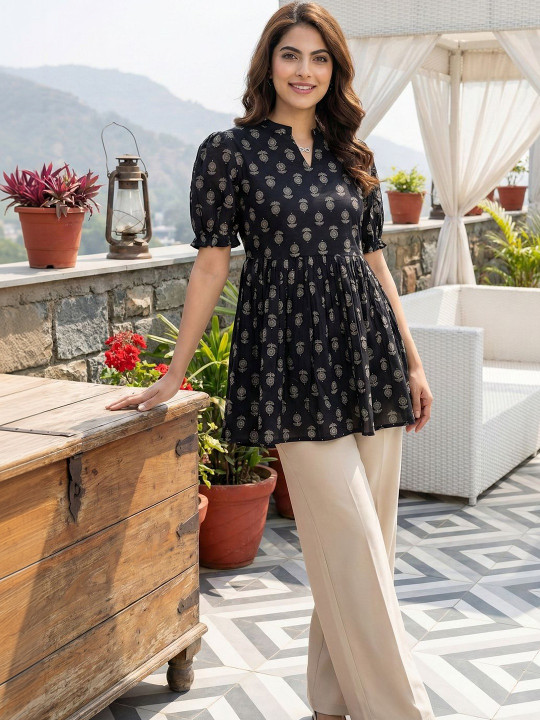
- **Fabric Physics:** The source garment appears to be a lightweight printed cotton or viscose rayon blend. It possesses medium tensile strength with high drapability (low stiffness). It has a matte finish, meaning it should not exhibit specular highlights like silk or leather, though the golden geometric pattern requires a subtle metallic response to light. The structural integrity relies on the gathered waist seam and the elasticized sleeve cuffs.
- **Key Features:** The specific geometric "mandala" print pattern and its scale must be preserved without distortion. The "peplum" silhouette (fitted bodice transitioning to a flared, gathered lower section) is critical. The short puff sleeves with ruffled/elasticized hems and the small V-notch neckline are essential design elements that must be generated onto the target.
PHASE 2: FIT & DRAPE SIMULATION
- **Body Mapping:**
- **Right Arm (Raised):** This is the critical physics calculation. The source sleeve is a puff sleeve. On the raised arm, gravity will cause the sleeve fabric to slide down toward the shoulder/armpit, bunching slightly at the shoulder connection while stretching the fabric across the underarm area. The sleeve cuff should sit higher on the bicep compared to the relaxed left arm.
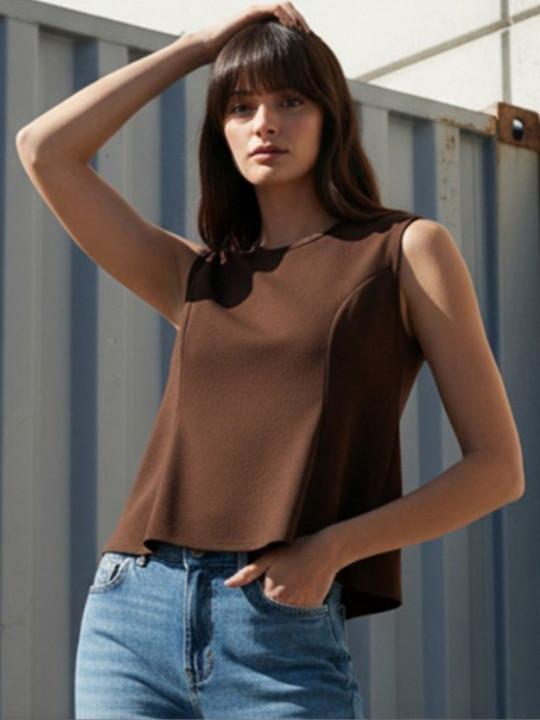
- **Torso & Waist:** The target is twisting slightly to her left. The center-front of the garment must align with this twist. Since the source garment is a tunic/peplum length, it must hang *over* the waistline of the user's jeans, obscuring the belt loops and top button. Gravity will pull the flared bottom section straight down, creating vertical folds rather than clinging to the hips.
- **Occlusion Handling:** The user's right hand (touching head) and the hair falling on the forehead are clear of the garment zone. However, the hair strands near the nape of the neck and behind the shoulders must be segmented and layered *over* the collar/shoulder of the new blouse. The user's jeans are currently visible; the new garment will occlude the upper portion of the denim.
PHASE 3: ENVIRONMENT & LIGHTING
- **Light Match:** The target environment features hard, high-contrast sunlight coming from the upper-left, casting sharp shadows (note the shadow of the arm on the forehead and neck). The new garment must render with deep, sharp shadows in the folds of the peplum and under the bust. The "flat" lighting of the source image must be replaced with this high-dynamic-range lighting map.
- **Color Calibration:** The deep black of the source fabric must be adjusted to match the exposure of the user image. In direct sunlight areas, the black value should be lifted slightly to dark grey to preserve texture detail, while shadow areas (under the armpit) must be crushed to near-black. The beige/gold print should reflect the warm tone of the sunlight.
PHASE 4: IDENTITY PROTECTION
- **Facial Lock:** Absolute freeze on the user’s facial structure, specifically the eyes, nose, lips, and the unique fringe/bangs covering the forehead. The skin tone of the exposed arms and neck must remain unaltered.
- **Body Integrity:** Strictly forbid any mesh warping that slims the user's waist or arms. The garment must adapt to the user's existing volume. The volumetric space occupied by the user's raised right bicep must be preserved exactly, with the sleeve generated *around* the existing arm volume, not replacing it.