Thinking Process
PHASE 1: VISUAL DECONSTRUCTION
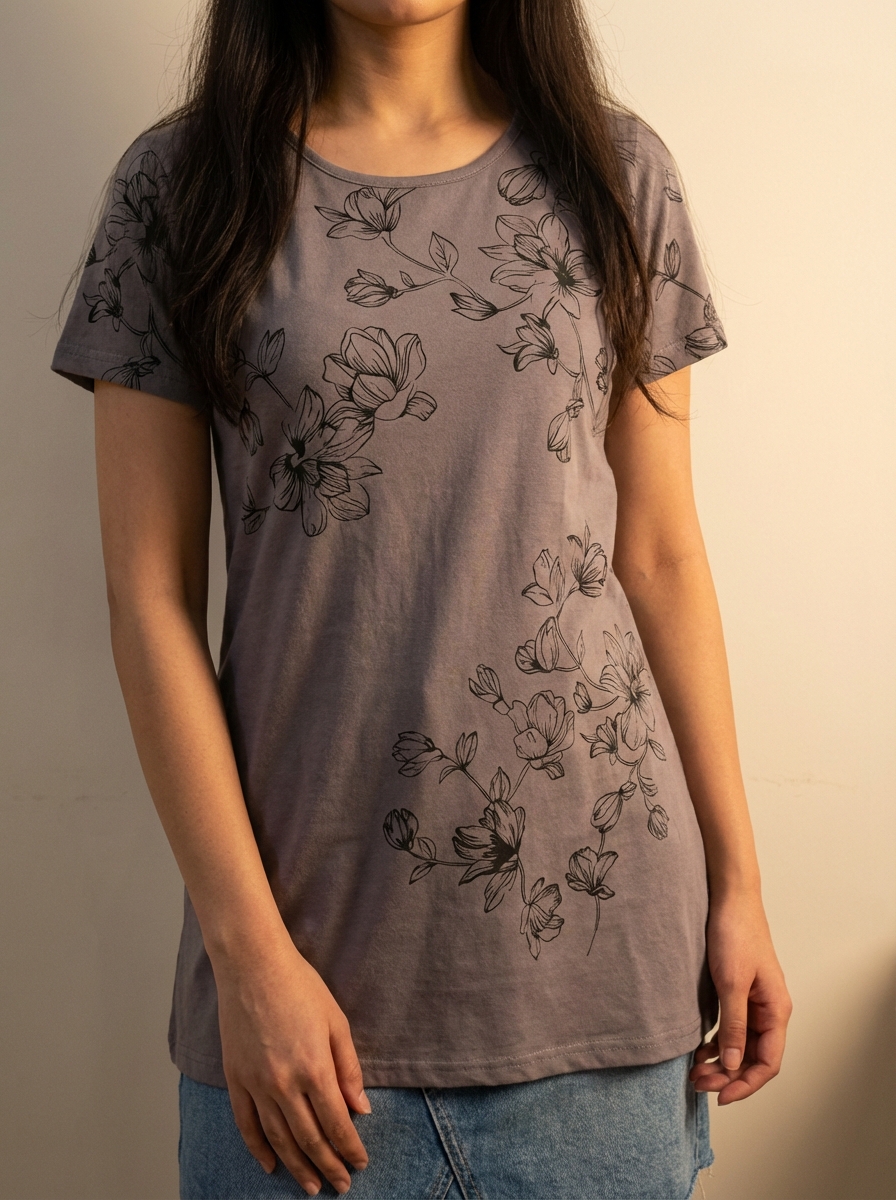
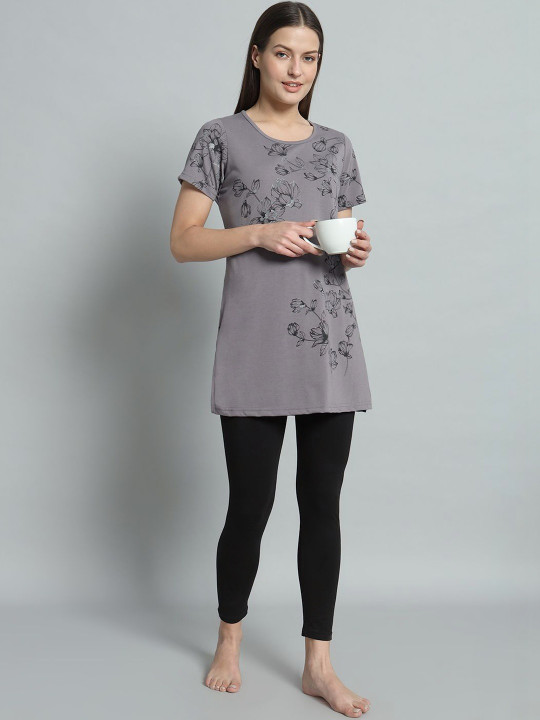
- **Fabric Physics:** The source garment is a matte cotton-jersey blend (knit). It has low specularity (no shine) and a soft, pliable drape. Unlike the user's current stiff button-down, this fabric relies on gravity and stretch. It should absorb light rather than reflect it.
- **Key Features:**
- **Length:** This is a tunic-length top (mid-thigh); it must NOT be generated as tucked in.
- **Print:** The black floral line-art graphics located on the right shoulder/sleeve and left hip/torso area must remain high-contrast and crisp.
- **Neckline:** The simple scooped round neck with visible stitching.
- **Sleeves:** Short, set-in sleeves that end mid-bicep.
PHASE 2: FIT & DRAPE SIMULATION
- **Body Mapping:**
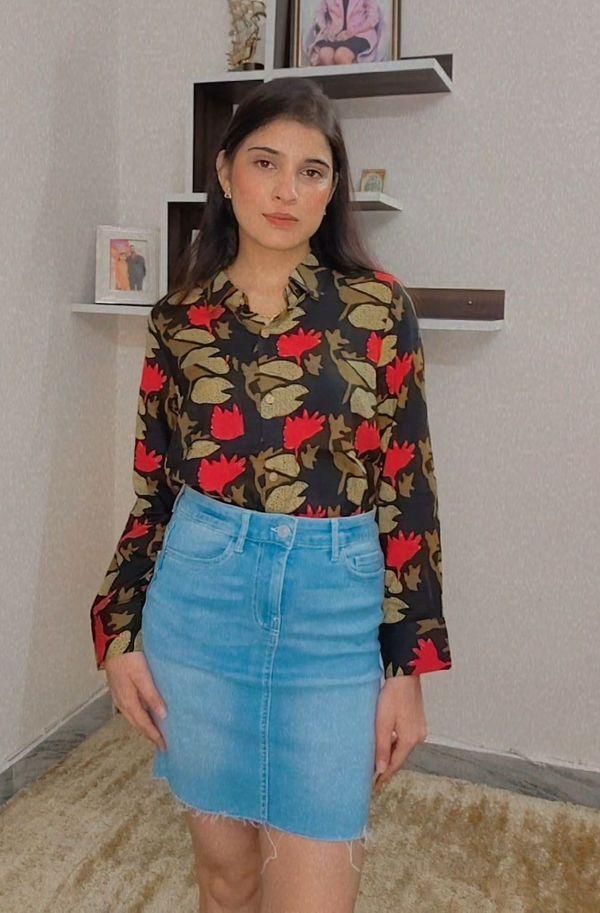
- **Silhouette Change:** The user is currently wearing a tucked-in shirt. The simulation must ignore the current waist cinch and drape the grey tunic *over* the waistband of the denim skirt, falling loosely to the upper/mid-thigh area.
- **Gravity:** The fabric should hang vertically from the shoulders, skimming the bust and hips without clinging tightly.
- **Sleeves:** The short sleeves should drape loosely around the user's upper arms, replacing the current long sleeves. The skin of the forearms (currently covered by the patterned shirt) must be generated/inpainted to look natural.
- **Occlusion Handling:**
- **Hair:** The user's long dark hair rests on both shoulders and the upper chest. This hair must be segmented and layered *on top* of the new grey tunic.
- **Hands:** The user's hands are resting near her thighs. Since the tunic is long, the hemline may interact with the wrists/backs of hands; the fabric must flow behind the hands or drape naturally around them, not merge with skin.
PHASE 3: ENVIRONMENT & LIGHTING
- **Light Match:** The user is in a room with overhead, slightly warm indoor lighting (casting soft shadows behind her on the wall). The source garment has cool, flat studio lighting. The grey tunic must be colour-graded to a slightly warmer tone to match the room's ambient light.
- **Shadows:**
- Artificial shadows must be generated under the bust to indicate volume.
- A drop shadow must be cast by the tunic's hem onto the denim skirt to ground the garment in the scene.
- **Color Calibration:** Reduce the contrast of the black floral print slightly to match the slightly softer contrast of the user's photo (camera phone quality vs. DSLR source).
PHASE 4: IDENTITY PROTECTION
- **Facial Lock:** The user's entire head, including eyes, nose, mouth, jawline, and the specific fall of her hair, must be completely frozen and preserved pixel-for-pixel.
- **Body Integrity:** Do not alter the user's shoulder width or hip width to match the source model. The user's legs and the denim skirt (below the new tunic hem) must remain untouched. Do not slim the user's waist; the tunic should drape realistically over her actual body shape.