
Thinking Process
PHASE 1: VISUAL DECONSTRUCTION
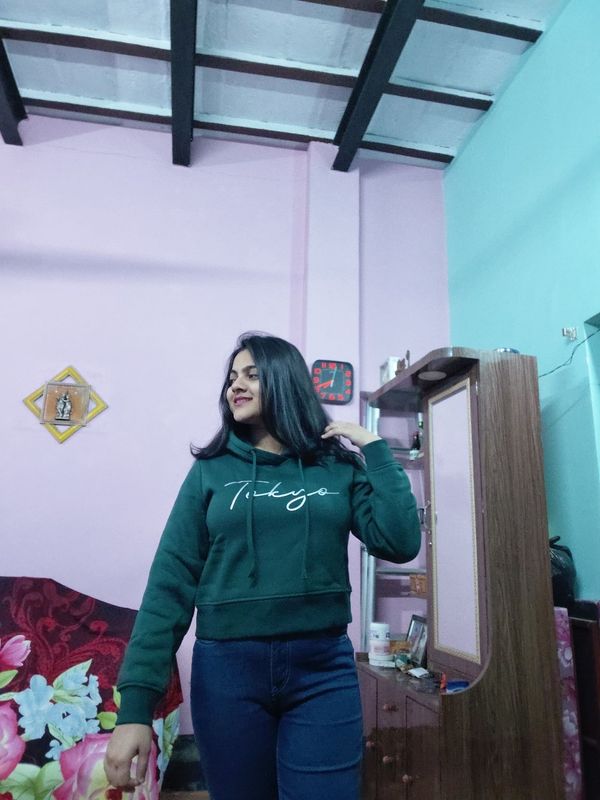
- **Fabric Physics:** The source garment is a fleece-lined cotton blend hoodie. It possesses significant weight and thickness compared to the user's current thin strap top. It has a matte finish with low reflectivity. The simulation must account for material volume; it will not cling to the skin like the current top but will structure its own shape, particularly at the shoulders and hood base.
- **Key Features:**
- **Typography:** The white "Tokyo" script across the chest must be preserved.
- **Hardware/Trims:** Long drawstrings hanging from the grommets at the neck.
- **Structural Elements:** The hood itself (which will add bulk behind the neck), the ribbed cuffs at the wrists, and the drop-shoulder seam construction.
- **Color:** Deep forest green/teal matte dye.
PHASE 2: FIT & DRAPE SIMULATION
- **Body Mapping:**
- **Pose Adaptation:** The user is in a side-profile twist (approx. 70-degree turn). The hoodie, originally front-facing, must be wrapped around the torso curvature. The "Tokyo" text will be viewed from an acute angle and must warp naturally around the bust line, not appear flat.
- **Sleeve Physics:** The user's right arm is bent upward. The heavy hoodie fabric must bunch significantly at the inner elbow (antecubital fossa) and pull taut across the outer elbow. The ribbed cuff must settle at the wrist, likely sliding down slightly due to gravity and the raised arm position.
- **Shoulder/Neck Volume:** The hood mechanism will build up volume around the neck and traps, contrasting with the user's current bare shoulder look.
- **Occlusion Handling:**
- **Hair:** The user's voluminous dark curly hair currently falls over her back and right shoulder. This is a critical occlusion layer; the hair must be segmented and composited *over* the new hoodie material, specifically over the hood and right shoulder area.
- **Hand:** The user's right hand touches her face. The sleeve must terminate at the wrist and NOT obscure the hand or fingers.
PHASE 3: ENVIRONMENT & LIGHTING
- **Light Match:** The target environment is outdoors with diffuse, overcast daylight (soft, cool, ambient lighting). The source image has indoor, artificial lighting. The garment's lighting model must be switched to soft, top-down scattering light.
- **Shadows:** The hair will cast soft, complex shadows onto the shoulder of the hoodie. The raised right arm will cast a subtle ambient occlusion shadow onto the side of the torso.
- **Color Calibration:** The source green needs to be desaturated slightly and shifted cooler to match the outdoor color temperature. The white text should reflect the ambient daylight, appearing slightly off-white/cool grey rather than blown-out artificial white.
PHASE 4: IDENTITY PROTECTION
- **Facial Lock:** The user's entire facial structure (eyes, nose, smile, teeth), jawline, and the specific angle of the head must remain pixel-perfectly frozen. The right hand touching the face is protected geometry.
- **Body Integrity:** The user's underlying skeletal structure must remain unchanged. However, the silhouette *must* expand to account for the hoodie's thickness. Do not slim the user; rather, add the necessary bulk of the fleece fabric on top of her existing frame.