Thinking Process
PHASE 1: VISUAL DECONSTRUCTION
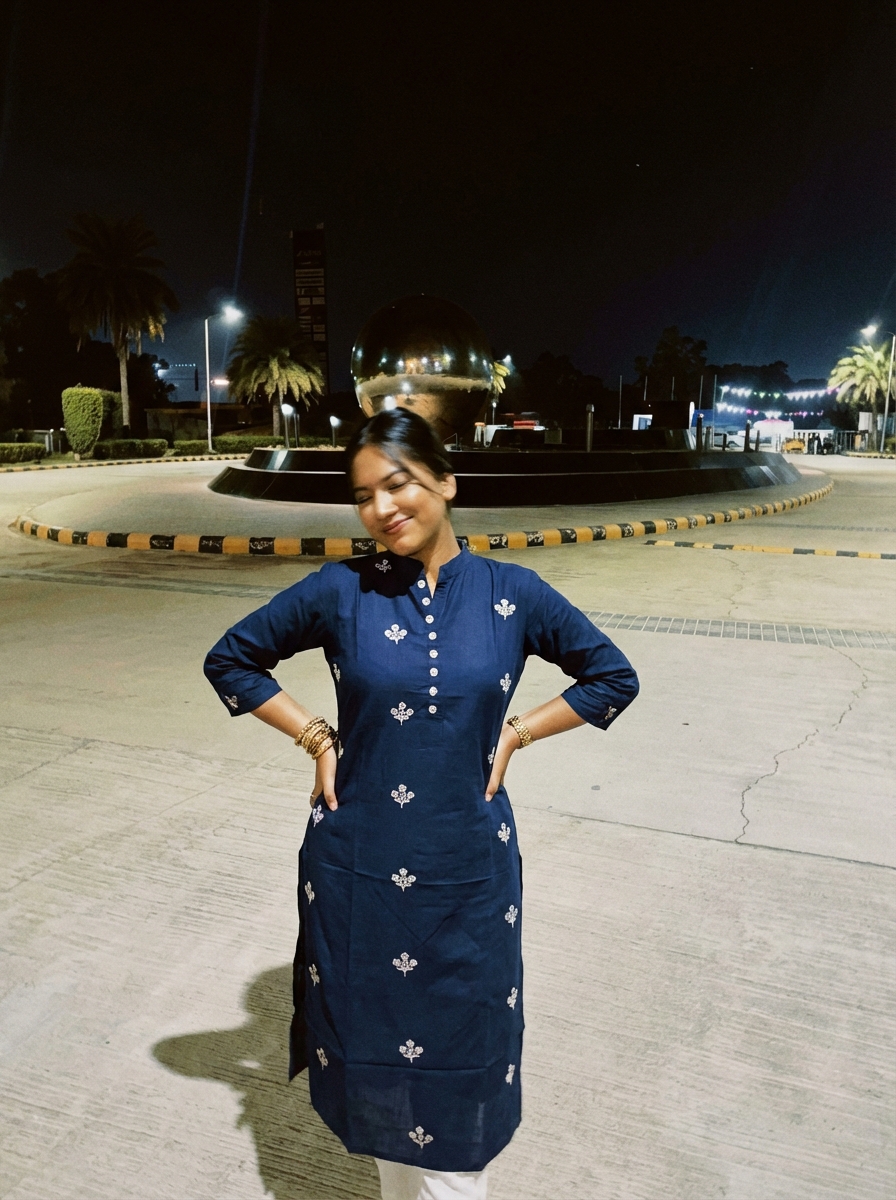
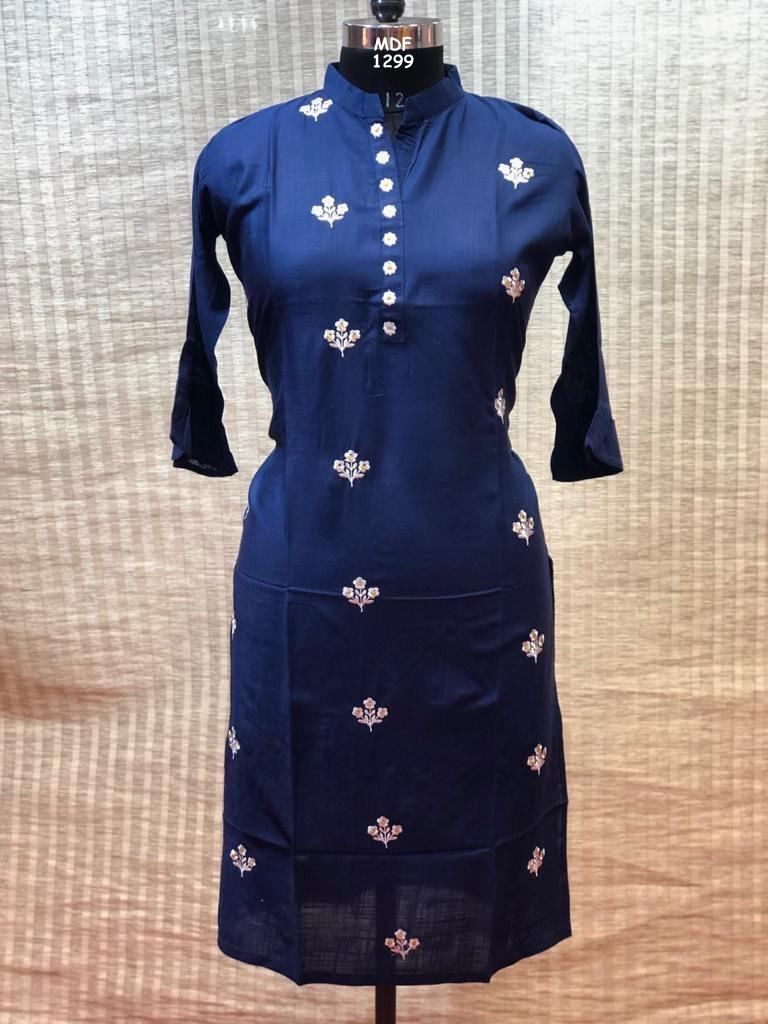
- **Fabric Physics:** The source garment appears to be a cotton or cotton-linen blend. It possesses a semi-structured drape—meaning it is breathable but holds its shape rather than clinging like spandex. The surface is matte with a low specular highlight; it should not reflect light like silk or leather, but absorb the flash/street lighting softly.
- **Key Features:** The central button placket (mandarin collar style), the specific pattern of white floral embroidery motifs (scattered placement), and the 3/4 length sleeves are critical. The dark navy blue hue must be preserved. The side vents (slits), typical of kurtas, must be implied in the geometry even if not fully visible.
PHASE 2: FIT & DRAPE SIMULATION
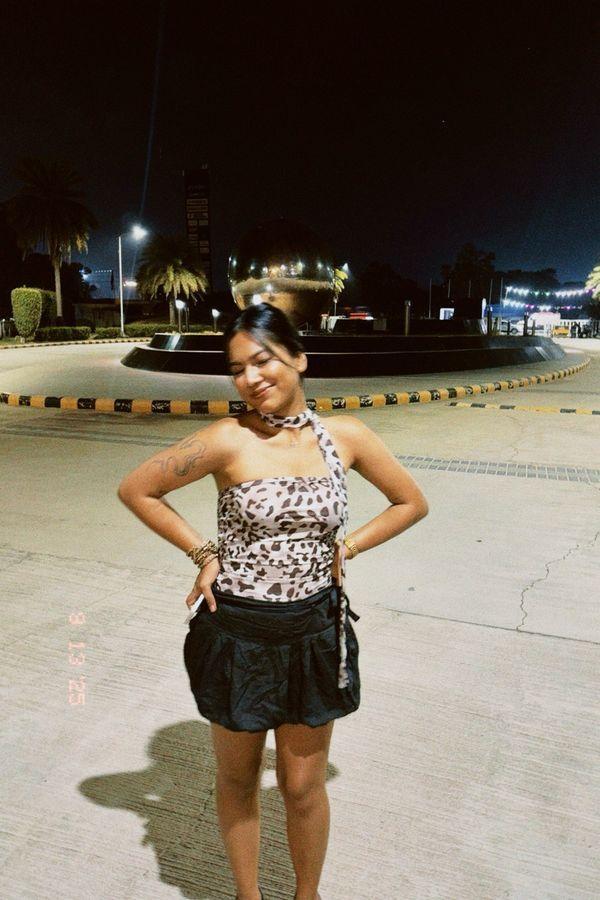
- **Body Mapping:** Due to the user's "hands-on-hips" (akimbo) pose, the simulation requires complex collision handling. The 3/4 sleeves will bunch significantly at the inner elbow crease and pull taut across the triceps. The main bodice of the kurta, which is naturally long, must interact with the hips; the fabric should bunch/gather around the wrists where the hands press into the waist, rather than clipping through the hands. The hemline will fall below the hips, covering the current skirt.
- **Occlusion Handling:** The user's hands and the gold bangles/bracelets on the wrists are the primary occlusion layer; they must render *on top* of the kurta fabric. The existing neck scarf must be removed entirely. The tattoo on the right bicep will likely be covered by the sleeve, but if the sleeve rides up due to the pose, the tattoo must remain on the skin layer.
PHASE 3: ENVIRONMENT & LIGHTING
- **Light Match:** The target environment is a high-contrast nighttime scene with strong, artificial lighting (likely a flash or direct street lamp from the front-left). The garment simulation must replicate this "hard light" setup. Expect deep, sharp shadows on the user's right side (viewer's right) and in the fabric folds created by the bent arms. The fabric should not look evenly lit; it must exhibit significant exposure fall-off.
- **Color Calibration:** The source garment is lit by flat studio lighting. In the target scene, the navy blue must be color-graded to match the cooler, grainier aesthetic of the night photo. The white embroidery should reflect the yellowish tint of the street lights or the cool white of the flash, avoiding a sterile "perfect white" look.
PHASE 4: IDENTITY PROTECTION
- **Facial Lock:** The user's facial expression (closed eyes, smile), head angle, hairstyle, and skin tone must be frozen and preserved.
- **Body Integrity:** The user's shoulder width and arm volume must remain unaltered. Strictly forbid any slimming of the waist or modification of the leg stance. The pose structure must remain rigid to ensure the hands remain exactly on the hips without warping.