Thinking Process
PHASE 1: VISUAL DECONSTRUCTION
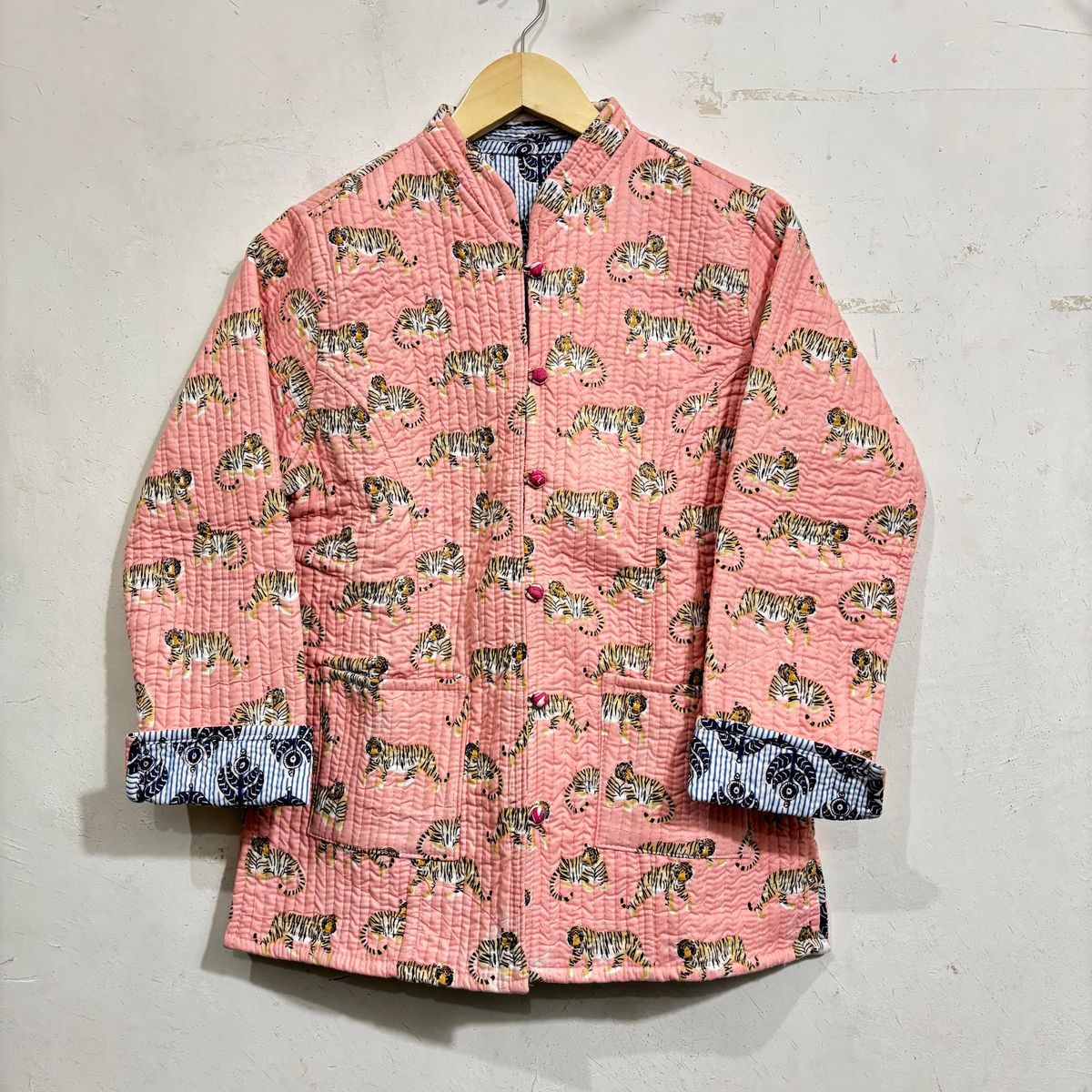
- **Fabric Physics:** The source garment is a quilted cotton or cotton-blend jacket. It possesses high structural rigidity due to the batting/padding and stitching. It should exhibit a matte finish with very low specularity (no shine). Light interaction should highlight the topographic relief of the quilting channels rather than flowing across the surface. The drape will be semi-stiff; it will fold rather than ripple.
- **Key Features:**
- The specific "Tiger" repeating pattern.
- The "channel" stitching texture creating the quilted relief.
- The Mandarin/Standing collar structure.
- The rolled cuffs revealing the contrasting blue-and-white striped lining with floral motifs.
- The knotted "frog" style buttons.
- Front patch pockets.
PHASE 2: FIT & DRAPE SIMULATION
- **Body Mapping:**
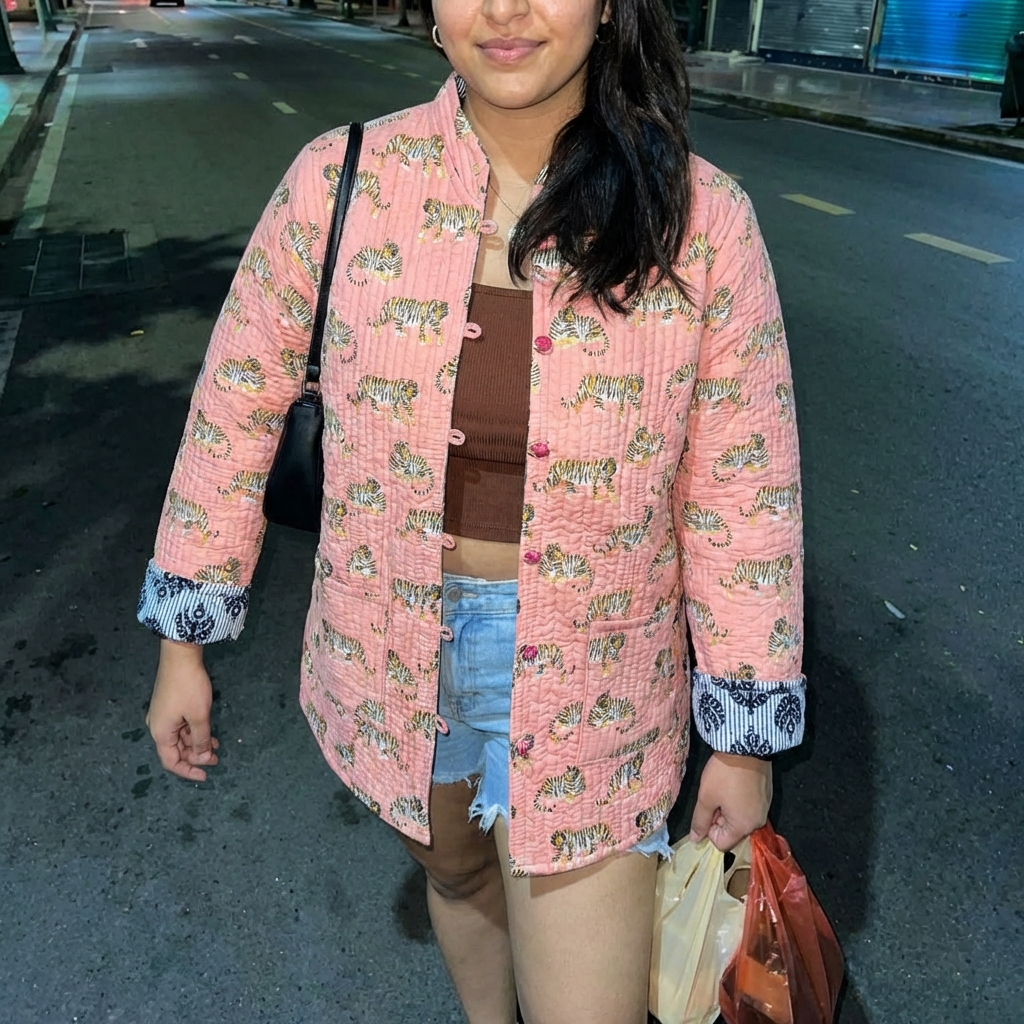
- **Torso:** The jacket has a boxy, straight cut. It should NOT cling to the waist or bust line but rather hang vertically from the shoulders, creating a slight gap between the fabric and the user's lower back/waist.
- **Length:** Based on the source, the hemline should extend past the waistband of the user's denim shorts, likely hitting the mid-hip or upper-thigh region.
- **Shoulders:** The user's right shoulder is slightly dropped/back; the jacket structure must maintain a squared shoulder silhouette despite this, showing slight tension creases across the upper chest.
- **Sleeves:** The user's arms are in motion. The left sleeve (arm holding the bag) should bunch at the inner elbow. The right sleeve should hang straighter but angle backward.
- **Occlusion Handling:**
- **Hair:** The user's long dark hair flows over the left shoulder. This implies a hard segmentation mask where hair pixels must act as the top layer, occluding the collar and left shoulder of the jacket.
- **Accessories:** The black handbag strap on the right shoulder must technically compress the quilted fabric if visualized, or be layered *over* the new garment. The plastic bag in the left hand is low but may interact with the jacket hem; the bag is the foreground layer.
PHASE 3: ENVIRONMENT & LIGHTING
- **Light Match:** The target environment is a night scene with strong, cool-toned artificial street lighting coming from the upper-front-right. The jacket must be rendered with high contrast: bright, cool highlights on the right side (user's left) and deep shadows on the left side (user's right) and under the arms.
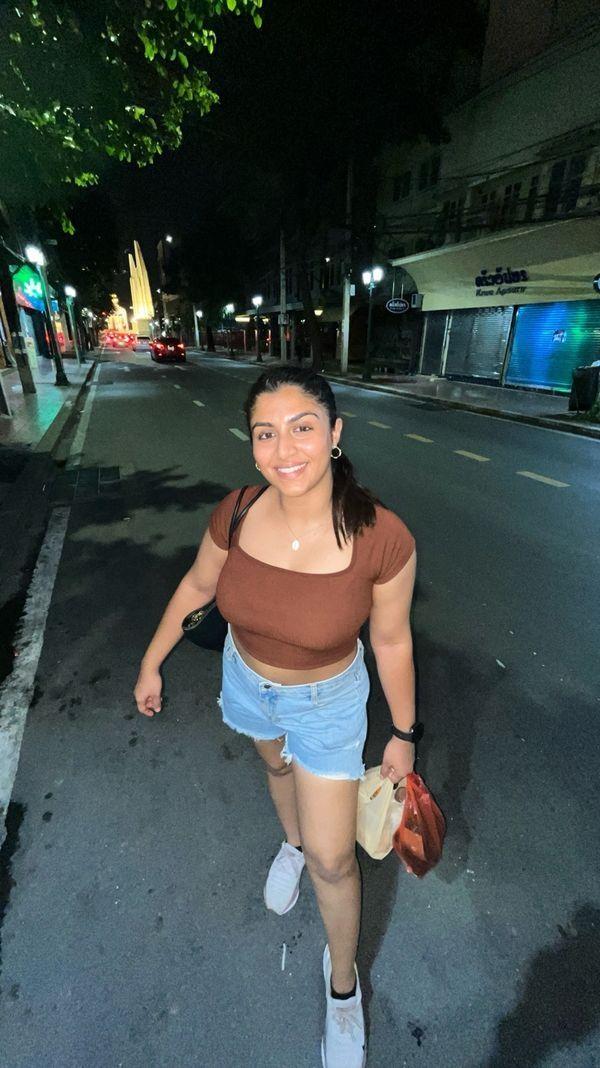
- **Color Calibration:** The source image is in neutral/warm studio light. The jacket's pink base must be shifted towards a cooler, slightly desaturated magenta to integrate with the blue/green ambient hues of the street at night. The brightness of the white stripes in the cuffs must be dampened to match the exposure of the user's shoes.
PHASE 4: IDENTITY PROTECTION
- **Facial Lock:** Absolute freeze on the facial ROI (Region of Interest) including eyes, nose, mouth, smile lines, and jawline. The neck area above the collar line must remain untouched.
- **Body Integrity:** The legs and lower body (denim shorts) must remain completely unaltered. Strict prohibition on "slimming" the torso; the jacket adds volume/bulk due to quilting, and the final render must reflect this added silhouette width accurately without warping the user's underlying anatomy.