Thinking Process
PHASE 1: VISUAL DECONSTRUCTION
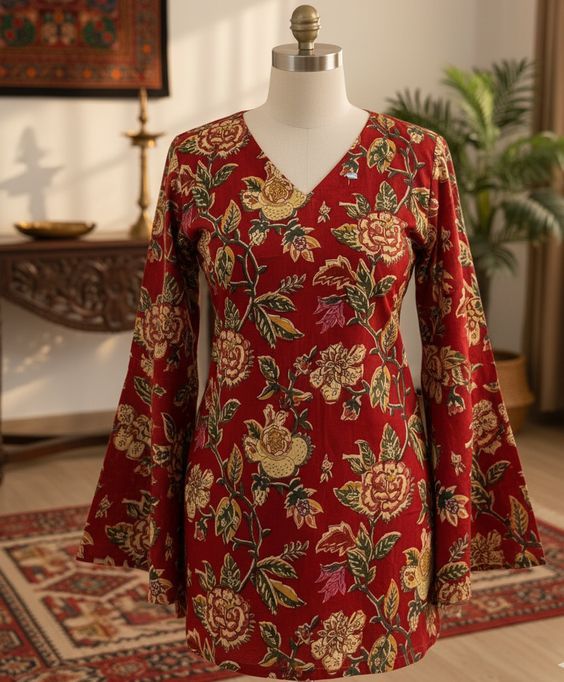
- **Fabric Physics:** The source garment appears to be a medium-weight cotton or linen blend with a matte finish. It exhibits a semi-structured drape, meaning folds should be crisp rather than fluid (unlike silk) or rigid (unlike heavy canvas). Light reflection should be diffuse with low specularity, absorbing the ambient light rather than reflecting it.
- **Key Features:** The defining V-neckline and the distinct "bell sleeve" (flared cuff) silhouette must be preserved. The complex red/green/yellow floral block print pattern (Kalamkari style) requires high-resolution texture mapping to prevent blurring during warping. The garment is a tunic/kurta, implying a longer hemline that will sit outside the waistband, unlike the user's current tucked/cropped top.
PHASE 2: FIT & DRAPE SIMULATION
- **Body Mapping:**
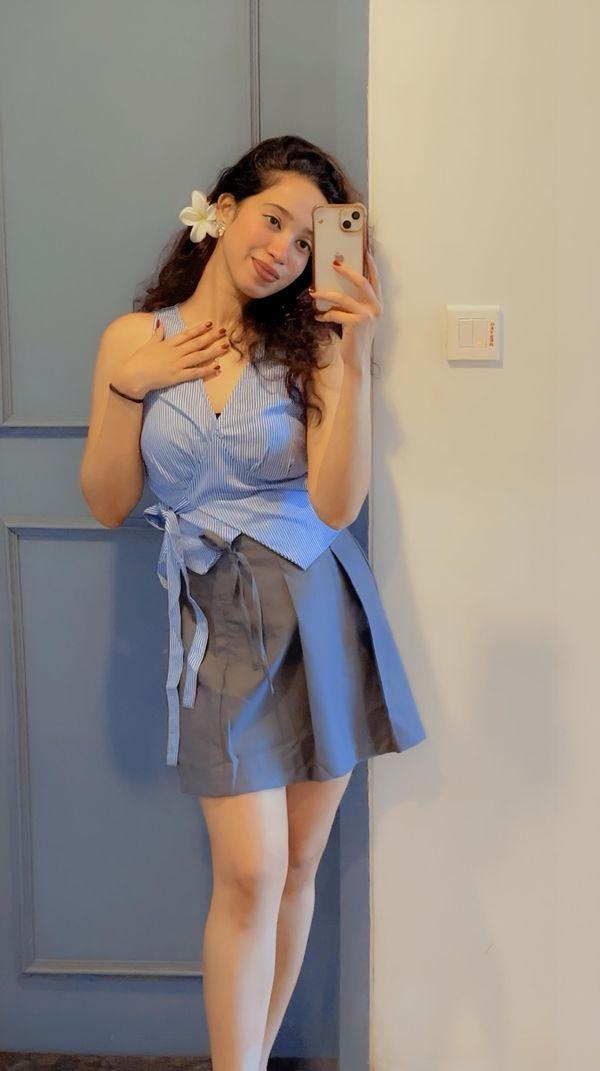
- **Shoulders & Torso:** The garment must drape loosely over the torso, replacing the tight-fitting blue wrap top. Gravity will pull the fabric vertically, relaxing the waist definition.
- **Sleeves (Critical):** The user is currently sleeveless, but the source has long bell sleeves. The simulation must generate new geometry for the sleeves.
- *Right Arm:* Since the elbow is bent and hand is on the chest, the fabric must bunch at the inner elbow and the flared cuff should cascade slightly backward from the wrist.
- *Left Arm:* Holding the phone. The sleeve will compress at the elbow crease. The flared cuff creates a collision challenge near the phone grip and must not clip through the device.
- **Occlusion Handling:**
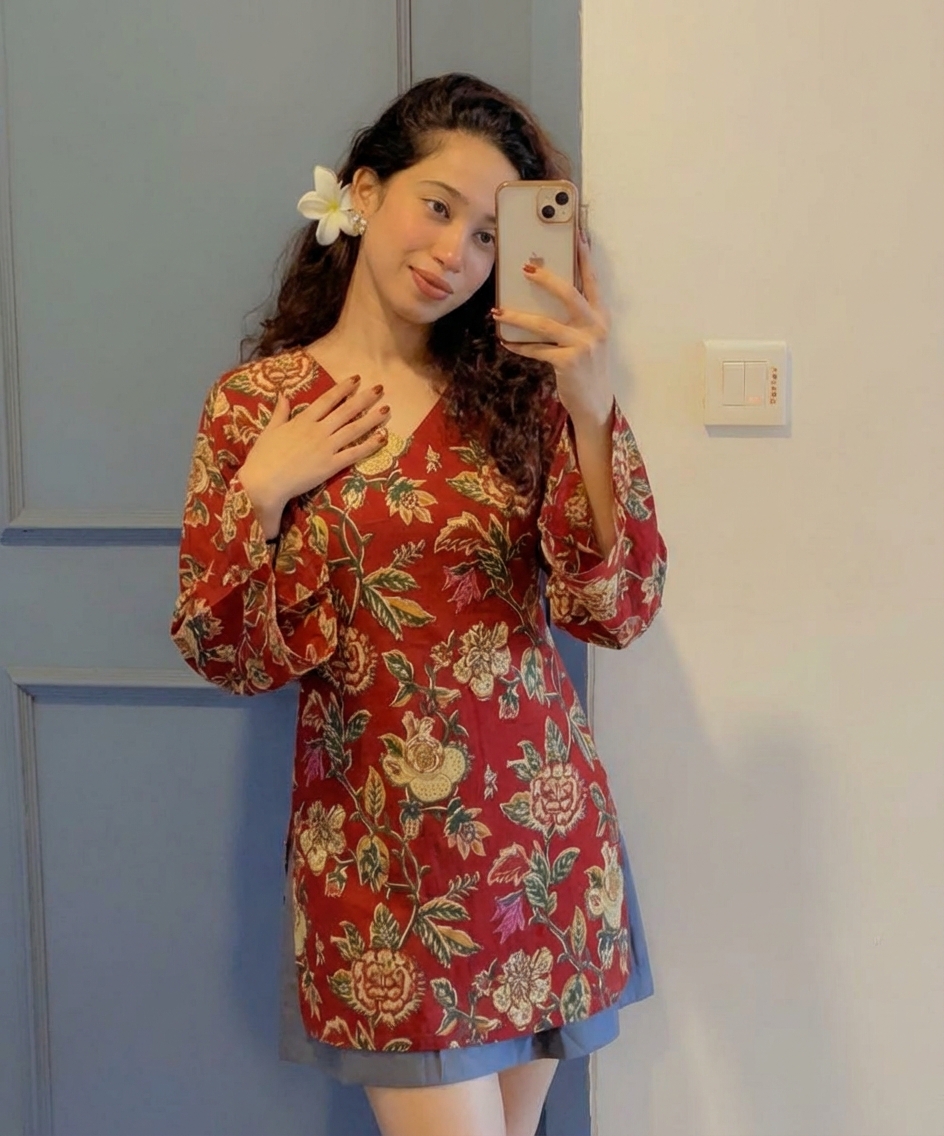
- **Right Hand:** The user's right hand is pressed flat against the sternum. The new red fabric must pass *underneath* this hand, requiring a precise segmentation mask around the fingers and wrist.
- **Hair:** The long, dark curly hair falling over both shoulders and the back must be layered *on top* of the new garment.
- **Phone:** The mobile device is a rigid occlusion object; the sleeve fabric must interact with it but never obscure the screen or the hand holding it.
PHASE 3: ENVIRONMENT & LIGHTING
- **Light Match:** The User Image features warm, artificial indoor lighting (tungsten dominance) coming from the front/right, casting soft shadows on the blue door behind. The source garment, currently in neutral studio light, must be re-lighted to accept this warm, yellow-orange cast.
- **Color Calibration:** The deep red of the cloth needs to be shifted slightly warmer to harmonize with the room's color temperature. Shadows generated by the garment (self-shadowing in folds and cast shadows onto the grey skirt) must match the density and softness of the shadow currently seen behind the user on the door.
PHASE 4: IDENTITY PROTECTION
- **Facial Lock:** The user's visible facial features (eyes, nose, mouth), the flower behind the ear, and the phone obscuring part of the face are absolute freeze zones. No pixels in the head region (above the neck) should be altered.
- **Body Integrity:** The user's arm volume, shoulder width, and stance must remain unchanged. While the garment adds volume due to its cut, the underlying avatar mesh must strictly adhere to the user's original biomechanics. No slimming, skin smoothing, or altering of skin tone on the exposed legs or face is permitted.