Thinking Process
PHASE 1: VISUAL DECONSTRUCTION
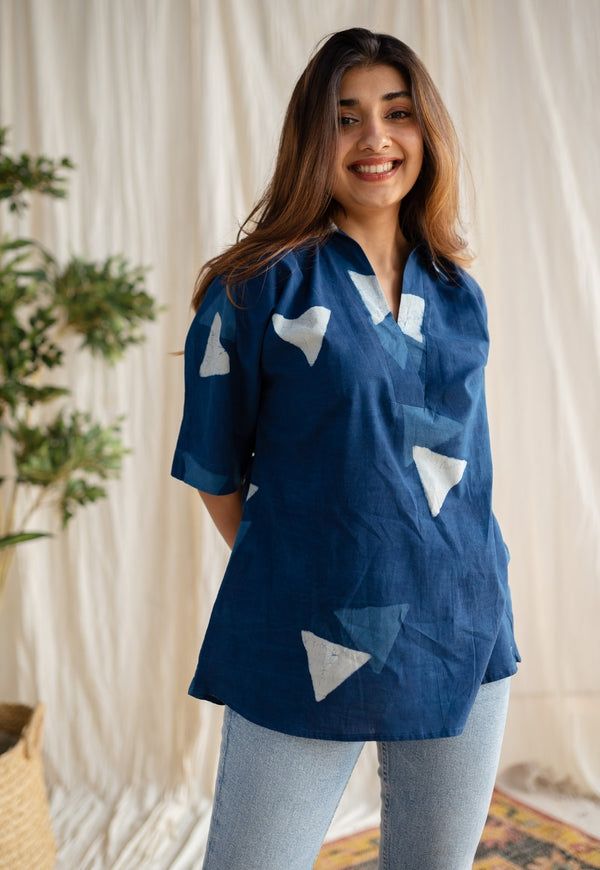
- **Fabric Physics:** The source garment appears to be a natural fiber blend, likely Cotton or Linen. It features a matte finish with zero specularity (no shine). The simulation must treat the material as semi-structured; it holds creases and folds rather than flowing like water (silk) or stretching tight (spandex). It has a "dry" texture that absorbs light.
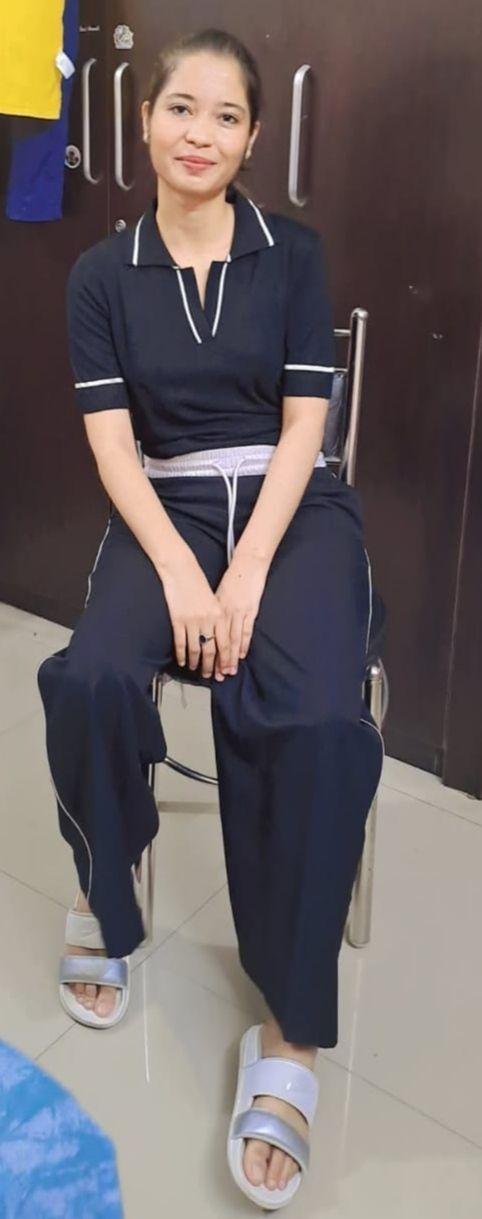
- **Key Features:** The distinctive V-neck collar stand must be preserved. The large, irregular block-print style white triangles (Shibori/Batik aesthetic) must remain crisp and not blur during warping. The sleeve length is roughly elbow-length (longer than the user's current polo) and loose fitting. The hemline is tunic-length, extending to the mid-hip.
PHASE 2: FIT & DRAPE SIMULATION
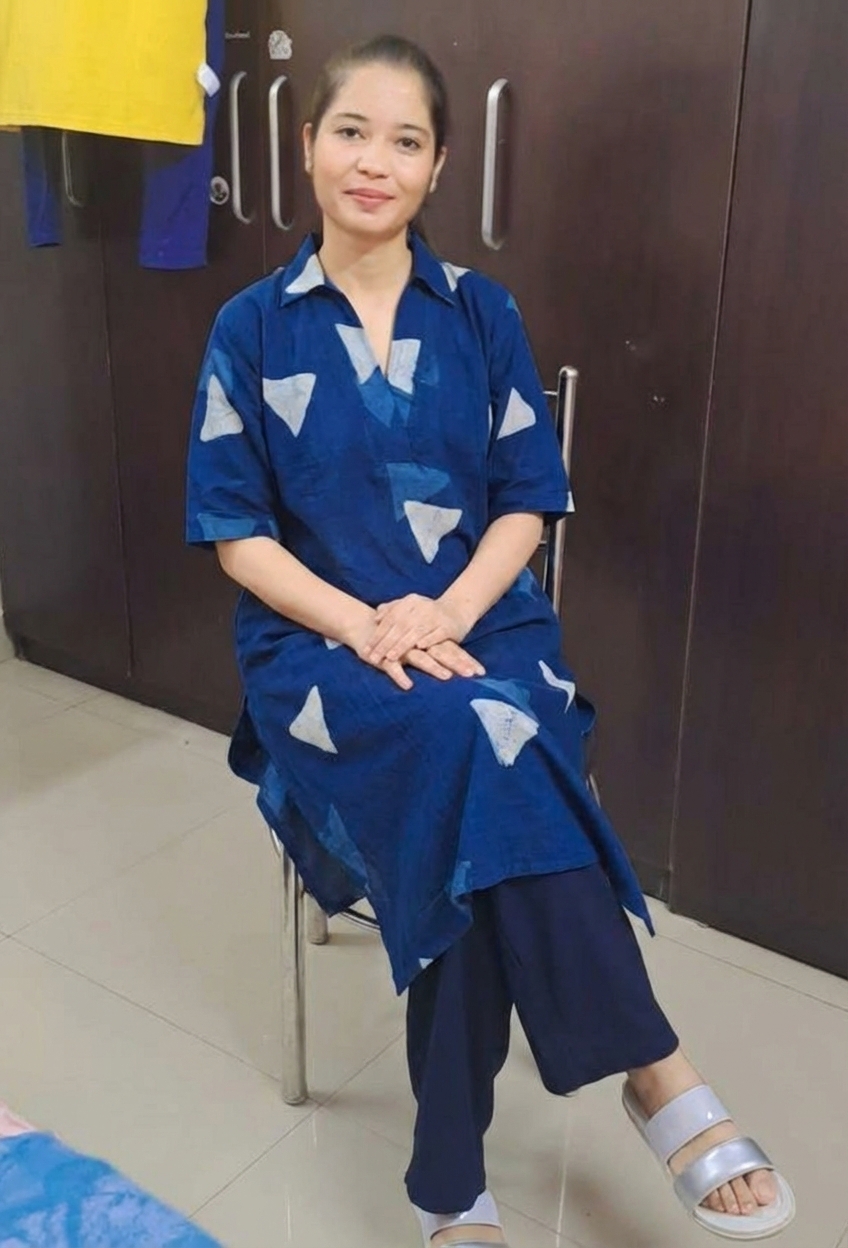
- **Body Mapping:** Since the user is in a **seated position**, the drape physics are critical. The tunic length means the lower portion of the garment cannot hang straight down. It must fold and "pool" naturally where the torso meets the legs (the lap area). The fabric should drape vertically from the chest but then crumble/bunch horizontally across the upper thighs. The back of the garment must flatten where it contacts the chair back.
- **Occlusion Handling:** The user's hands are resting on her thighs. The new garment is long enough to cover the upper thighs. Therefore, the simulation must layer the fabric **under** the user's hands and forearms. The hands serve as a rigid collision object; the fabric must compress beneath the wrists/palms, not float over them. The user's hair is tied back, eliminating neck occlusion issues.
PHASE 3: ENVIRONMENT & LIGHTING
- **Light Match:** The user image uses flat, cool-toned indoor overhead lighting (likely fluorescent or LED), casting soft shadows directly downward (note the shadow under the chair). The source garment has warm, directional studio lighting. The new garment's lighting must be neutralized (removing the warm yellow cast) and re-lit with a diffuse, top-down cool light source to generate shadows under the bust and deep occlusion shadows in the lap folds.
- **Color Calibration:** The "white" triangles on the source garment currently look cream due to studio warmth; they must be color-corrected to a neutral or cool white to match the white balance of the user's room (e.g., matching the white piping on her current shoes/pants). The indigo blue must be slightly desaturated to match the lower contrast of the user's environment.
PHASE 4: IDENTITY PROTECTION
- **Facial Lock:** Absolute pixel freeze required for the user's face, ears, neck, and hairline. The user's hairstyle (slicked back) is clean and must remain untouched.
- **Body Integrity:** Strict prohibition on body warping. The user's seated posture, thigh width, and arm thickness must remain identical. The target garment is loose-fitting; do not artificially taper the waist to make the user look slimmer. The garment must add volume appropriate to its loose cut, adhering to the user's actual seated geometry.