Thinking Process
PHASE 1: VISUAL DECONSTRUCTION
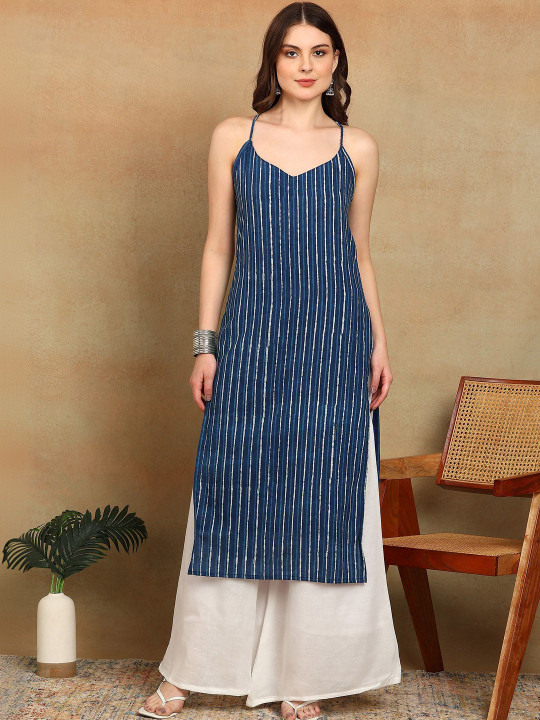
- **Fabric Physics:** The source garment appears to be a lightweight woven cotton or linen blend. It possesses a matte finish with zero specularity (no shine). The physics simulation must account for a "crisp but flowy" drape—meaning it holds vertical structure due to the weave but folds softly upon contact. It is not elastic; it should not cling to the skin but rather hang loosely.
- **Key Features:**
1. **Vertical Pinstripes:** These must remain parallel and undistorted, following the gravitational flow of the fabric.
2. **Spaghetti Straps:** The thin shoulder straps and the V-neckline geometry are critical and must replace the user's current high-neck collar.
3. **Length & Silhouette:** This is a long-line Kurta/tunic. The simulation must extend past the user's waist, likely ending mid-thigh or knee (depending on frame crop), maintaining the straight-cut boxy silhouette.
PHASE 2: FIT & DRAPE SIMULATION
- **Body Mapping:**
- **Shoulder Anchor:** The spaghetti straps must sit naturally on the user's trapezius muscles without digging in.
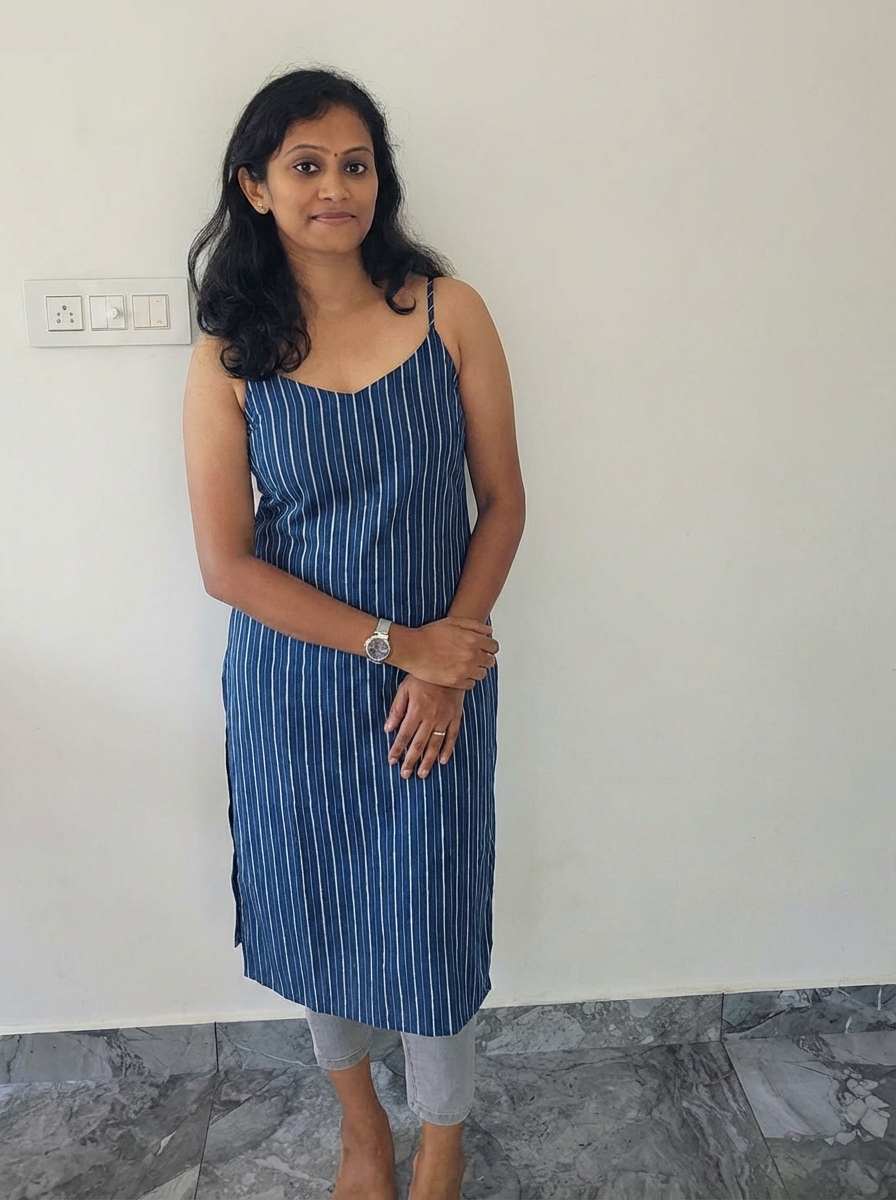
- **Torso Flow:** Due to the user's slight lean against the wall, the garment should hang vertically relative to world gravity, not perpendicular to the body's angle. This will create a slight gap between the fabric and the user's right side (viewer's left).
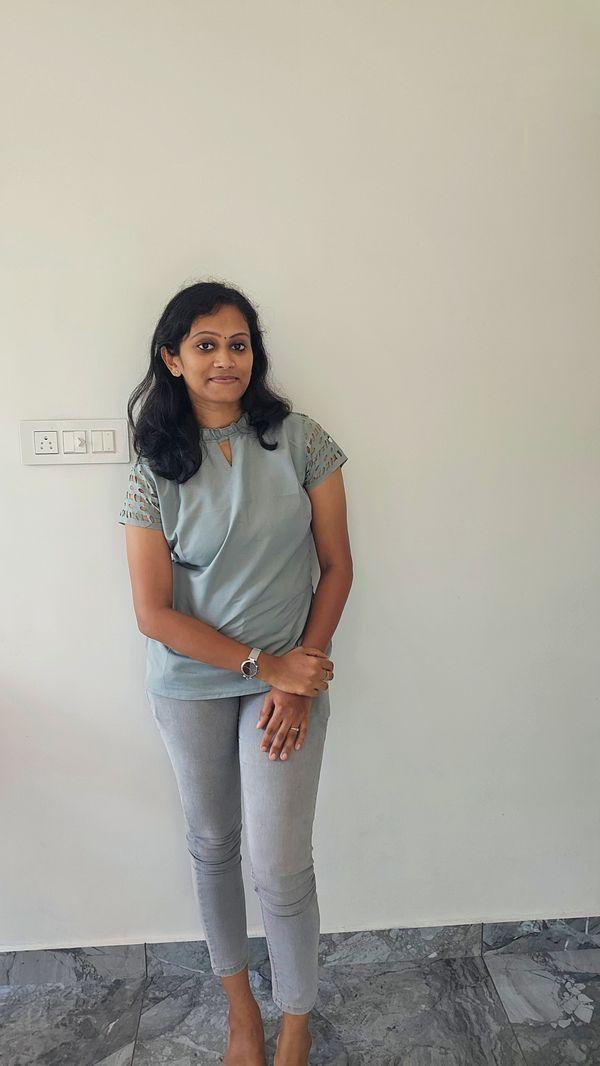
- **Waist Interaction:** The source garment is looser than the target's current grey top. It should skim over the waist curvature rather than tucking in.
- **Occlusion Handling:**
- **Hair:** The user's dark, wavy hair resting on the shoulders and upper chest is a primary occlusion layer. The new garment straps and upper bodice must be rendered *underneath* the hair volume.
- **Hands & Forearms:** The user's hands are clasped in front of the lower torso. This is a hard occlusion. The Kurta fabric must appear to pass *behind* the forearms and clasped hands. If the garment's volume pushes forward, slight compression folds should appear around the wrists where the arms press against the torso.
PHASE 3: ENVIRONMENT & LIGHTING
- **Light Match:** The user's environment features soft, diffused daylight coming from the left (viewer's perspective), casting soft shadows to the right against the wall. The new blue garment must render with highlights on the left folds and deeper shadows in the creases on the right side.
- **Color Calibration:** The source image has warm, golden studio lighting, while the target image has cooler, neutral indoor lighting. The Indigo blue of the Kurta must be color-graded to be slightly cooler and less saturated to match the ambient occlusion of the target room, preventing a "pasted-on" artifact look.
PHASE 4: IDENTITY PROTECTION
- **Facial Lock:** Absolute freeze on the user's facial pixels, extending from the forehead down to the chin. The neck area (exposed by the new lower neckline) requires skin tone synthesis matching the user's face.
- **Body Integrity:** Strict prohibition on warping the user's hip width or arm thickness. The garment serves as a layer on top; the user's underlying skeletal mesh and BMI must remain unaltered. The wall background behind the user must not be warped by the clothing expansion.