Thinking Process
PHASE 1: VISUAL DECONSTRUCTION
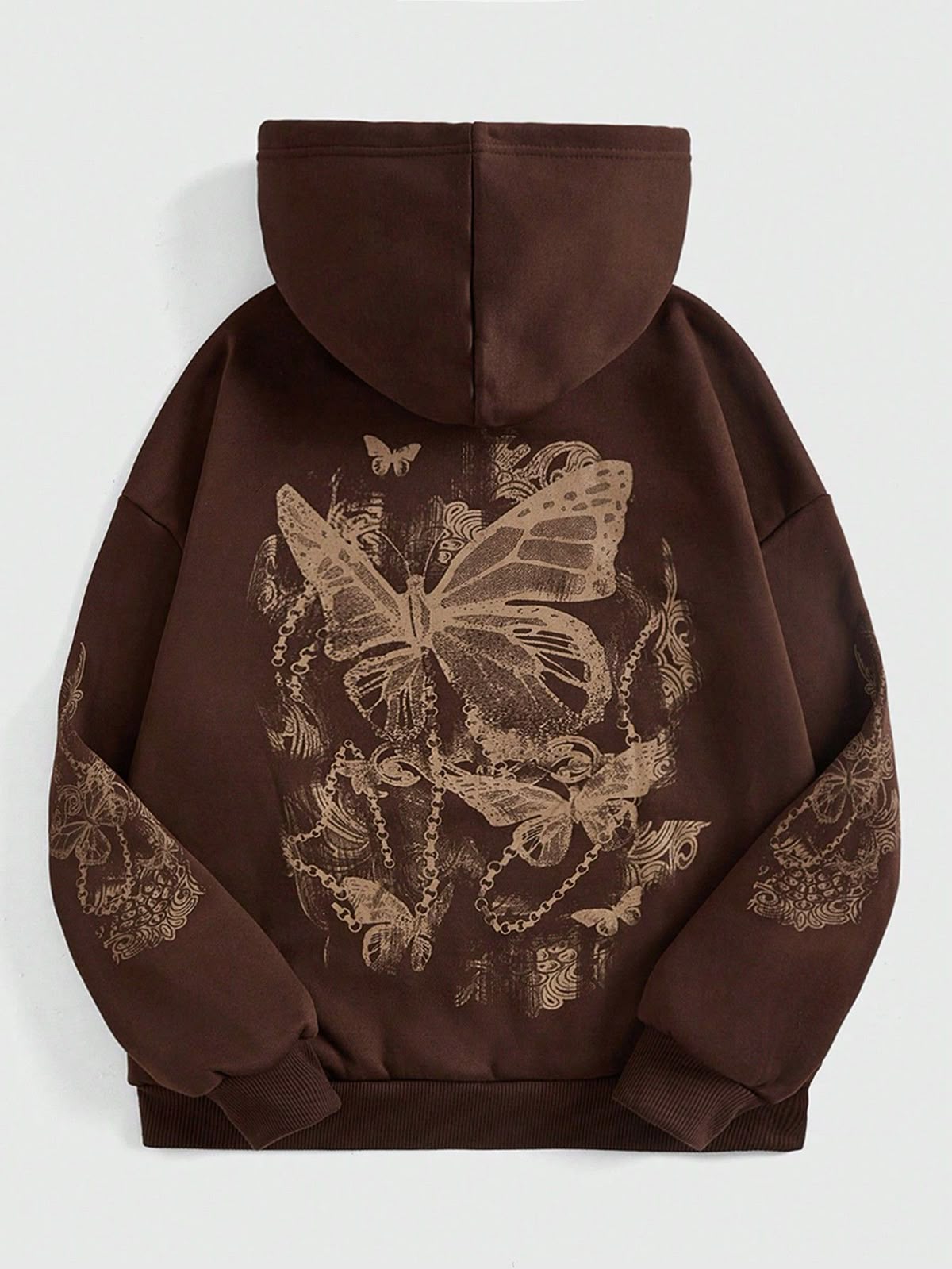
- **Fabric Physics:** The source garment is a heavy-weight cotton/polyester fleece blend. It has a matte finish with high light absorption and low reflectivity. The texture simulation must account for significant thickness (300+ GSM), resulting in soft, rounded folds rather than sharp, crisp creases.
- **Key Features:**
- **Hood Structure:** The hood is currently shown from the back; for the front-facing user, this requires generating the hood's "bunching" and interior volume around the clavicle/neck area.
- **Sleeve Graphics:** The ornate butterfly/chain prints on the sleeves must be preserved and mapped to the outer arms.
- **Ribbing:** Wide ribbed elastic cuffs and hemline must be distinct from the main body fabric.
- **Note on Graphic:** The source image shows the *back* of the hoodie. For a realistic front-facing simulation, the butterfly graphic should logically be on the back (hidden), leaving the front plain or with a pocket, unless style transfer dictates mapping the back texture to the front.
PHASE 2: FIT & DRAPE SIMULATION
- **Body Mapping:**
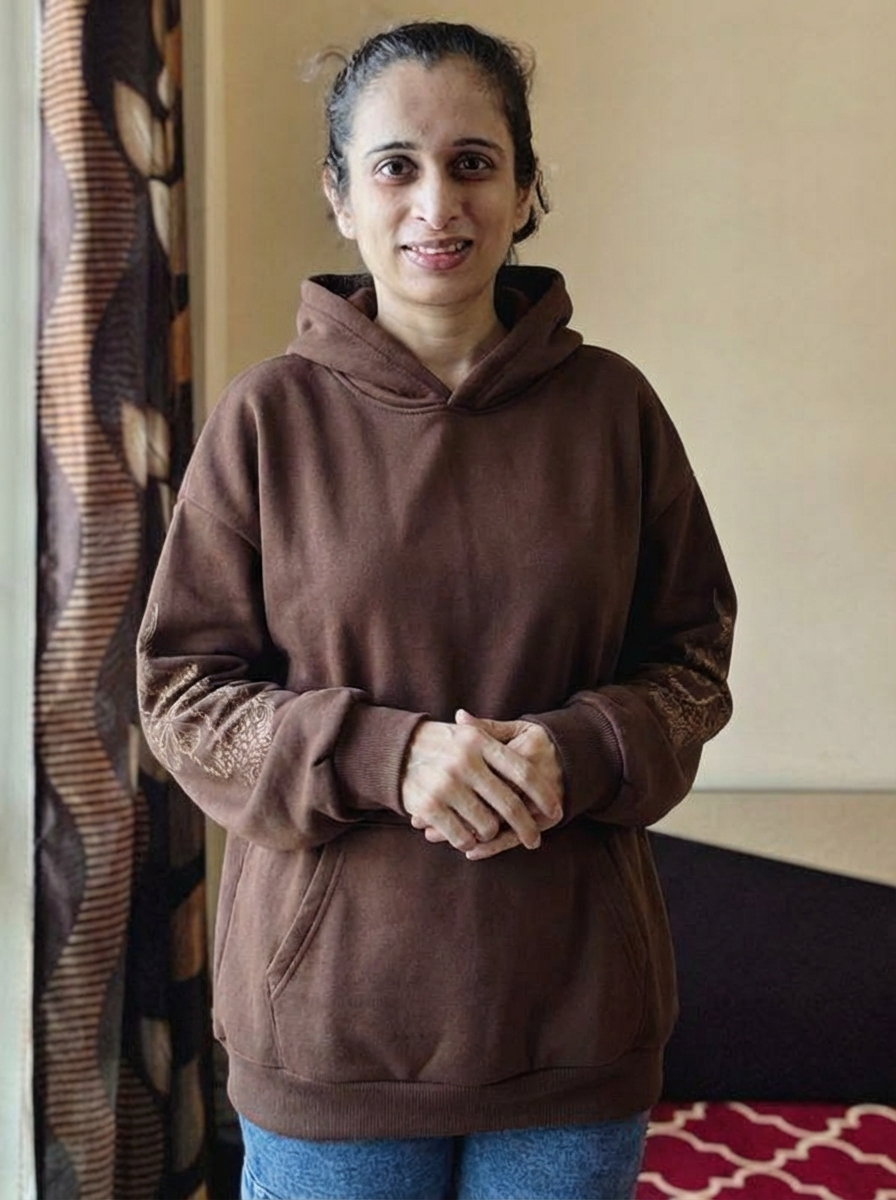
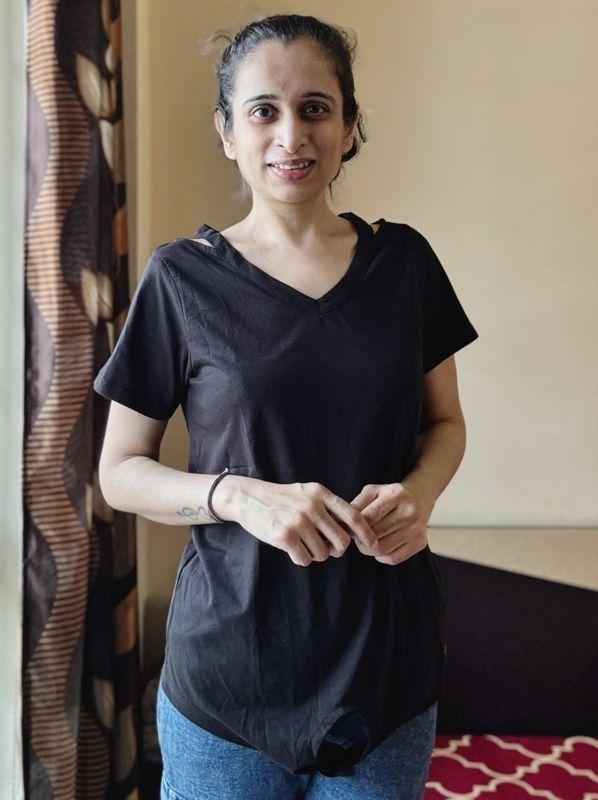
- **Silhouette Expansion:** The hoodie is oversized/drop-shoulder. The simulation must expand the user's silhouette significantly beyond the current fitted t-shirt, particularly at the shoulders and waist.
- **Elbow Compression:** Due to the user's bent elbows, the heavy fabric must create deep, thick compression folds at the inner elbow and tension wrinkles pulling across the forearm.
- **Gravity:** The garment should hang vertically from the chest apex, ignoring the waist curve (box fit).
- **Occlusion Handling:**
- **Primary Occlusion (Hands):** The user's clasped hands and wrists are the critical occlusion layer. The hoodie's lower front section must render *behind* the hands.
- **Sleeve Interaction:** The long sleeves will likely cover the wrists. The simulation must determine if the sleeves bunch up above the hands or partially cover the knuckles.
- **Hair:** Loose flyaway hairs near the neck must layer *over* the new hood geometry.
PHASE 3: ENVIRONMENT & LIGHTING
- **Light Match:** The user is illuminated by a strong, natural window light source from the (viewer's) left. The hoodie must render with high-value highlights on the left shoulder and sleeve, transitioning to deep, soft shadows on the right torso and under the bent arms.
- **Color Calibration:** The source image is cool/neutral studio lighting. The target brown must be warmed slightly to match the ambient temperature of the room (beige walls/warm sunlight). The black point of the hoodie shadows should match the black point of the curtain's dark patterns.
PHASE 4: IDENTITY PROTECTION
- **Facial Lock:** Absolute freeze on the entire head region from the chin up, including the neck geometry visible above the new neckline.
- **Body Integrity:** The user's hands (skin tone, finger shape) must remain unaltered. Do not apply "slimming" filters; the simulation must respect the user's shoulder width and stance while adding the necessary bulk of the garment. The tattoo on the left forearm will likely be occluded by the sleeve, but if the sleeve is pushed up, the tattoo must be preserved, not textured over.