Thinking Process
PHASE 1: VISUAL DECONSTRUCTION
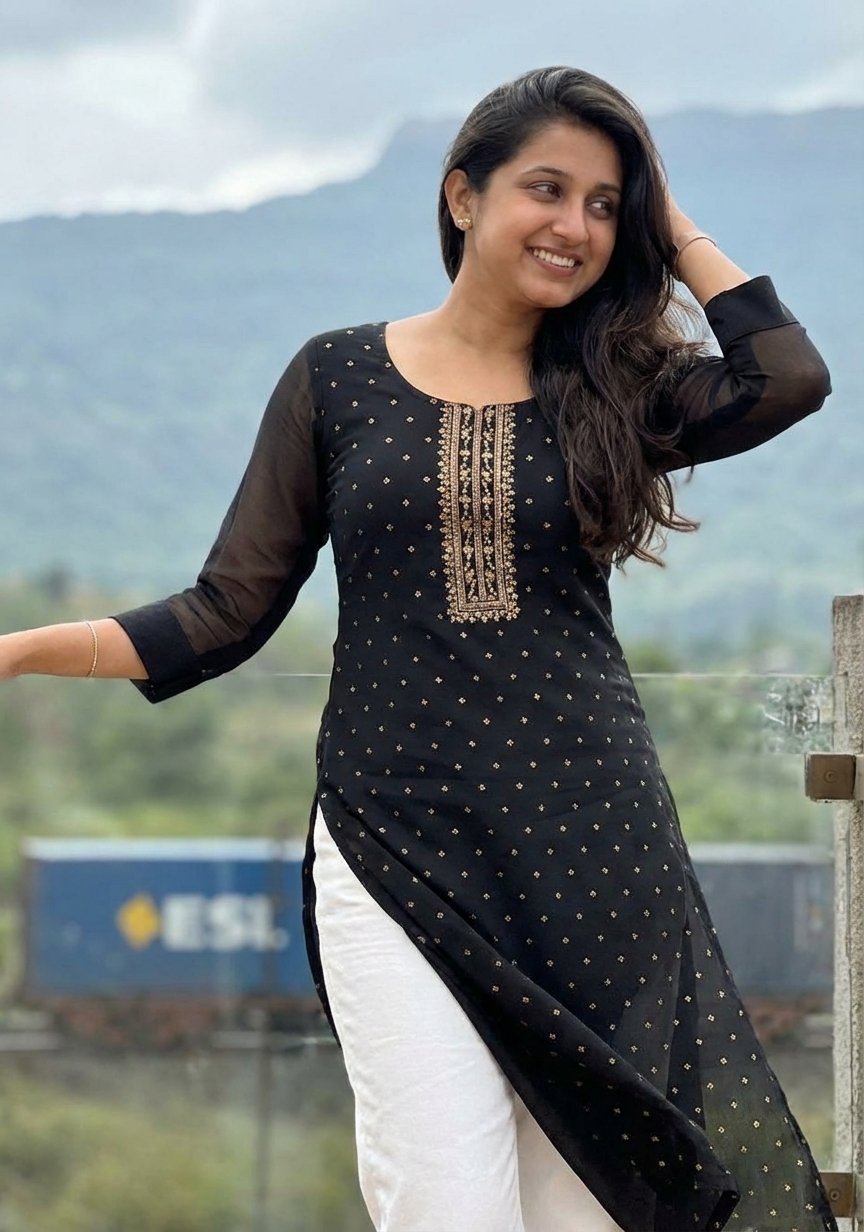
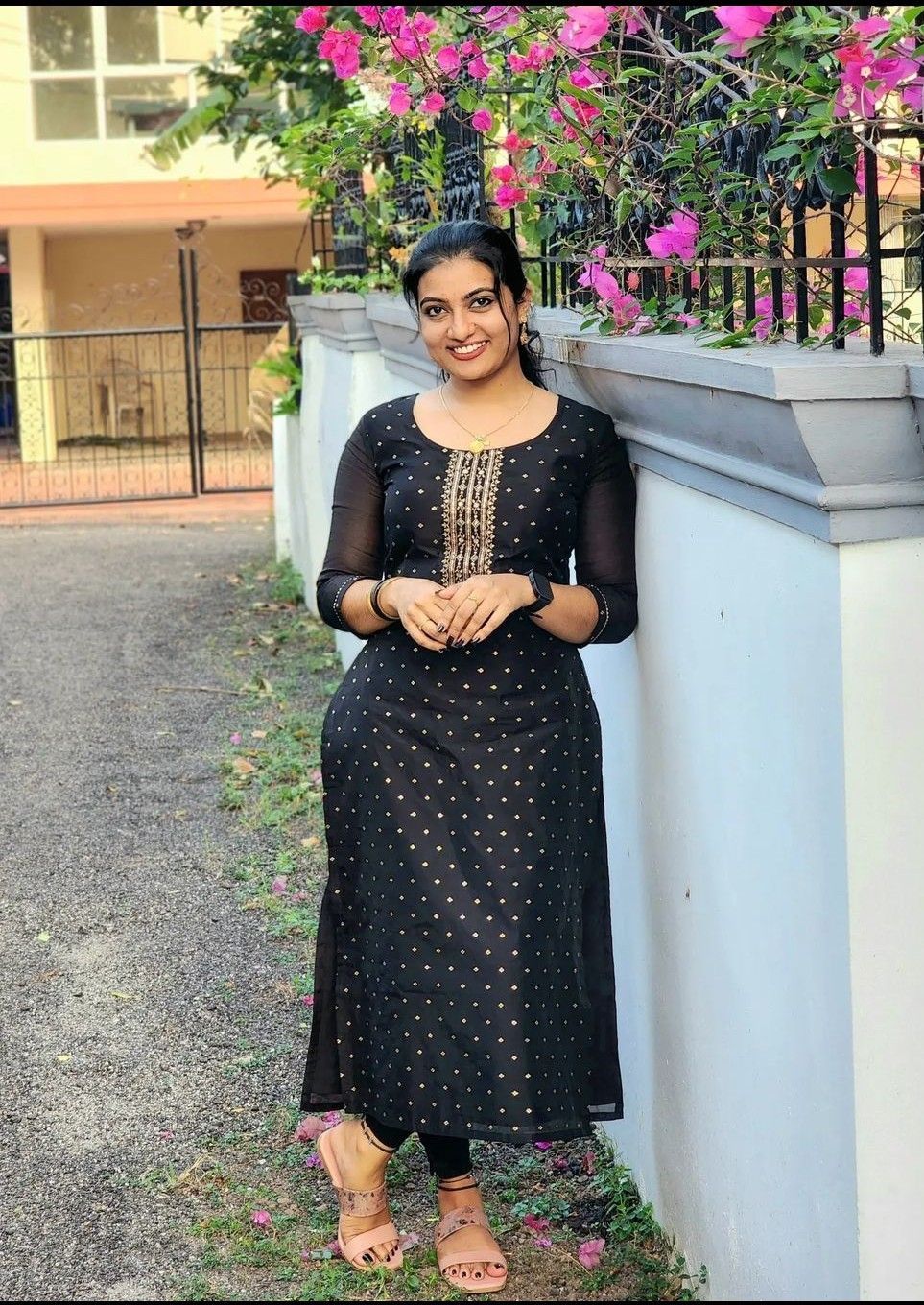
- **Fabric Physics:** The source garment is a black Kurti, likely made of Georgette or soft crepe. It features a semi-translucent (sheer) quality on the sleeves, while the bodice is lined and opaque. The material has a fluid drape with moderate weight—it is not stiff like denim but holds a structured shape better than soft jersey. The gold foil prints and embroidery must exhibit metallic specularity (shiny reflection) distinct from the matte black fabric.
- **Key Features:**
1. Central vertical embroidery panel (gold/silver mix) on the chest.
2. Scattered gold geometric "butti" patterns across the entire fabric.
3. 3/4 length sheer sleeves with opaque solid black cuffs.
4. Round neckline.
5. The hemline is long (below hip), which will drastically change the silhouette compared to the current tucked-in tee.
PHASE 2: FIT & DRAPE SIMULATION
- **Body Mapping:**
- **Shoulders & Chest:** The Kurti must sit flatter across the chest than the current stretch-tee, bridging the gap between the breasts rather than contouring under them.
- **Torso & Waist:** Due to the user's leaning pose against the railing, the Kurti needs to hang vertically due to gravity on the left side (away from the rail), but will bunch and compress slightly at the right hip where she contacts the railing.
- **Arms:** The left arm is raised; the fabric of the sleeve should pull slightly downward toward the shoulder, creating tension creases at the armpit. The right arm is resting down; the sleeve should hang naturally with radial folds at the elbow bend.
- **Occlusion Handling:**
- **Hair:** The user has significant volume of hair flowing over the left shoulder and back. This requires a high-precision mask to layer the hair *over* the new Kurti neckline and shoulders.
- **Railing:** The transparent glass/metal railing in the foreground partially occludes the lower torso. The garment must extend behind this railing, maintaining the correct depth map.
- **Hands:** The left hand touches the hair; the wrist area must interact with the sleeve cuff correctly.
PHASE 3: ENVIRONMENT & LIGHTING
- **Light Match:** The User Image features soft, diffuse outdoor lighting (overcast sky) with a cool color temperature. There are no harsh directional shadows. The new black garment must be rendered with soft, ambient occlusion shadows rather than hard cast shadows.
- **Color Calibration:** The Source Image is warmer/sunnier. The black of the Kurti must be color-graded slightly cooler (towards blue-black rather than brown-black) to match the ambient light of the mountain background. The gold embellishments should reflect the white/grey sky, appearing less yellow and more metallic/neutral.
PHASE 4: IDENTITY PROTECTION
- **Facial Lock:** The user's face, skin tone, and specific expression (smile, gaze) must remain pixel-perfectly frozen. The hairline and the flying strands of hair must not be blurred or altered.
- **Body Integrity:** Strictly forbidden to slim the user's waist or arms to match the source model. The simulation must drape the Kurti over the user's *existing* geometry. While the Kurti is a looser fit than the brown top, it must imply the user's actual body mass underneath, preserving her natural hip width and posture.