
Thinking Process
PHASE 1: VISUAL DECONSTRUCTION
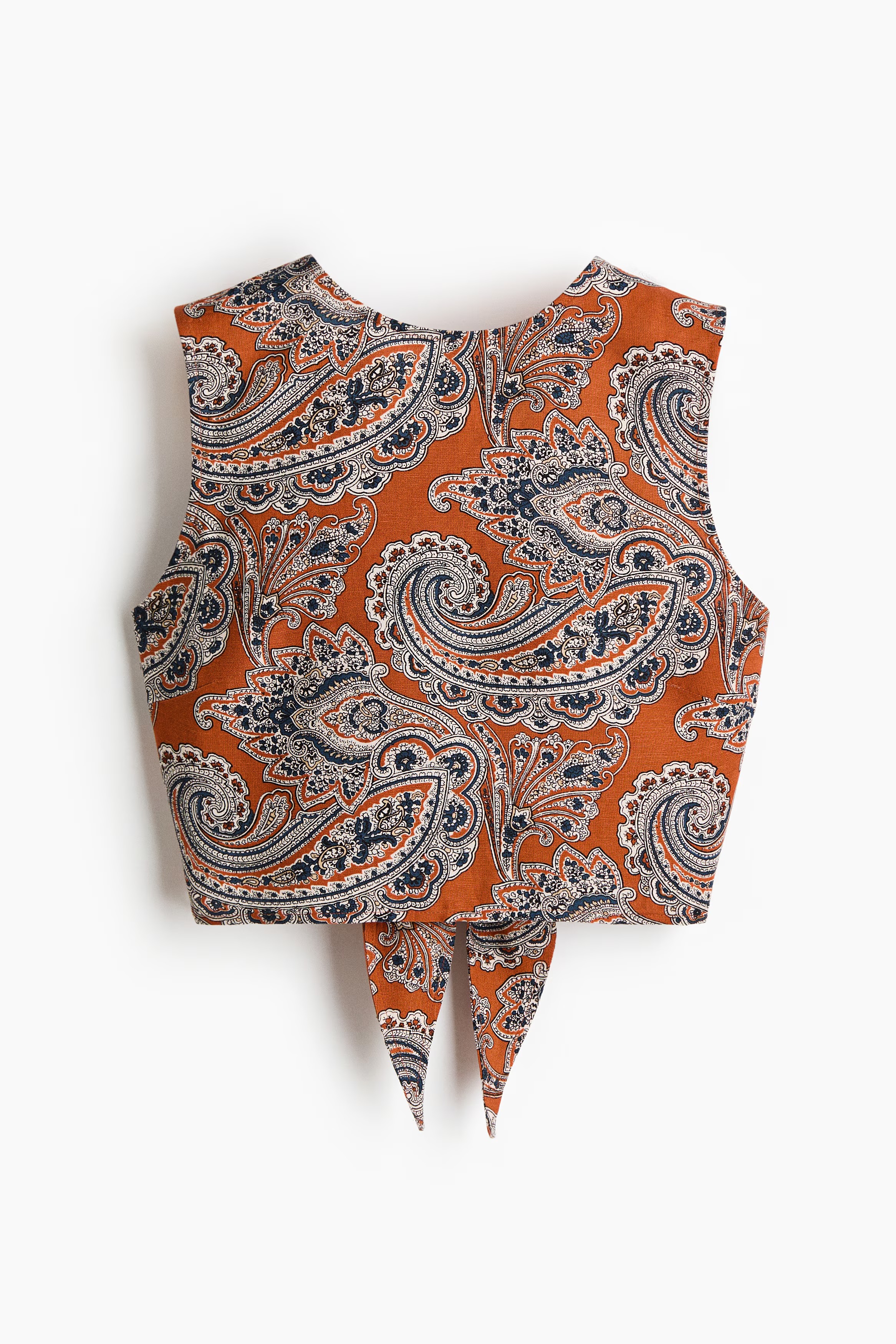
- **Fabric Physics:** The source garment appears to be a woven cotton or linen blend with a matte finish. It lacks high specularity (shine) and has a structured but pliable drape. Simulation must reflect a non-stretchy material that holds its shape around the armholes and neckline rather than clinging tightly like spandex.
- **Key Features:** The complex paisley pattern (rust, navy, white) must maintain high resolution without blurring. The crucial structural element is the front tie-knot detail with two hanging "tails" at the bottom hem; these must hang freely under gravity. The sleeveless cut and round neckline are essential geometry markers.
PHASE 2: FIT & DRAPE SIMULATION
- **Body Mapping:** This is a sleeve-length transformation (Long sleeve -> Sleeveless). The simulation must generate accurate skin texture for the user's arms where the current red sleeves exist. The new garment is a crop top; the hemline will sit significantly higher than the current red top, likely resting at or just above the waistband of the jeans. The tie-front tails must drape vertically, following gravity, potentially brushing against the upper jean area.
- **Occlusion Handling:** The user's left wrist has a watch; since the new garment is sleeveless, the watch must be preserved and layered *over* the newly generated skin of the forearm. There is no significant hair occlusion on the shoulders. The hands must remain in front of the body plane, unaffected by the garment layer.
PHASE 3: ENVIRONMENT & LIGHTING
- **Light Match:** The scene utilizes soft, diffuse outdoor lighting (overcast/cloudy sky). There are no harsh directional shadows. The new garment must accept a global illumination model consistent with "cloudy day" physics—soft shadows in folds and ambient occlusion where the fabric touches the skin.
- **Color Calibration:** The source image has studio white-balance. To integrate into the outdoor scene, the rust/orange tones of the paisley top should be slightly desaturated and cooled very subtly to match the atmospheric perspective of the riverbed environment.
PHASE 4: IDENTITY PROTECTION
- **Facial Lock:** The user's entire head, including the hairline, sunglasses, nose, and mouth, must be strictly frozen. The neck geometry must be preserved while blending the new neckline.
- **Body Integrity:** Strictly forbidden to alter the user's BMI, waist width, or arm thickness. The volume of the generated bare arms must match the implied volume of the current sleeved arms. The torso shape must remain consistent with the user's natural posture.