Thinking Process
PHASE 1: VISUAL DECONSTRUCTION
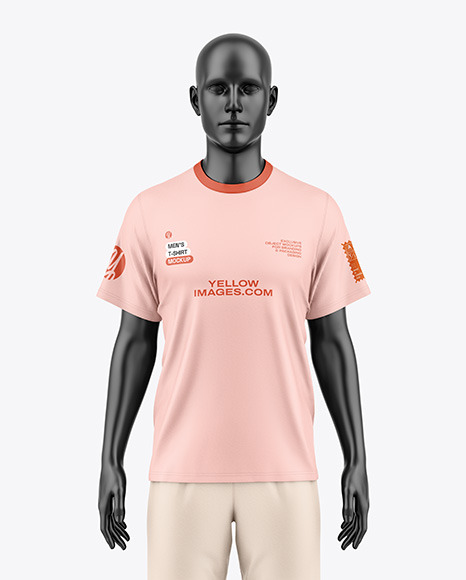
- **Fabric Physics:** The source garment is a standard medium-weight cotton jersey. It possesses a matte finish with low specularity (no shine). Simulation must account for moderate elasticity; it should stretch slightly over the pectorals but drape loosely around the waist. Light absorption should be uniform, diffusing rather than reflecting sharp highlights.
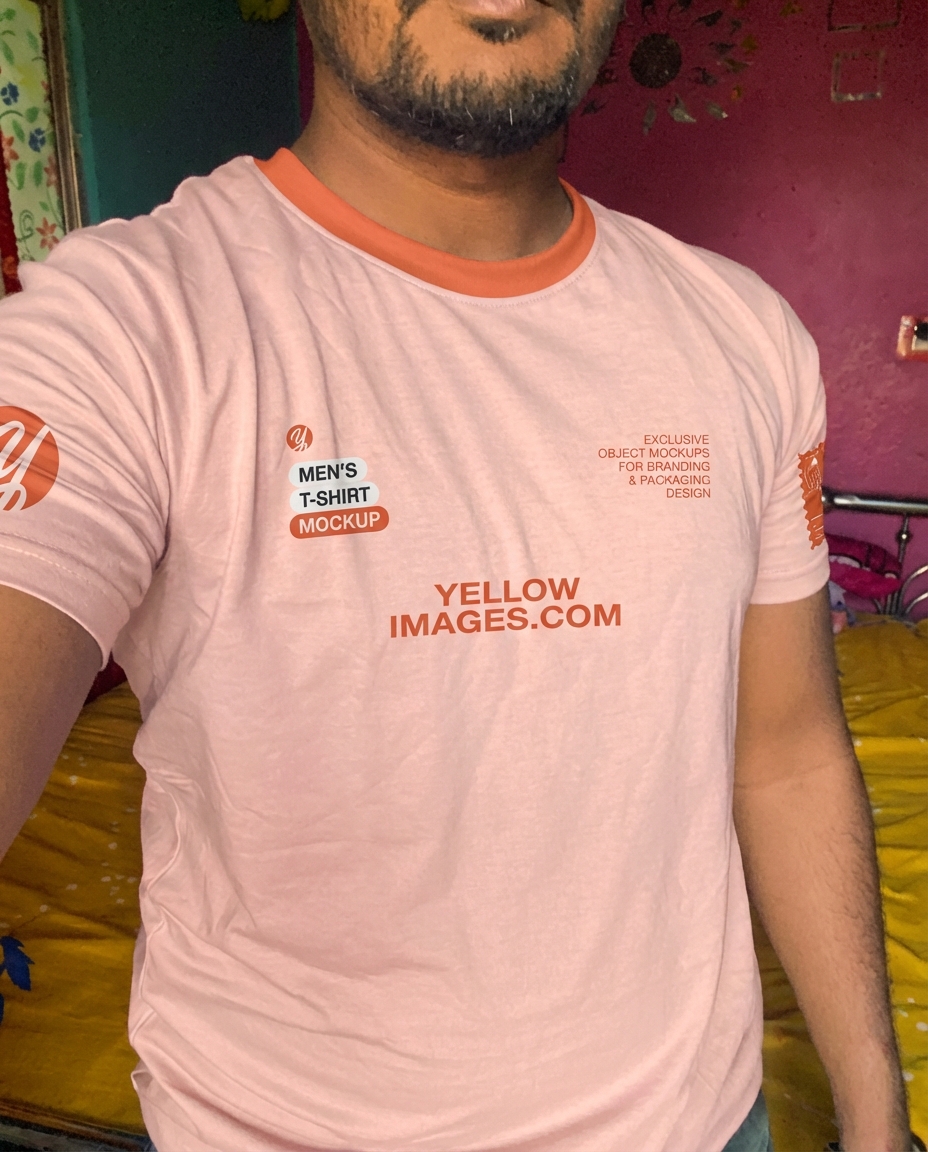
- **Key Features:** The orange/rust-colored contrast crew neck collar is a critical design element that must be preserved. All graphic elements must be mapped accurately: the "YELLOW IMAGES.COM" text centered on the chest, the "MEN'S T-SHIRT" patch on the right upper chest (viewer's left), and the distinct sleeve graphics (circular logo on left sleeve, vertical rectangular stamp on right sleeve). The hem stitching detail on the sleeves needs to remain visible.
PHASE 2: FIT & DRAPE SIMULATION
- **Body Mapping:** The user has a broad chest and shoulder build. The virtual mesh must account for the camera's slight downward-facing angle (selfie perspective). The fabric should drape with slight horizontal tension across the widest part of the chest (pec line) but relax vertically towards the abdomen. The sleeves must follow the cylindrical volume of the biceps, curving naturally rather than appearing as flat cutouts.
- **Occlusion Handling:** The primary occlusion is the user's beard and jawline. The new collar simulation must sit *behind* the beard hairs on the chin and under the jaw. The user's arms are clearly visible; the new sleeves must layer over the upper arm skin but terminate cleanly, allowing the user's forearms and hands (if visible lower down) to remain distinct.
PHASE 3: ENVIRONMENT & LIGHTING
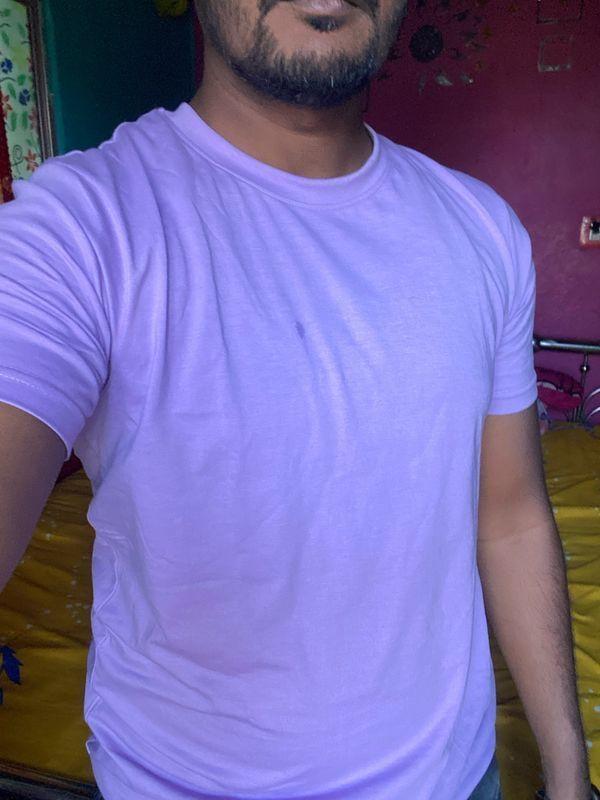
- **Light Match:** The user's environment has a strong, directional light source coming from the upper left (user's right shoulder), creating high exposure on that side and deep shadows on the opposing side (user's left ribcage). The new garment must render with a bright highlight on the right shoulder (viewer's left) and a gradient into shadow towards the bottom right.
- **Color Calibration:** The source image is lit with neutral studio white light, while the user environment is warm with ambient reflection from the pink wall and yellow bedding. The pink/salmon hue of the source shirt must be color-graded to accept a warm cast (lowering color temperature) and desaturated slightly in the shadow areas to match the contrast levels of the original purple shirt.
PHASE 4: IDENTITY PROTECTION
- **Facial Lock:** The lower face, including the lips, chin, and specifically the grooming/texture of the beard, must remain frozen and unaltered. The neck structure and Adam's apple area must be preserved up to the collar line.
- **Body Integrity:** Strict volumetric preservation is required. The user's shoulder width, pectoral definition, and arm girth must not be slimmed or warped. The skin tone and arm hair texture on the visible parts of the arms must remain original.