Thinking Process
PHASE 1: VISUAL DECONSTRUCTION
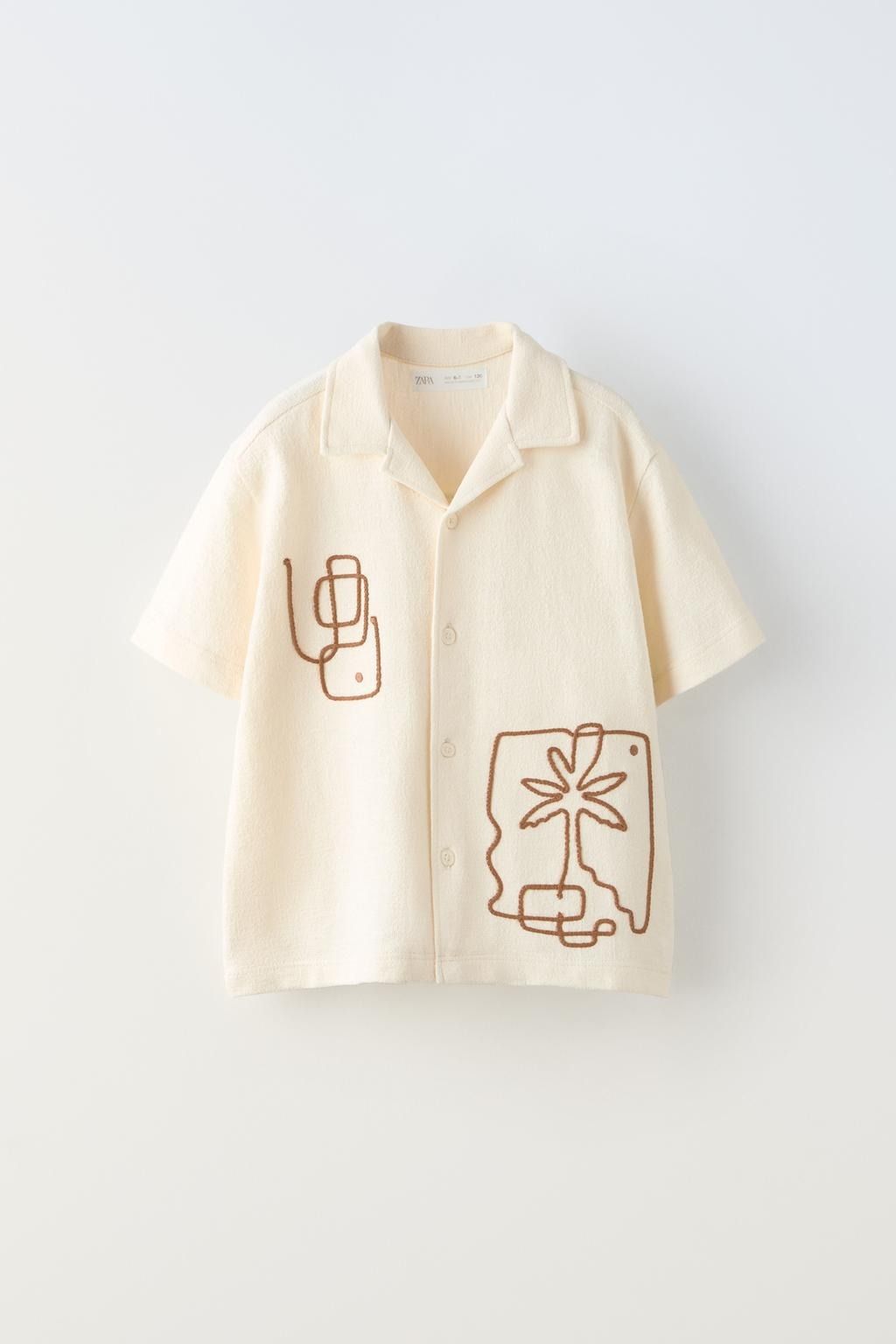
- **Fabric Physics:** The source garment appears to be a textured terry cloth or heavy cotton-bouclé blend. It has a matte finish with zero specularity. Light must diffuse across the surface rather than reflect sharply, highlighting the "towel-like" loop texture. The fabric has medium weight/stiffness—it holds the collar shape well but will fold softly rather than crease sharply.
- **Key Features:**
- The "Camp Collar" (cuban style) structure must be maintained.
- The brown abstract embroidery (line art face on right chest, palm tree/square on left hem) must remain distinct and follow the fabric's warp/weft.
- The visible button placket and the specific cream/off-white color code.
- The hem stitching details on the short sleeves.
PHASE 2: FIT & DRAPE SIMULATION
- **Body Mapping:**
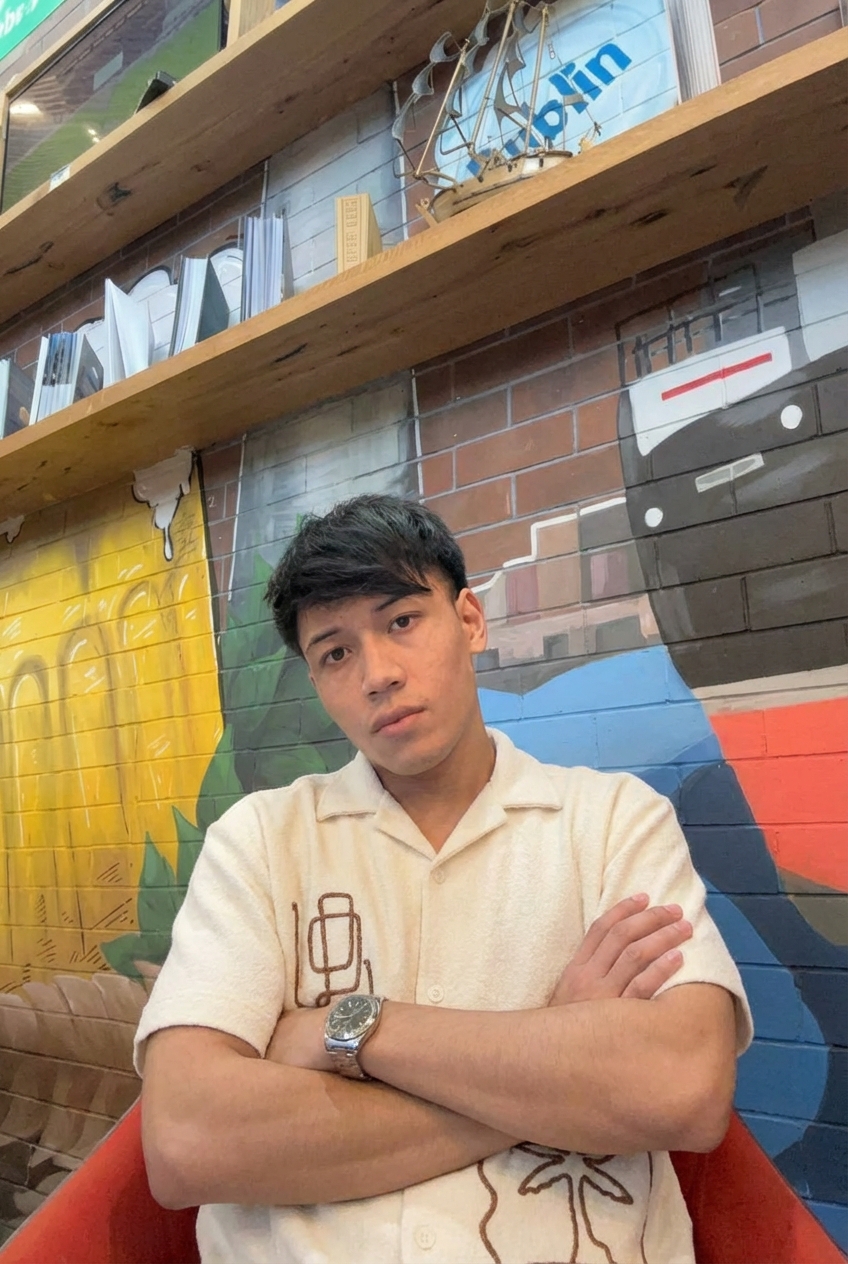
- **Pose Complexity:** The user has arms crossed over the chest. The simulation must account for high compression across the pectoral area and the mid-section.
- **Gravity:** As the user is leaning back into a chair, the fabric should settle backwards against the torso, not hang vertically straight.
- **Sleeve Logic:** The source is short-sleeved; the target is long-sleeved. The simulation must likely generate skin texture for the biceps or assume the short sleeves end prior to the elbow fold, potentially bunching slightly in the armpits due to the crossed posture.
- **Occlusion Handling:**
- **Critical Layering:** The user's crossed arms (hands, wrists, and forearms) and the silver wristwatch on the left wrist are **foreground objects**. The new shirt must appear *behind* these elements.
- The shadows cast by the crossed arms onto the torso must be re-projected onto the new cream fabric to ground it in the scene.
PHASE 3: ENVIRONMENT & LIGHTING
- **Light Match:** The scene utilizes warm, ambient indoor lighting (likely cafe tungsten) mixed with diffused daylight from the left. Shadows are soft. The cream shirt must absorb the warm ambient yellow/orange hues of the wood and brick environment, avoiding a stark, cool-white appearance which would look artificial.
- **Color Calibration:** Apply a subtle warm grade to the garment's texture map to match the "yellow" cast of the room. The brown embroidery should appear deep earth-tone, not black.
PHASE 4: IDENTITY PROTECTION
- **Facial Lock:** Absolute freeze on the facial region (eyes, nose, mouth), the jawline contour, and the entire hairstyle. The neck connection point must be seamless.
- **Body Integrity:** The user's shoulder width and perceived chest volume must remain constant. Do not slim the torso; the bulk of the crossed arms must not be warped or thinned during the in-painting process. The skin tone of the hands/arms must be preserved exactly as is.