Thinking Process
PHASE 1: VISUAL DECONSTRUCTION
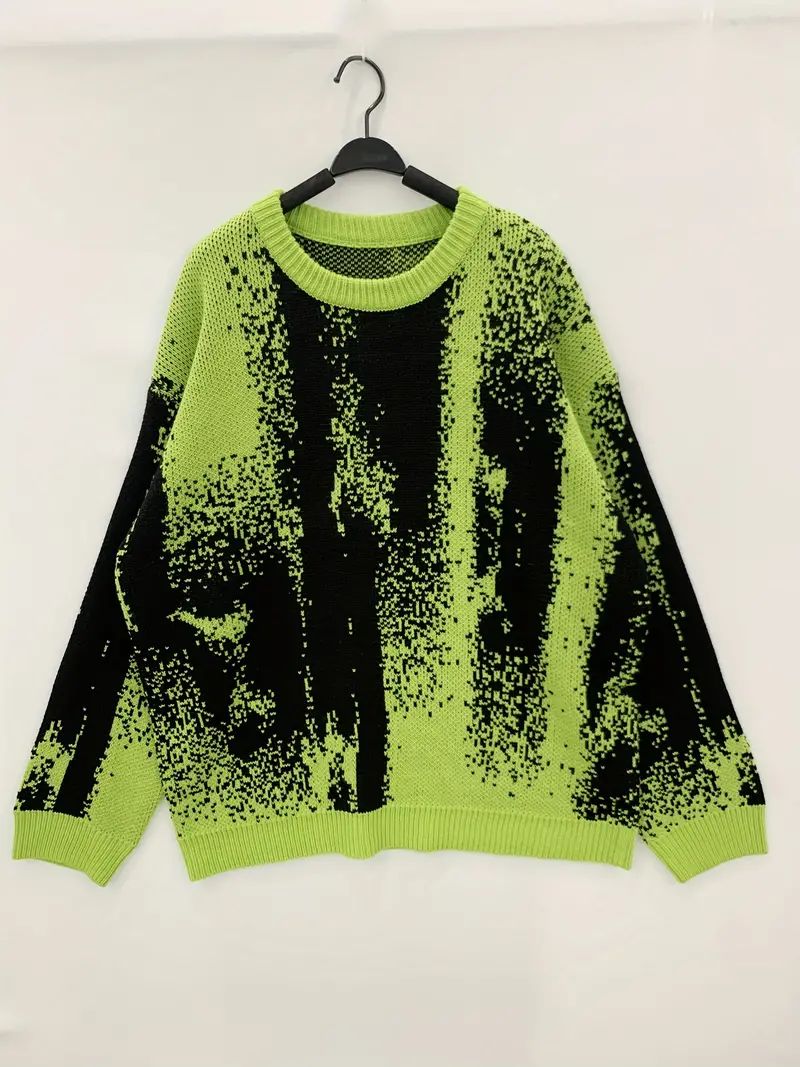
- **Fabric Physics:** The source garment is a medium-weight knit (likely acrylic or wool blend). Unlike the user's current thin cotton T-shirt, this material has significant volume and stiffness. It is matte and light-absorbent, not reflective. The texture must feature microscopic fuzz/pilling consistent with yarn, rather than a smooth surface.
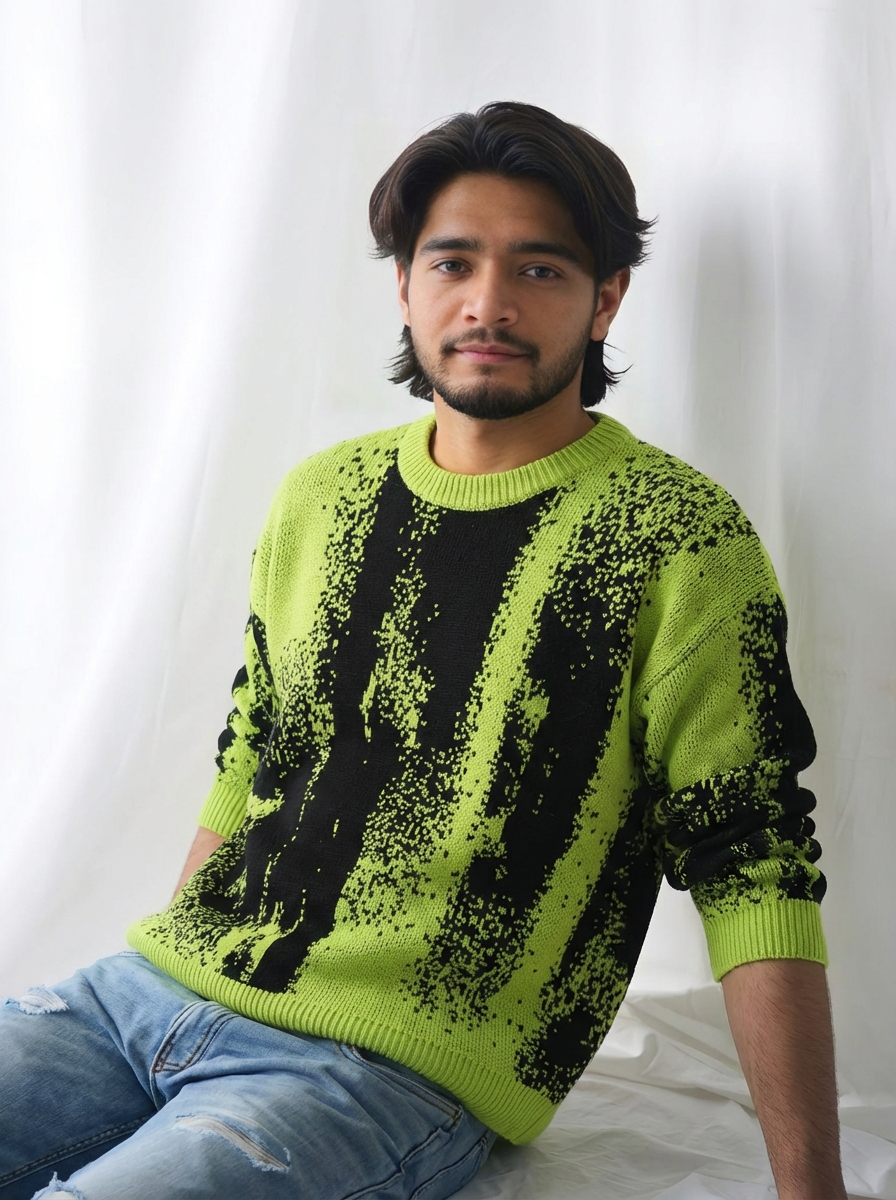
- **Key Features:** The thick ribbed crewneck collar, ribbed hem, and ribbed cuffs are structural anchors that must be rendered with 3D depth, not flat textures. The abstract "glitch" pattern (lime green vs. black) must maintain its aspect ratio and not distort excessively across the chest curvature.
PHASE 2: FIT & DRAPE SIMULATION
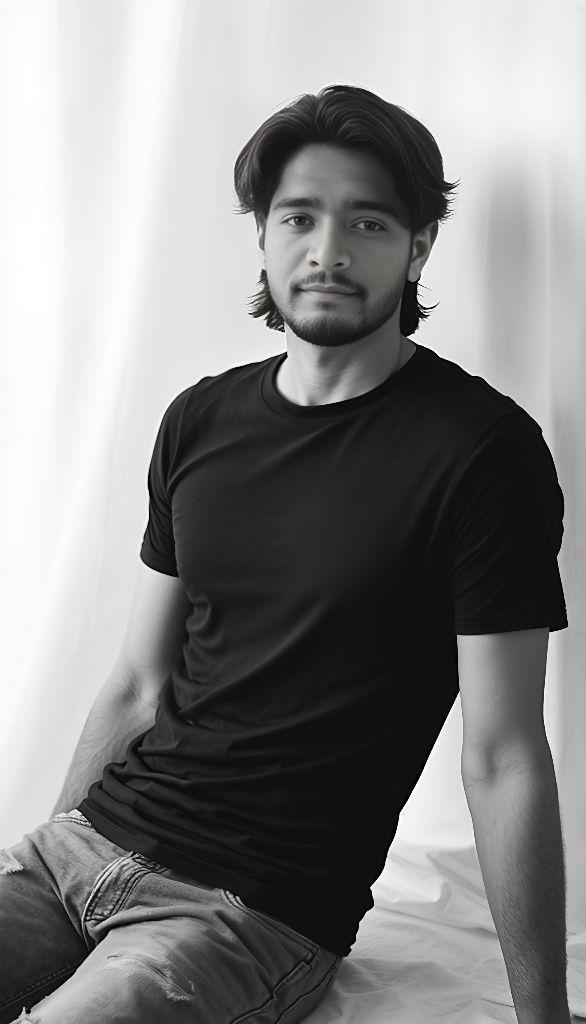
- **Body Mapping:** Due to the user's leaning-back pose, the sweater will not hang vertically. Gravity will pull the fabric toward the user's back and the surface they are leaning on. The front of the sweater should drape somewhat flatter across the chest compared to the clinging T-shirt, bridging the gap between pectorals and abdomen rather than adhering to skin. Tension folds will appear horizontally across the stomach due to the seated posture.
- **Occlusion Handling:** The user's mid-length hair touches the nape of the neck and ears. The new, thicker collar of the sweater will sit higher than the current T-shirt neckline; precise segmentation is required to layer the hair *over* the new knit collar. The shadows cast by the jawline must be re-projected onto the new garment.
PHASE 3: ENVIRONMENT & LIGHTING
- **Light Match:** The user image utilizes soft, diffused side-lighting coming from the viewer's left, creating a gradient from bright (left arm/shoulder) to deep shadow (right side of torso). The sweater's displacement map must react to this: the lime green sections on the left must be highlighted, while the right side of the garment must fall into deep shadow to match the user's high-contrast aesthetic.
- **Color Calibration:** The target image is grayscale (Black & White). To look "natural" in this specific room context, the lime green source garment should ideally be desaturated to a light-grey value to match the tonal range of the photograph. If color is forced, the saturation must be lowered significantly to avoid looking like a sticker overlay, and the black patterns in the sweater must match the "true black" point of the user's hair and current t-shirt.
PHASE 4: IDENTITY PROTECTION
- **Facial Lock:** The user's entire head, including the specific jawline shape, facial hair (beard texture), and hair volume, must remain completely frozen. The neck area above the thyroid cartilage must be preserved.
- **Body Integrity:** The simulation must respect the user's seated, relaxed width. While the sweater adds bulk (expanding the silhouette slightly due to fabric thickness), the underlying skeletal structure and the width of the arms must not be slimmed or warped. The jeans and hand placement at the bottom edge must remain untouched.