Thinking Process
PHASE 1: VISUAL DECONSTRUCTION
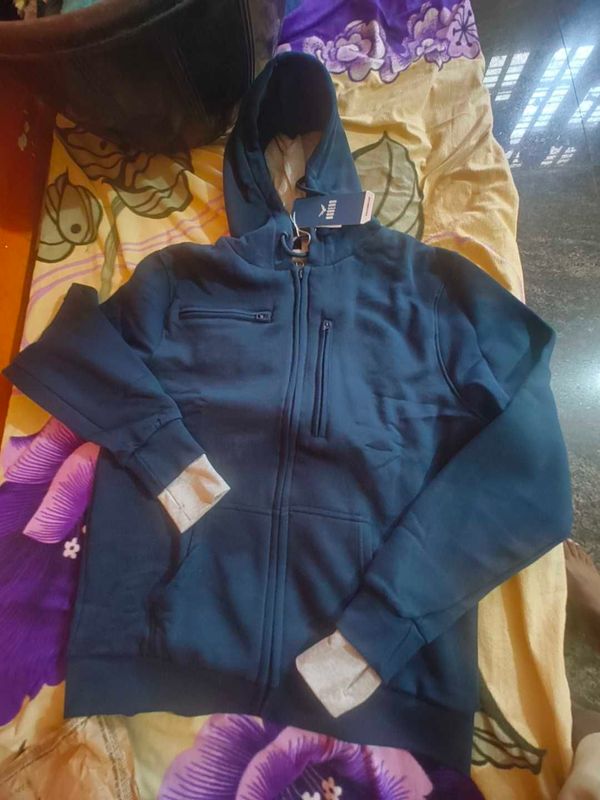
- **Fabric Physics:** The source garment is a heavy-weight cotton-poly fleece blend. Unlike the user's current thin cotton shirt, this material possesses high bending stiffness and shear resistance. It must not cling tightly to the body; instead, it requires volumetric rendering to show thickness, particularly at the folds. The surface finish is matte/diffuse with low specular highlights.
- **Key Features:** The vertical center zipper and the two horizontal zippered chest pockets must be preserved with their metallic sheen. The contrasting light-grey ribbed cuffs and hem are critical design elements that must be retained. The hood structure (visible behind the neck) must be rendered as resting naturally on the trapezius, exposing the inner contrast lining, rather than looking inflated or flat.
PHASE 2: FIT & DRAPE SIMULATION
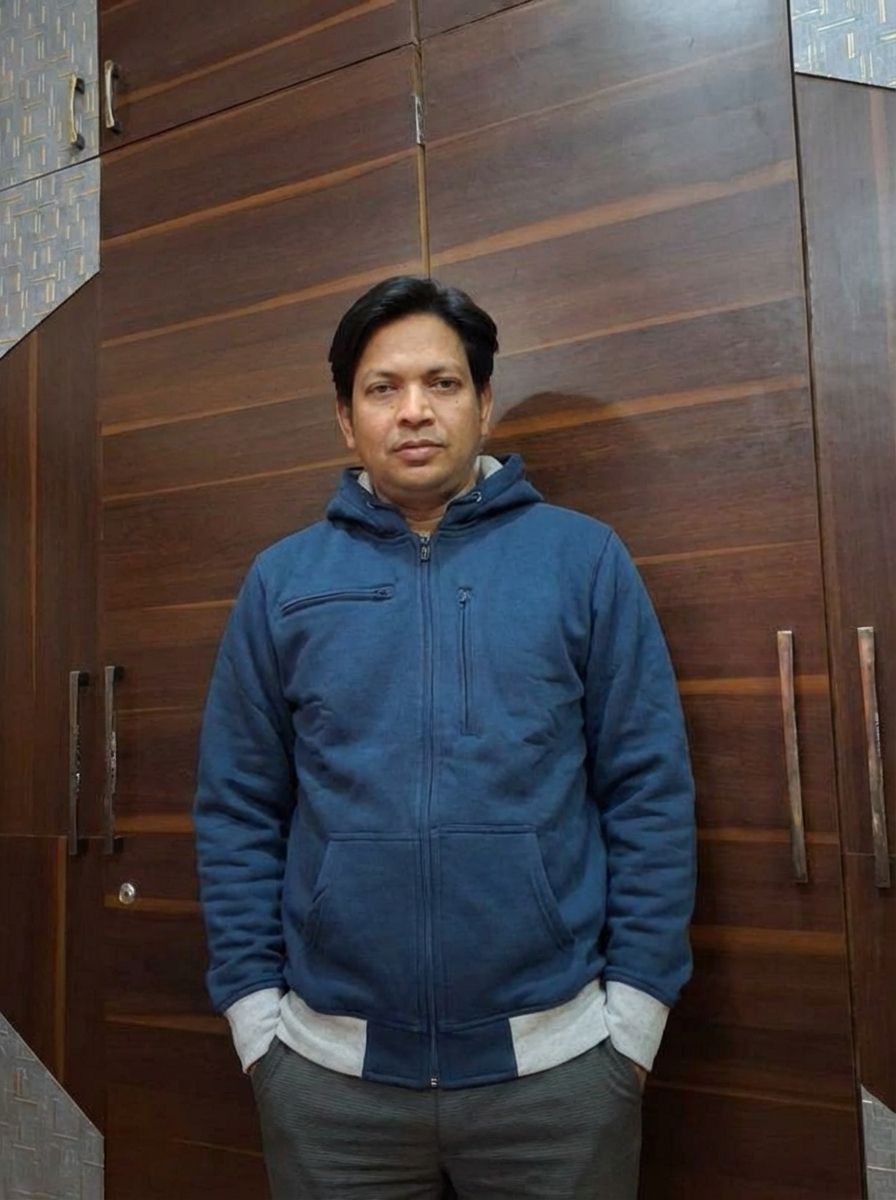
- **Body Mapping:** The hoodie is outerwear and must be simulated as "untucked," extending past the user's waistline (covering the current belt and trouser waist). Because the user's elbows are slightly bent and arms are held away from the torso, distinct tension wrinkles should form at the inner elbow. The shoulders of the hoodie drop slightly, so the seam should sit lower than the user's natural shoulder point.
- **Occlusion Handling:** The most critical physics challenge is the user's hands being placed in trouser pockets. The hoodie's hemline is long; therefore, the simulation must calculate the fabric bunching up around the wrists/forearms where the hands enter the pockets, or drape over the pocket area if the fit is loose enough. The garment must completely obscure the current light blue collar.
PHASE 3: ENVIRONMENT & LIGHTING
- **Light Match:** The user is in an environment with soft, diffuse overhead lighting (likely fluorescent), casting gentle downward shadows. The source cloth image has harsh, direct lighting (likely flash). The garment's texture must be neutralized (delit) to remove the source's harsh highlights and then re-lit to match the user's ambient indoor lighting. Shadows must gather under the hood and in the underarm areas.
- **Color Calibration:** The source garment image has a warm cast from the yellow bedspread. This color bleed must be removed to restore the true deep teal/petrol blue hue of the hoodie. The white balance must then be shifted slightly cooler to match the user's environment against the dark wood background.
PHASE 4: IDENTITY PROTECTION
- **Facial Lock:** The user's head, neck, and hair (including the hairline and ears) are strictly frozen. The simulation boundary ends at the base of the neck where the hoodie zipper meets the collarbone.
- **Body Integrity:** The user's shoulder width and torso volume must be preserved. The simulation is explicitly forbidden from slimming the user; in fact, due to the thickness of the fleece hoodie compared to the current dress shirt, the silhouette should appear slightly bulkier to maintain physical realism.