
Thinking Process
PHASE 1: VISUAL DECONSTRUCTION
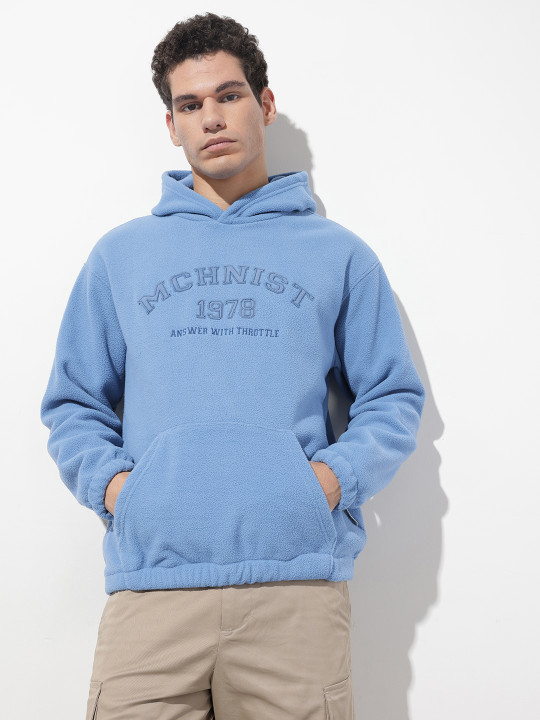
- **Fabric Physics:** The source garment is a high-pile fleece or sherpa material. It features a matte, non-reflective surface with significant surface texture and "fuzz." Unlike the user's current smooth knit sweater, this fabric has high structural rigidity and volume; it will not drape like thin cotton but will instead hold soft, rounded shapes. Light absorption is high; there should be no specular highlights.
- **Key Features:**
1. The embroidered text block ("MCHNIST," "1978," "ANSWER WITH THROTTLE") on the chest.
2. The distinct kangaroo pocket structure on the lower abdomen.
3. The gathered/elasticated hemline and cuffs.
4. The hood bulk gathered around the neck, which replaces the current crew neckline.
PHASE 2: FIT & DRAPE SIMULATION
- **Body Mapping:** Due to the user's pose (arms bent upward holding a phone), the fleece material must exhibit significant compression folds at the inner elbows. The fabric is thicker than the original garment, so the silhouette will expand slightly outward at the shoulders and arms to account for the pile thickness. The hood must settle naturally around the trapezius muscles, covering the current collar completely.
- **Occlusion Handling:**
1. **Phone:** The black smartphone is the primary occlusion layer. The garment graphics (specifically the text) must pass *behind* the phone.
2. **Hands:** Both hands (fingers, knuckles, and wrists) are positioned in the foreground. Precise segmentation is required to ensure the fleece sleeves terminate behind the wrists or bunch correctly, and the chest area of the hoodie renders strictly behind the fingers.
PHASE 3: ENVIRONMENT & LIGHTING
- **Light Match:** The user's environment is lit by an overhead fluorescent tube light (visible in the mirror reflection), creating a diffuse, cool-toned illumination. The source image has high-contrast studio lighting. The hoodie's brightness must be reduced, and contrast softened. Shadows should cast downward from the hood onto the chest and into the elbow creases, matching the soft shadow fall-off seen on the user's face.
- **Color Calibration:** The source blue is vibrant and clean. To match the user's mirror selfie, the blue must be desaturated slightly and shifted toward a cooler temperature. A noise/grain layer matching the ISO of the user's camera sensor must be applied to the garment so the texture resolution does not look artificially sharp compared to the face.
PHASE 4: IDENTITY PROTECTION
- **Facial Lock:** The user's entire head region—including the hair, forehead, glasses (and reflections within them), eyes, nose, and mouth—must be preserved pixel-for-pixel. No blending should occur above the neck line.
- **Body Integrity:** While the garment adds volume due to fabric thickness, the underlying skeletal structure (shoulder width, arm length) must remain unaltered. Do not artificially slim the waist or broaden the shoulders beyond what the fabric's natural bulk dictates.