Thinking Process
PHASE 1: VISUAL DECONSTRUCTION
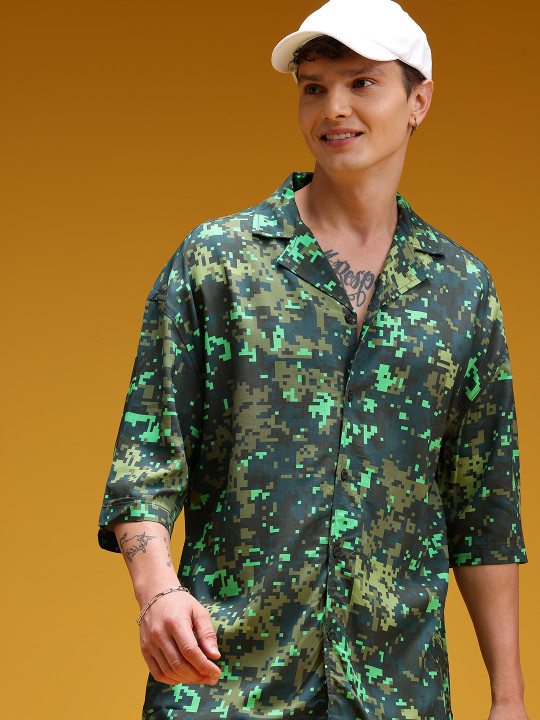
- **Fabric Physics:** The source garment appears to be a lightweight viscose or soft cotton poplin blend. It exhibits a semi-fluid drape—holding its structure at the shoulders but flowing loosely over the torso. It has a matte texture with very low specularity; it should not shine like silk or synthetic satin.
- **Key Features:**
- **Pattern:** High-frequency green/black/grey digital camouflage print.
- **Collar:** "Camp" or "Cuban" style open collar (V-neck shape) which differs significantly from the target's current crew neck.
- **Construction:** Black buttons down the center placket, dropped shoulder seams, and elbow-length sleeves (longer than the target's current t-shirt).
PHASE 2: FIT & DRAPE SIMULATION
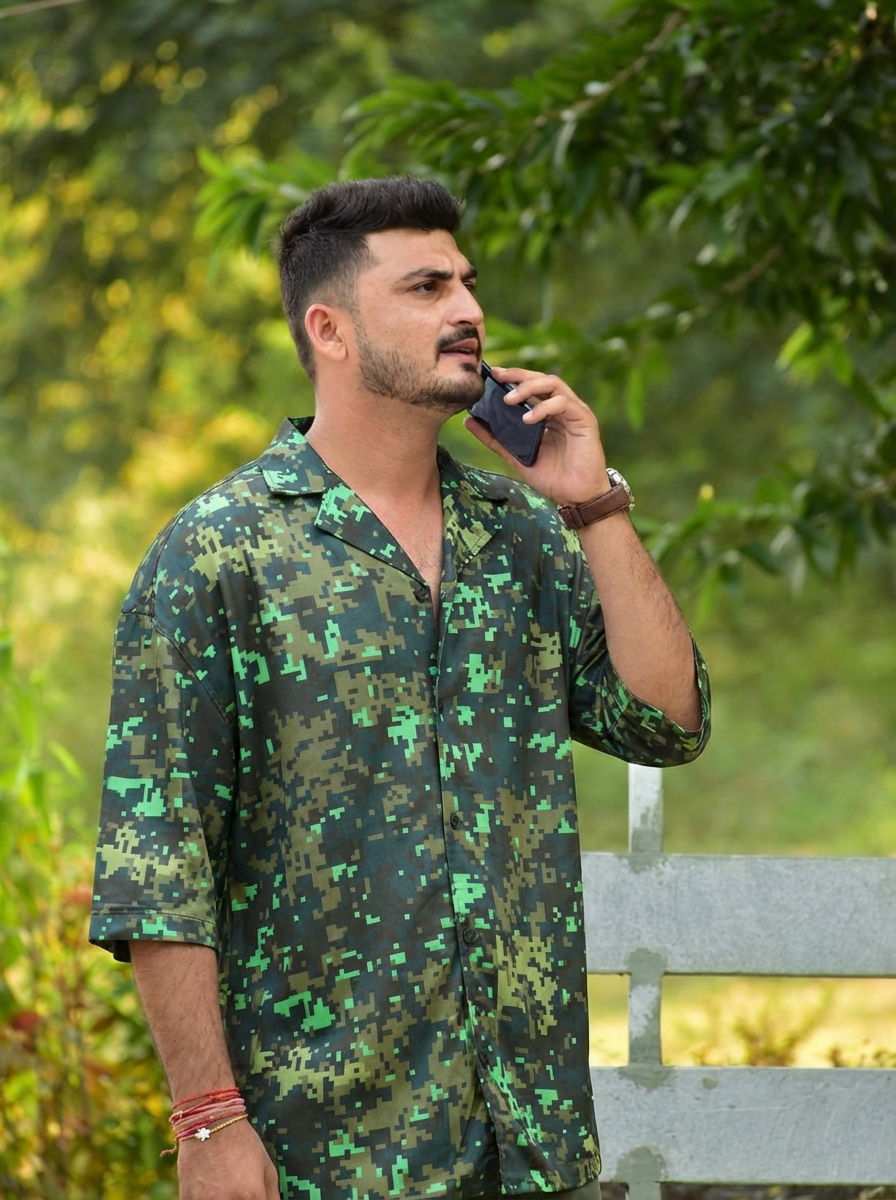
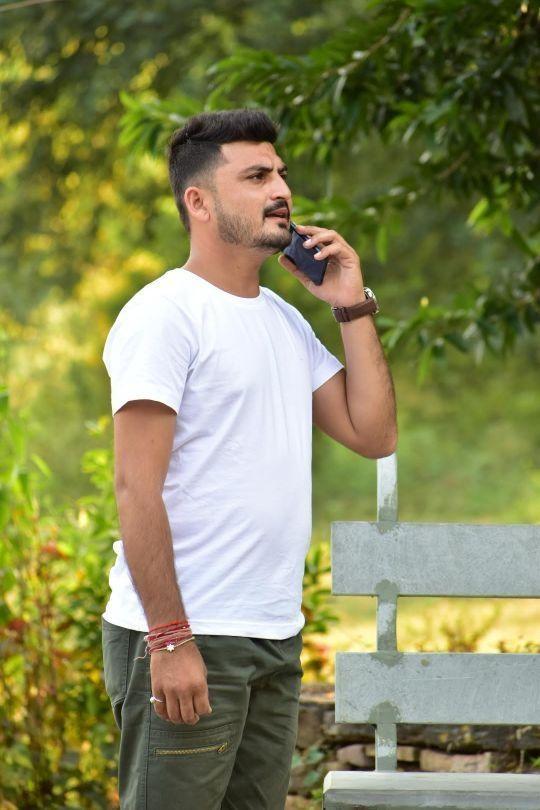
- **Body Mapping:** The source shirt is an "oversized/boxy" fit, whereas the target is currently wearing a fitted t-shirt. The simulation must expand the silhouette around the waist and chest to reflect the looser cut.
- **Right Arm (Phone Arm):** Due to the acute angle of the elbow, the fabric must bunch significantly at the antecubital fossa (inner elbow) and slide down toward the shoulder, exposing the forearm/watch.
- **Shoulders:** The dropped shoulder line of the source garment needs to fall lower on the target's deltoids than the current t-shirt seam.
- **Occlusion Handling:**
- **Primary Occlusion:** The user's Right Hand and the Smartphone are critical layers. They must be masked and rendered *over* the new collar/shoulder area.
- **Accessories:** The wristwatch on the right arm and the red bracelets on the left wrist must be preserved.
- **Beard:** The bottom edge of the user's beard may overlap the new, higher-standing collar structure; depth segmentation is required here.
PHASE 3: ENVIRONMENT & LIGHTING
- **Light Match:** The target environment is outdoor natural daylight with dappled lighting from foliage (bokeh background). The light source is diffuse, coming from above/left. The "studio lighting" from the source image must be removed. Shadows must be generated under the right arm and along the right side of the torso (user's right) to match the ambient occlusion of the original image.
- **Color Calibration:** The source image has a warm/yellow studio cast. This must be color-corrected to match the cooler, natural daylight of the target scene. The greens in the digital camo must be balanced so they don't blend invisibly into the green foliage background; contrast adjustment is necessary to separate subject from background.
PHASE 4: IDENTITY PROTECTION
- **Facial Lock:** The user's entire head, including hair, ears, beard, and neck profile, is frozen. **Crucial:** Since the new shirt has a deeper open neckline than the current white t-shirt, skin inpainting is required to generate the upper chest/throat area currently covered by the white fabric.
- **Body Integrity:** The user's underlying physical build (arm thickness, chest width) remains constant. Do not slim the user or artificially puff the chest. The change in volume should come strictly from the garment's oversized cut, not a modification of the body mesh.