Thinking Process
PHASE 1: VISUAL DECONSTRUCTION
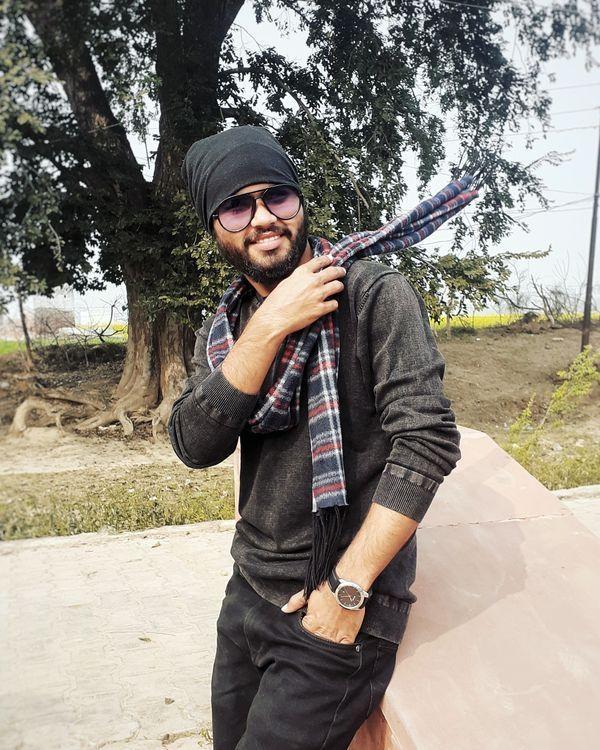
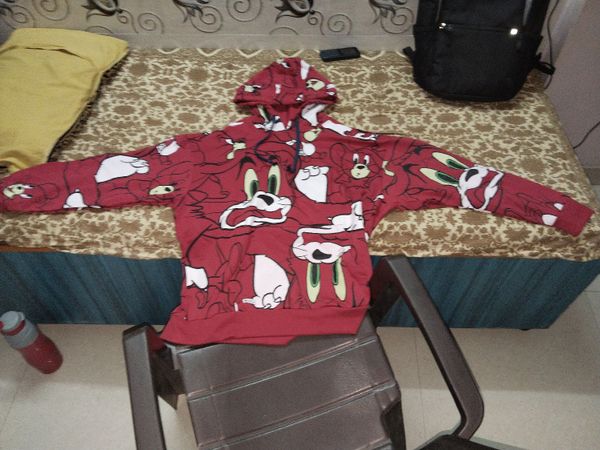
- **Fabric Physics:** The source garment is a cotton-polyester blend fleece hoodie (jersey knit). It possesses medium weight and low specular reflection (matte finish). The simulation must treat the material as semi-stiff; it will not drape like silk but rather form soft, tubular folds. It has significant volume/thickness compared to the user's current thin knit sweater.
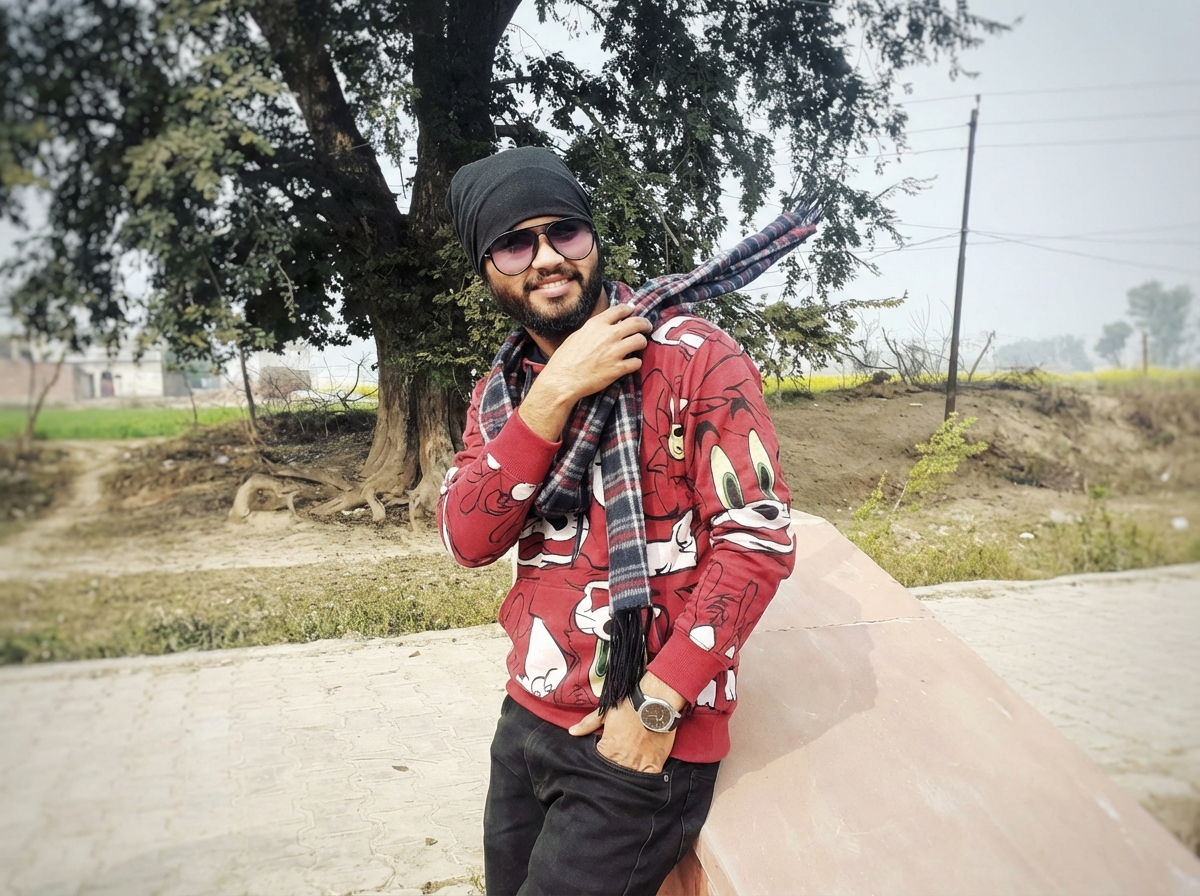
- **Key Features:** The all-over cartoon graphic print (red background with characters) must warp realistically around the volumetric curvature of the torso and arms. The attached hood, navy blue drawstrings, and the ribbed elastic cuffs and bottom hem are structural elements that must be rendered 3D, not flat.
PHASE 2: FIT & DRAPE SIMULATION
- **Body Mapping:**
- **Right Arm (Bent):** The fabric must compress and crease heavily at the inner elbow (antecubital fossa) and stretch tight across the outer elbow. The sleeve cuff should pull back slightly from the wrist due to the lift.
- **Torso:** The hoodie is a loose fit. It should hang somewhat straight from the chest down, overriding the user's waist indentation.
- **Neck/Hood Area:** The source garment has a hood. This bulk must be simulated piling up around the back of the neck and shoulders, sitting *behind* the user's neck.
- **Occlusion Handling:**
- **Primary Occlusion:** The user's right hand is raised near the neck. This hand MUST be segmented and layered *over* the new garment.
- **Complex Occlusion (Scarf):** The plaid scarf is intertwined with the user's hand and wrapped around the neck. To maintain physical reality, the new hoodie must be generated *underneath* the scarf layer. Alternatively, if the scarf is removed, the area behind the scarf and hand requires deep generative in-painting to reconstruct the neck, though preserving the scarf as a foreground object is the physically accurate approach.
PHASE 3: ENVIRONMENT & LIGHTING
- **Light Match:** The User Image features outdoor daylight with diffuse skylight and soft directional shadows (likely overcast or shaded area). The Cloth Image has harsh, warm indoor artificial lighting. The new garment must be relit to eliminate the yellow indoor cast, adopting a cooler, natural daylight temperature (approx. 5500K-6500K).
- **Color Calibration:** The saturation of the red hoodie needs to be slightly toned down to match the slightly desaturated/matte color grading of the target environment. Shadows on the garment should fall downwards and slightly to the right, matching the shadows on the user's face and jeans.
PHASE 4: IDENTITY PROTECTION
- **Facial Lock:** The user's beard, nose, mouth, and specifically the sunglasses and beanie (which defines the upper head shape) must remain pixel-perfect and untouched.
- **Body Integrity:** The user has a standard build. The new hoodie adds bulk. Do not slim the user; the silhouette must expand outward slightly to account for the thickness of the fleece material. The legs/jeans and the watch on the left wrist must remain unaltered.