Thinking Process
PHASE 1: VISUAL DECONSTRUCTION
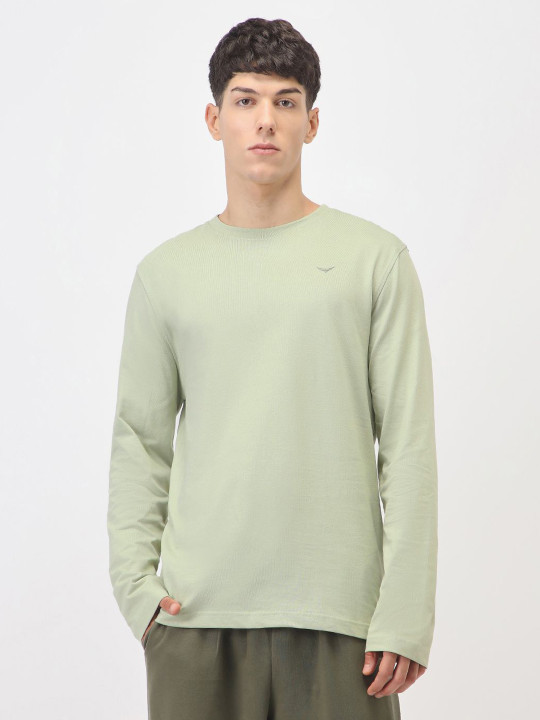
- **Fabric Physics:** The source garment is a light-to-mid-weight cotton jersey or fine knit. It possesses a matte finish with high light absorption and very low specularity. The simulation must treat this as a semi-structured soft body—it should not cling like spandex but drape with moderate weight, showing soft, rolling folds rather than sharp creases.
- **Key Features:** The small, winged logo on the upper left chest is critical; note that in the target's profile view, this logo may be obscured or heavily distorted by perspective. The ribbed crew neck collar, the visible stitching on the bottom hem, and the relaxed, elongated sleeve length (extending past the wrist bone) are essential structural elements to preserve.
PHASE 2: FIT & DRAPE SIMULATION
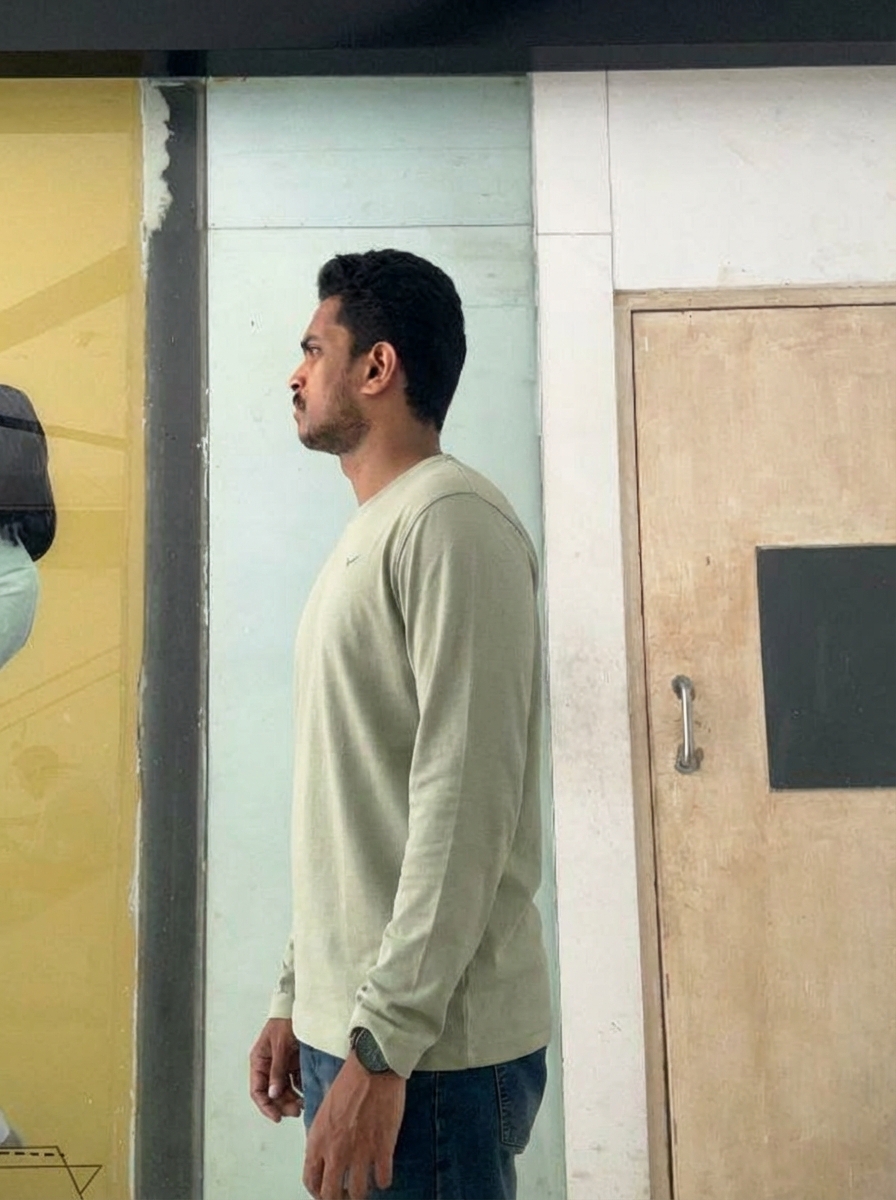
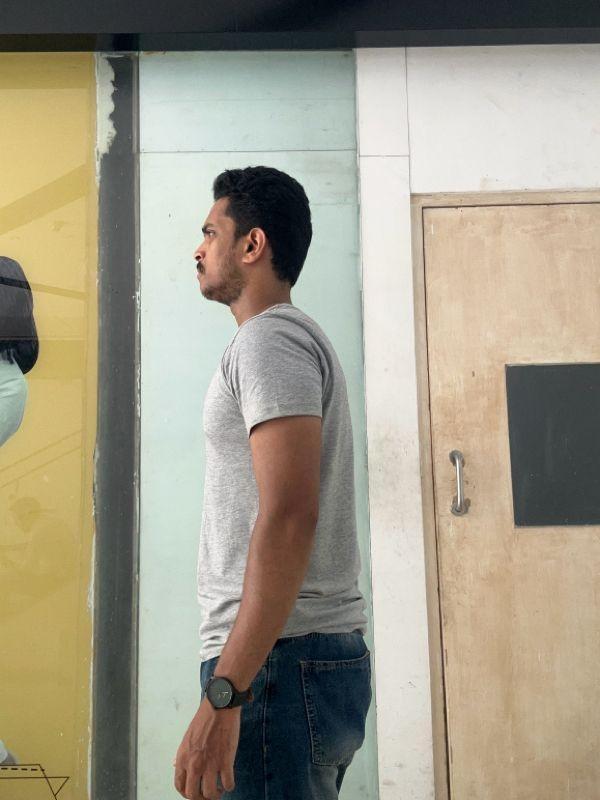
- **Body Mapping:** The most complex aspect is the geometric transformation from a Frontal Source to a Profile Target. The simulation must generate the side seam and profile silhouette of the garment. Unlike the user's current tight grey t-shirt, the source garment is a "relaxed fit." Therefore, the generated image must add volume away from the user's lower back and chest, creating a gap between the skin and the fabric to mimic the looser cut. The long sleeves must generate realistic compression folds at the inner elbow (antecubital fossa) where the user's arm is slightly bent.
- **Occlusion Handling:** The user's right arm (foreground) completely occludes the side of the torso. The new garment must render the sleeve on the arm as the top layer, with the torso portion of the shirt rendered visibly "behind" the arm. The watch on the right wrist presents a collision object; given the source garment's long sleeves, the fabric should logically drape *over* the watch, creating a slight bulge, or be simulated as slightly pulled back, revealing the watch face depending on final sleeve length calculation.
PHASE 3: ENVIRONMENT & LIGHTING
- **Light Match:** The target environment utilizes soft, natural daylight coming from the left (the user's front). Consequently, the new sage green garment must feature a luminance gradient: brighter highlights on the chest and front of the sleeve, fading into deeper shadows towards the back and under the armpit. The shadows must be soft and diffuse, not harsh.
- **Color Calibration:** The source image is studio-lit (neutral/cool white). The target image has a slight outdoor/urban cast. The sage green of the garment must be slightly desaturated and warmed very subtly to integrate with the ambient light reflected from the beige door and cream wall in the background.
PHASE 4: IDENTITY PROTECTION
- **Facial Lock:** A rigid pixel mask must be applied to the user's entire head (hair, forehead, nose, beard, ear, and neck above the collar line). The profile contour of the face must remain untouched.
- **Body Integrity:** The user's athletic build and posture (upright with a slight forward lean) must be preserved. While the garment is looser, the underlying skeletal structure (shoulder width and arm thickness) must not be warped or slimmed. The lower body (jeans) must be masked out to prevent texture bleeding from the new shirt.