Thinking Process
PHASE 1: VISUAL DECONSTRUCTION
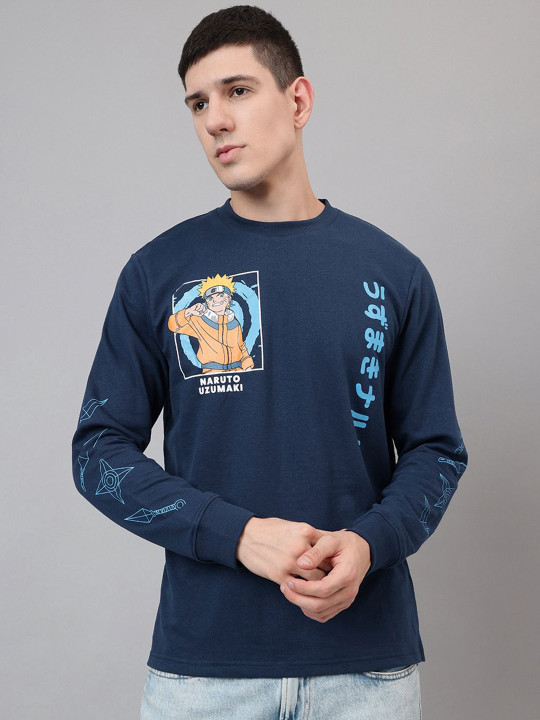
- **Fabric Physics:** The source garment is a heavyweight cotton-blend jersey (sweatshirt material). It has a higher structural rigidity than the user's current thin t-shirt. It possesses a matte finish with low specular reflection. The simulation must account for a thicker weave that resists small micro-wrinkles, instead forming larger, softer folds at stress points (armpits, elbows).
- **Key Features:**
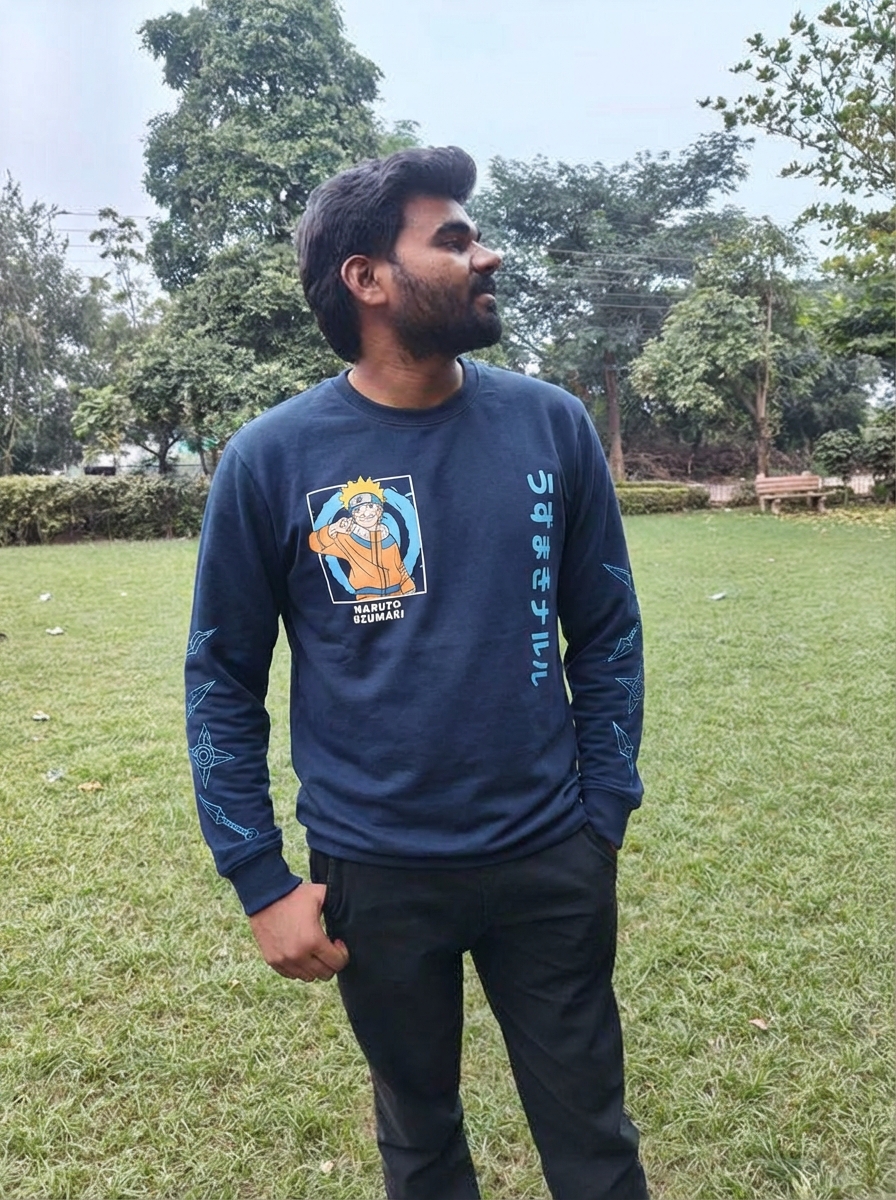
1. **Central Graphic:** The "Naruto Uzumaki" chest print with orange accents must remain centered on the sternum, distorting only with the volumetric curve of the chest.
2. **Lateral Typography:** The vertical Japanese text on the wearer's left side must be preserved and aligned vertically along the ribcage.
3. **Sleeve Detail:** The line-art graphics (kunai/shuriken) on the sleeves are critical; these must be mapped onto the generated long sleeves which do not exist in the target image.
4. **Structural Trims:** The ribbed crew neck collar and ribbed cuffs must appear thicker and tighter than the main body fabric.
PHASE 2: FIT & DRAPE SIMULATION
- **Body Mapping:**
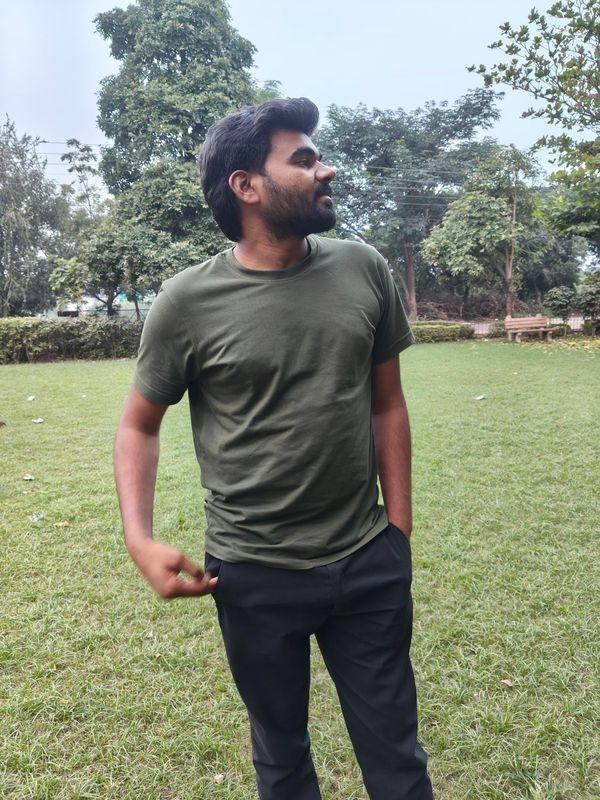
- **Sleeve Generation:** Since the target is wearing a short-sleeve tee, the simulation must structurally extrapolate long sleeves down to the wrists. The fabric should exhibit slight bunching (stacking) at the elbows due to the semi-relaxed arm position.
- **Torso Volume:** The sweatshirt is a "relaxed fit." It should not cling to the user's pectorals or abdomen as tightly as the current olive t-shirt. It must hang somewhat vertically from the chest apex, creating a slight air gap between the fabric and the lower torso.
- **Hemline Interaction:** The sweatshirt is longer than the current t-shirt. The hem will likely hit lower on the hips, potentially interacting with the trouser pockets.
- **Occlusion Handling:**
- **Hands:** The user's left hand is in the pocket; the sweatshirt hem must drape *around* or *behind* the wrist, or bunch slightly on top of the forearm if the sleeve is pulled down. The right hand is near the waist; the sleeve cuff must terminate naturally at the wrist bone, layered *under* the hand if the thumb is hooked in the pocket.
- **Beard/Jaw:** The beard hair extends over the neck area. The new higher crew neck collar must sit *underneath* the beard shadow and hair.
PHASE 3: ENVIRONMENT & LIGHTING
- **Light Match:** The target environment is an outdoor park with diffuse, overcast sky lighting (soft, ambient occlusion, no harsh directional shadows). The source garment's studio lighting is too flat. We must introduce soft shadowing on the underside of the sleeves and the lower abdomen to match the user's current self-shadowing pattern.
- **Color Calibration:** The source Navy Blue is quite saturated. To match the outdoor environment, the black levels of the sweatshirt must be lifted slightly to account for atmospheric scattering. The bright orange and cyan in the graphics must be desaturated slightly to avoid looking like a superimposed sticker.
PHASE 4: IDENTITY PROTECTION
- **Facial Lock:** The user's entire head, including the specific hairstyle, beard grooming, and ear profile, must be masked and frozen. The skin tone on the visible hands and neck must remain unaltered.
- **Body Integrity:** Strictly forbidden to slim the user's midsection or alter shoulder width to match the model. The simulation must wrap the new garment around the user's *existing* volumetric data, preserving his natural stance and body mass index.