Thinking Process
PHASE 1: VISUAL DECONSTRUCTION
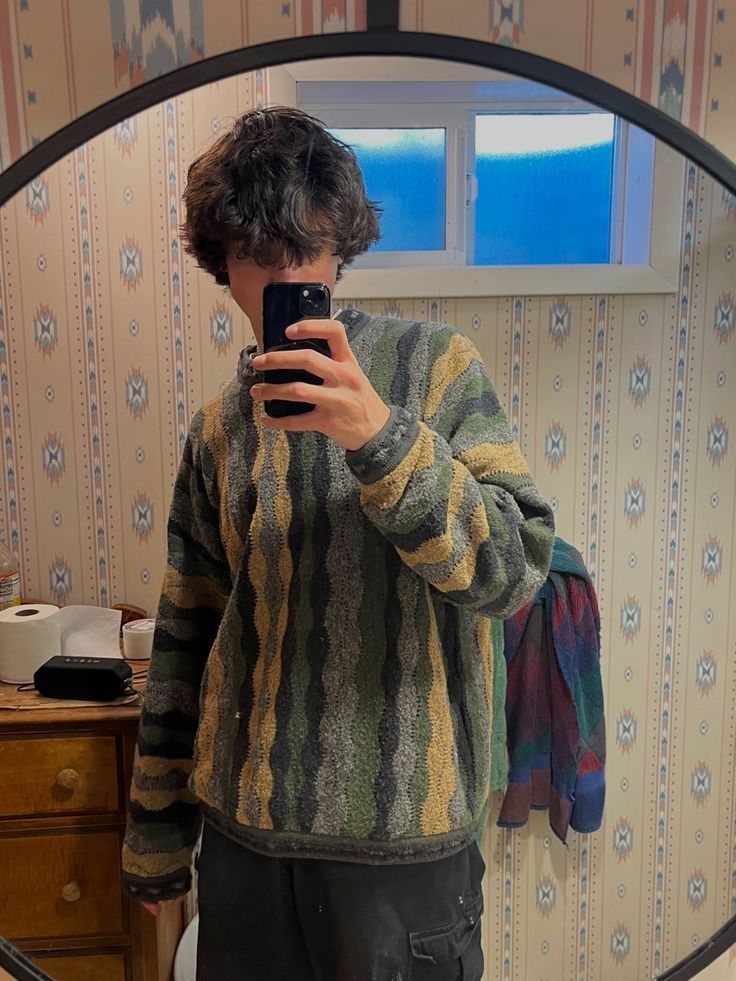
- **Fabric Physics:** The source garment is a heavy-gauge knit sweater (likely wool or acrylic blend) with a distinct textured weave. Unlike the user's current crisp cotton shirt, this material has high friction and low stiffness. It absorbs light rather than reflecting it, creating soft shadows within the knit ridges. It must exhibit "fuzziness" at the silhouette edges rather than a sharp vector line to simulate the wool texture.
- **Key Features:** The vertical wavy stripe pattern (olive, charcoal, mustard, and beige) is critical and must remain aligned vertically. The thick ribbed crewneck collar, ribbed hemline, and ribbed cuffs are structural anchors that must be preserved. The "drop shoulder" seam design from the source must be adapted to the target's broader shoulder width.
PHASE 2: FIT & DRAPE SIMULATION
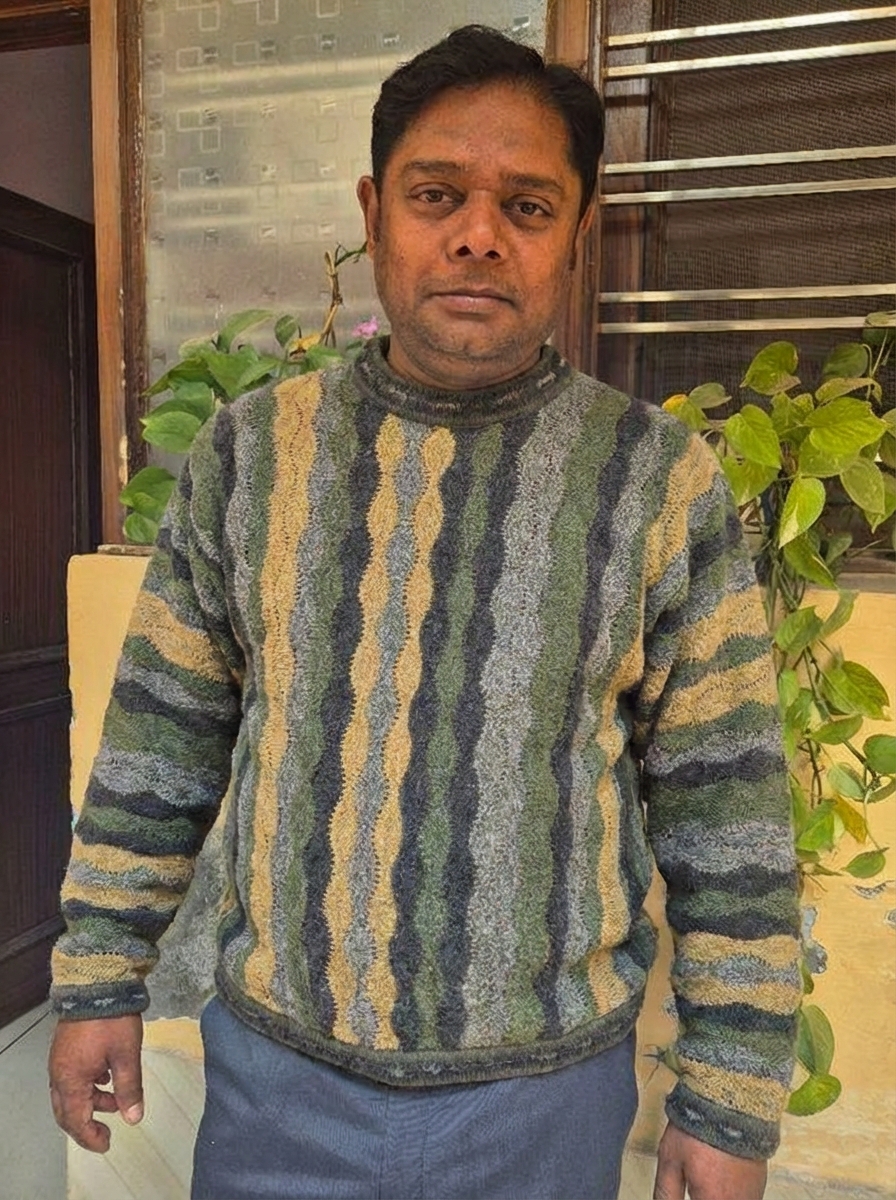
- **Body Mapping:** The target user currently wears a tucked-in shirt; the new sweater must be generated as **untucked**. The drape should be relaxed, falling straight from the chest and bridging over the midsection rather than contouring tightly to the stomach. Gravity will cause the heavy knit to stack slightly above the wrists and hips. The shoulder line should be softer and more rounded than the current tailored shirt seams.
- **Occlusion Handling:** The user's hands are fully visible at the sides. The new sweater sleeves must terminate at the wrist bone, ensuring the hands remain layered *over* the fabric. The user's neck above the collarbone must be masked out to overlay the new crewneck collar, ensuring the old shirt collar is completely obscured.
PHASE 3: ENVIRONMENT & LIGHTING
- **Light Match:** The target environment utilizes diffuse natural daylight (cool to neutral tone) coming from the upper-left, casting soft shadows to the user's right. The source garment was photographed in warm, artificial indoor light. The sweater's texture maps must be re-lit to match the target's ambient occlusion, ensuring shadows falls downward and to the right side of the folds.
- **Color Calibration:** A white-balance correction is required on the sweater to remove the yellow/orange cast from the source image's indoor bulb. The olive and grey tones must be cooled down to harmonize with the blue trousers and yellow wall of the target image.
PHASE 4: IDENTITY PROTECTION
- **Facial Lock:** The user's entire head (hair, forehead, eyes, nose, mouth, chin, and neck skin up to the suprasternal notch) must be rigidly frozen.
- **Body Integrity:** The simulation is strictly forbidden from altering the user's BMI or bone structure. The sweater must be scaled up to fit the user's broader chest and waist dimensions, rather than shrinking the user to fit the narrower source garment. The volume of the user's torso must remain constant.