Thinking Process
PHASE 1: VISUAL DECONSTRUCTION
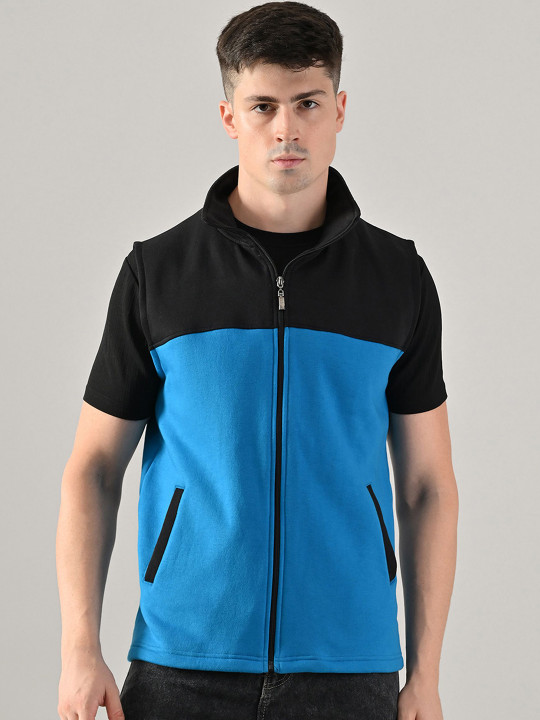
- **Fabric Physics:** The source garment is a composite: a sleeveless fleece or soft-shell synthetic vest (gilet) layered over a black cotton jersey t-shirt. The blue/black vest sections have a matte finish with a slight thickness and stiffness, meaning they will not drape like thin liquid but will hold a semi-rigid structure. The black sleeves are softer cotton and should deform more easily with arm muscle contours.
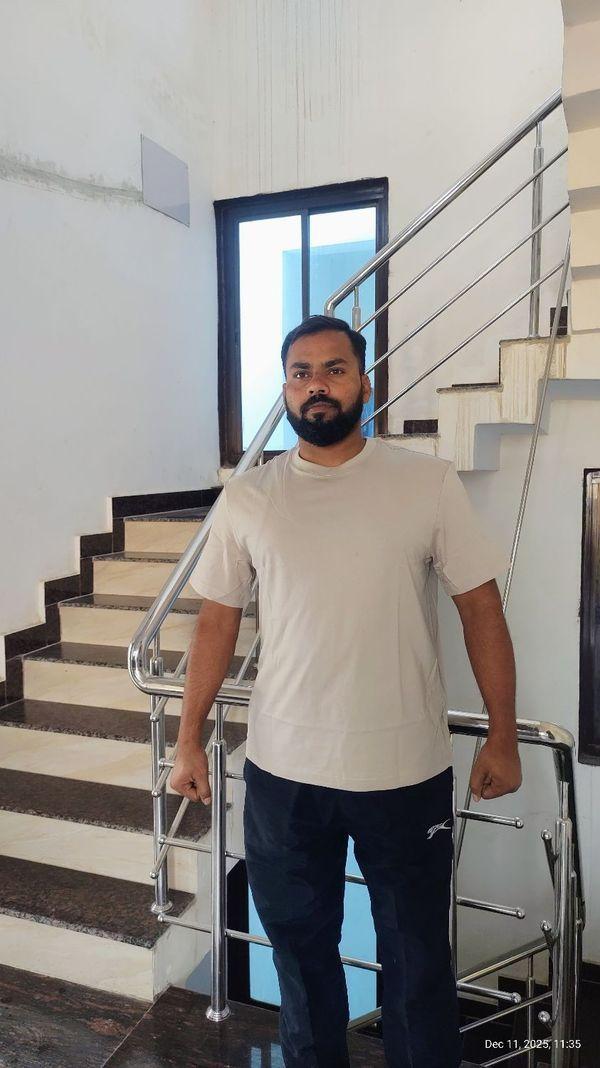
- **Key Features:** The high funnel-neck collar must replace the user's current low crew neckline. The central silver zipper and the metallic pull tab are high-contrast anchor points. The horizontal seam separating the black yoke from the blue body, and the diagonal welt pockets on the blue section, must be preserved with sharp texture fidelity.
PHASE 2: FIT & DRAPE SIMULATION
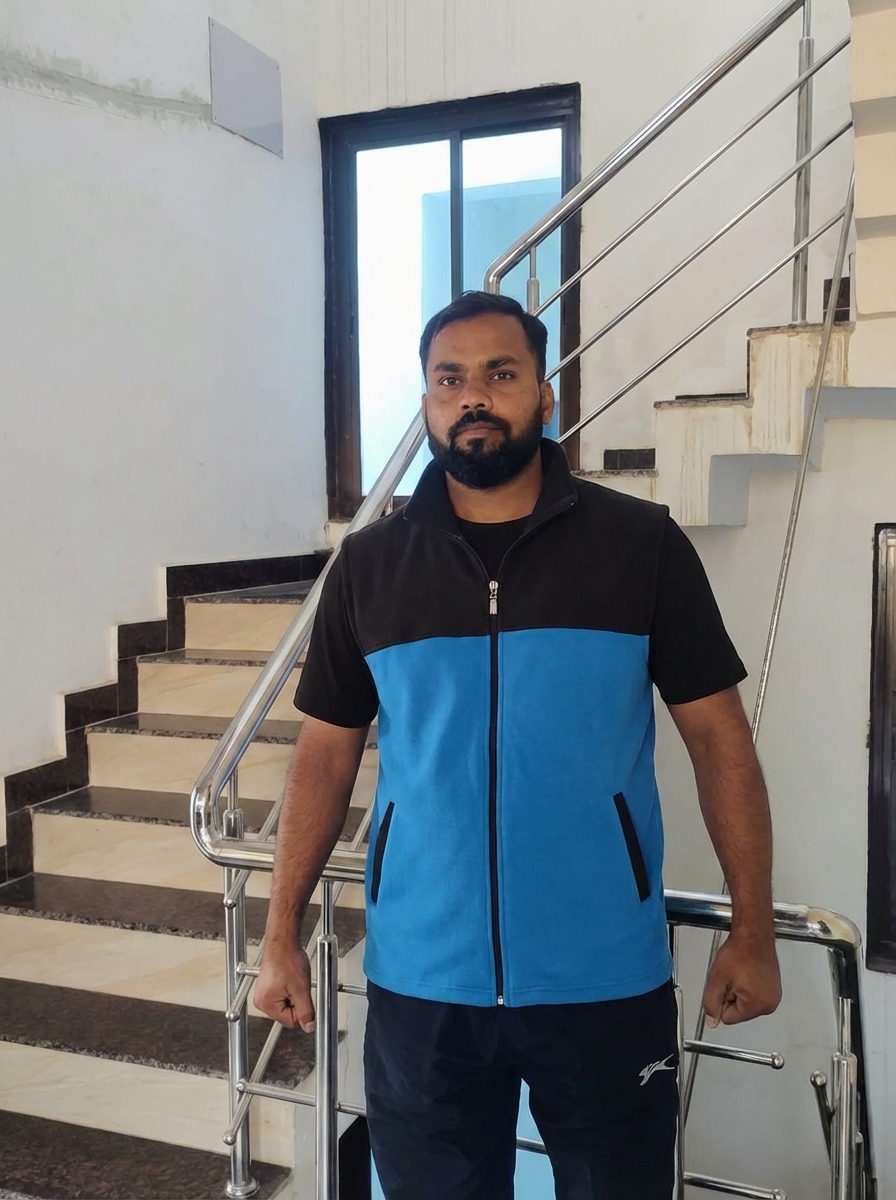
- **Body Mapping:** The user has a broader chest and shoulder width than the source model. The vest must be volumetrically expanded to fit the user's torso without stretching the texture (preserving the aspect ratio of the pockets). The collar needs to stand upright around the user's neck, maintaining the "unzipped top" V-shape, sitting higher than the current t-shirt line. The armholes of the vest must align with the user's axilla, transitioning into the black short sleeves which must wrap around the user's biceps.
- **Occlusion Handling:** The user's right hand (viewer's left) is in close proximity to the stainless steel railing; segmentation masks must separate the arm from the railing to prevent the new black sleeve from bleeding onto the metal. The user has no long hair or jewelry obstructing the chest, allowing for a clean varied-depth mapping on the torso.
PHASE 3: ENVIRONMENT & LIGHTING
- **Light Match:** The user is in a high-contrast environment with a strong backlight (window) and a frontal fill light source. The studio-lit source garment is too evenly lit. We must introduce a light fall-off from top-left to bottom-right. The "black" of the vest and sleeves must be lifted to a dark charcoal/grey value to match the black levels of the user's track pants, preventing a "black hole" effect where detail is lost.
- **Color Calibration:** The bright cyan/blue of the source vest is too saturated for the stairwell environment. It requires desaturation and a slight cool-temperature shift to match the ambient light reflecting off the white walls and tiles. A subtle rim light should be added to the shoulders to match the backlighting from the window.
PHASE 4: IDENTITY PROTECTION
- **Facial Lock:** Absolute freeze required on the user's head above the mid-neck, specifically preserving the beard line, jaw shape, and skin tone.
- **Body Integrity:** The user has a stocky, muscular build. The simulation is strictly forbidden from slimming the waist or narrowing the shoulders to match the slimmer source model. The target user's arm volume (biceps/forearms) and hand position must remain exactly as is; only the skin texture of the upper arm is replaced by the black cloth, while the forearms remain skin.