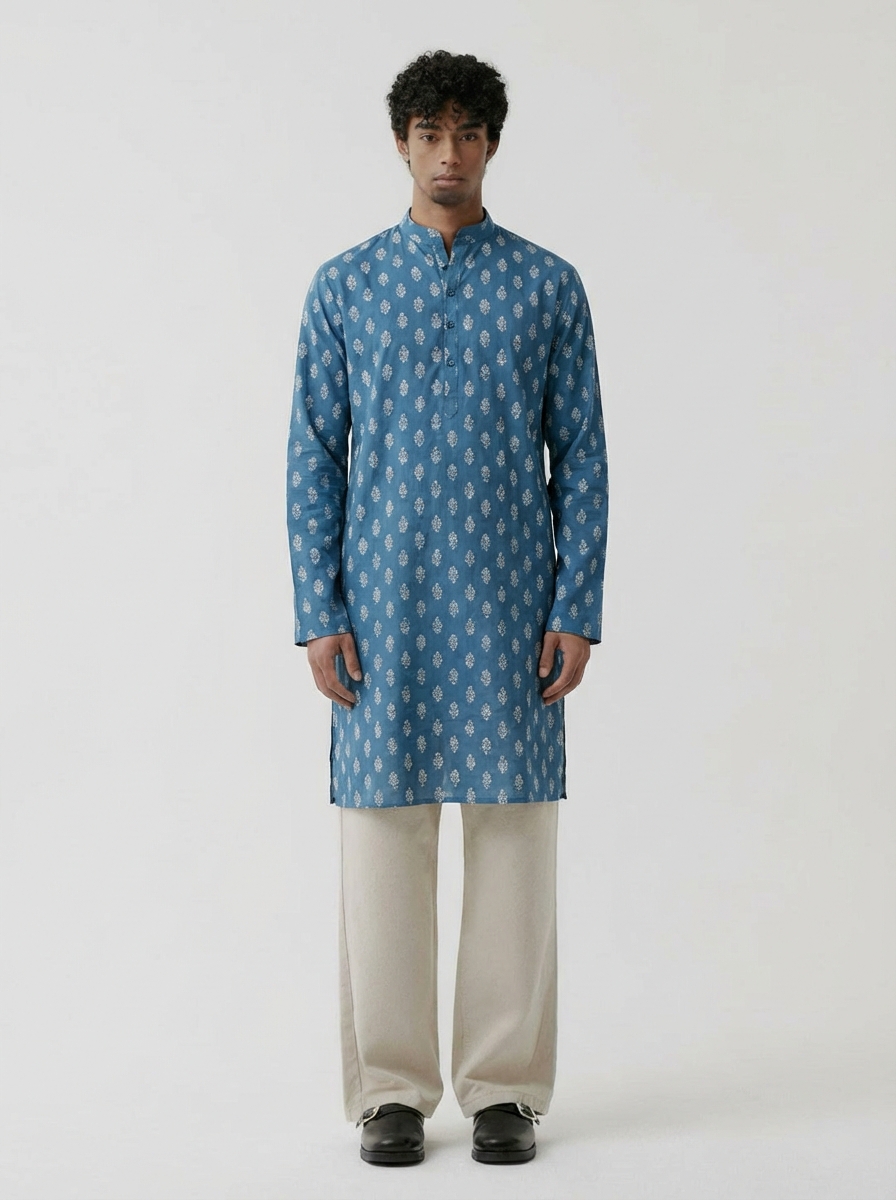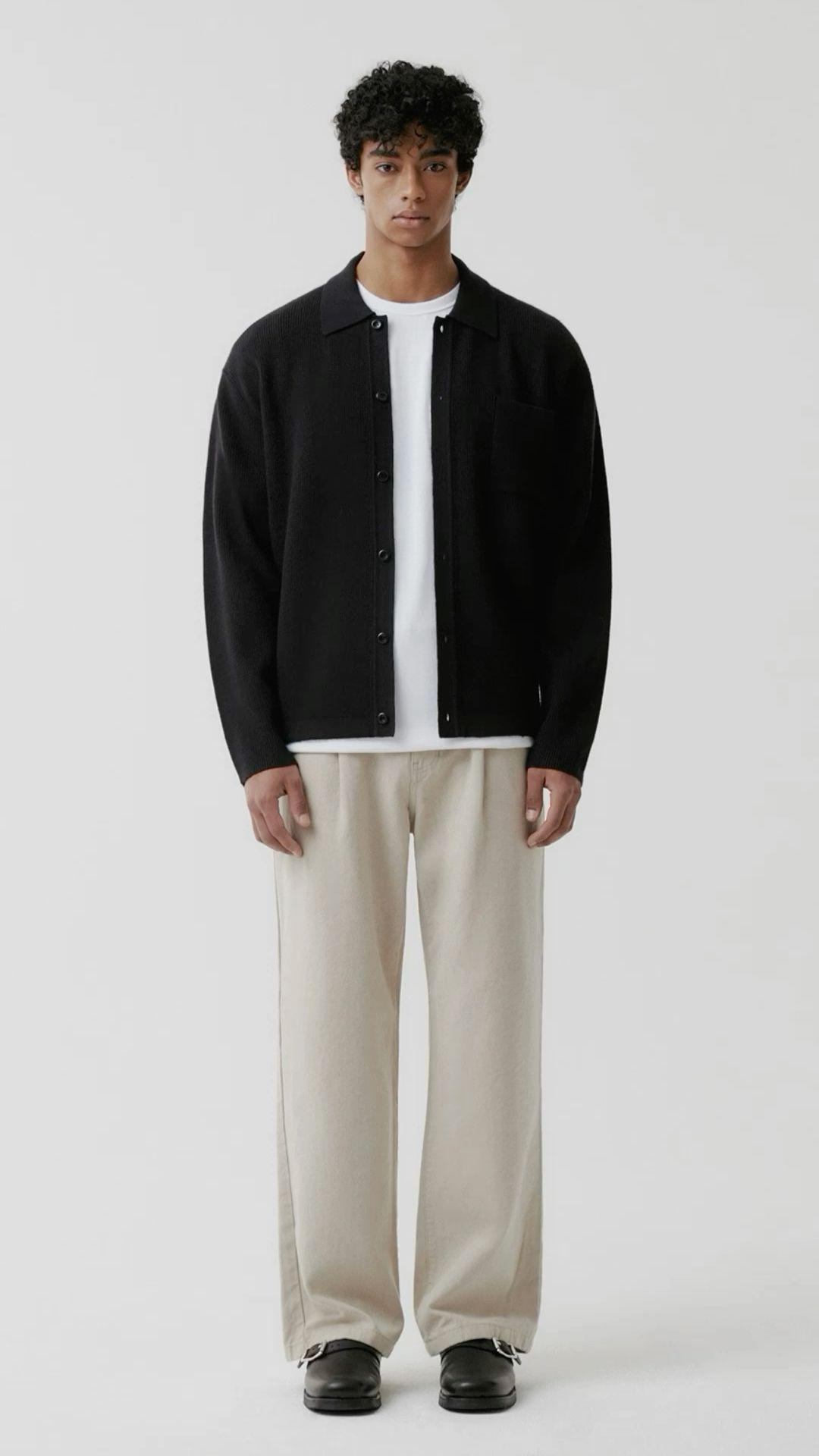
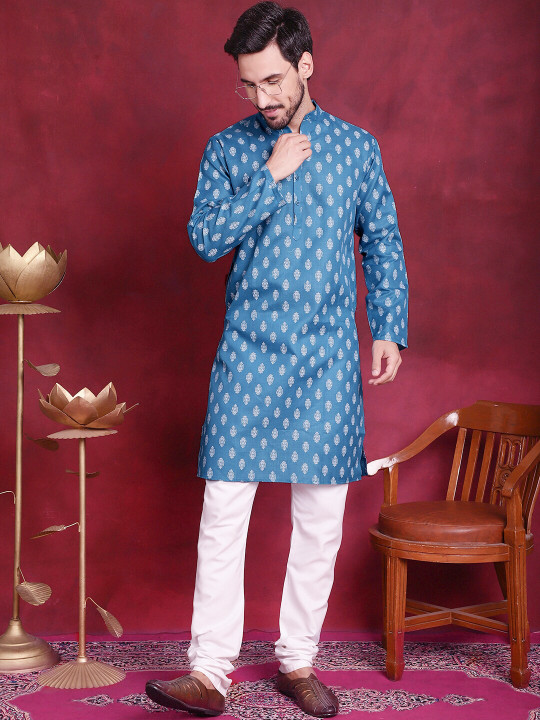
Thinking Process
PHASE 1: VISUAL DECONSTRUCTION
- **Fabric Physics:** The source garment is a woven cotton or cotton-silk blend Kurta. Unlike the target's current knit cardigan, this fabric has low elasticity and medium weight. It should simulate a semi-structured drape that holds creases vertically rather than clinging to musculature. The surface has a matte finish with a very subtle sheen on the printed areas; it should scatter light diffusely rather than specularly.
- **Key Features:** The Mandarin/band collar is a critical structural element that must replace the current lapel collar. The repeated white floral/paisley block print pattern must remain geometrically consistent and not distort on the z-axis. The button placket (center chest), the long sleeves with straight cuffs, and crucially, the extended hemline (which falls to mid-thigh/knee level) must be generated, as the current target garment is waist-length.
PHASE 2: FIT & DRAPE SIMULATION
- **Body Mapping:** The Kurta is a loose-fitting garment. It should hang vertically from the target's broad shoulders, skimming over the chest and falling straight past the waist. Because the target is standing in a neutral pose, the fabric should exhibit minimal tension wrinkles. The "skirt" of the Kurta needs to extend over the hips and upper thighs of the target's beige trousers, creating a tiered silhouette that does not exist in the current image. The sleeves should drape cylindrically, stopping exactly at the wrist bone.
- **Occlusion Handling:** The target's curly hair at the nape of the neck must be segmented and layered *over* the new Mandarin collar. The user's hands are visible; the sleeve cuffs must slide *under* the hands/wrists, ensuring the fingers remain entirely visible. The target's current bulky black cardigan adds artificial volume; the simulation must estimate the skin surface beneath to ensure the Kurta doesn't look artificially puffed out.
PHASE 3: ENVIRONMENT & LIGHTING
- **Light Match:** The target environment uses soft, high-key studio lighting with a neutral/cool temperature (approx 5500K), creating soft shadows directly beneath the subject. The source garment currently has warm, directional lighting (reflections from the red background). This red color cast must be neutralized. The generated Kurta must accept the soft top-down ambient light of the target scene, casting a drop shadow onto the beige trousers where the hem overlaps.
- **Color Calibration:** The source teal/blue is saturated. It needs to be slightly desaturated and harmonized to fit the sterile, desaturated palette of the target image. The white print on the Kurta must appear true white/light grey, matching the white point of the target's original inner t-shirt to maintain visual consistency.
PHASE 4: IDENTITY PROTECTION
- **Facial Lock:** The user's entire head, including the specific texture of the curly hair, facial structure, skin tone, and neck (up to the Adam's apple), must be frozen and pixel-preserved.
- **Body Integrity:** The user's shoulder width and stance must remain unaltered. While the upper legs will be covered by the long Kurta, the lower legs (beige trousers and black shoes) must remain the user's original geometry. Do not slim the waist or taper the shoulders to fit the garment; fit the garment to the existing body mesh.