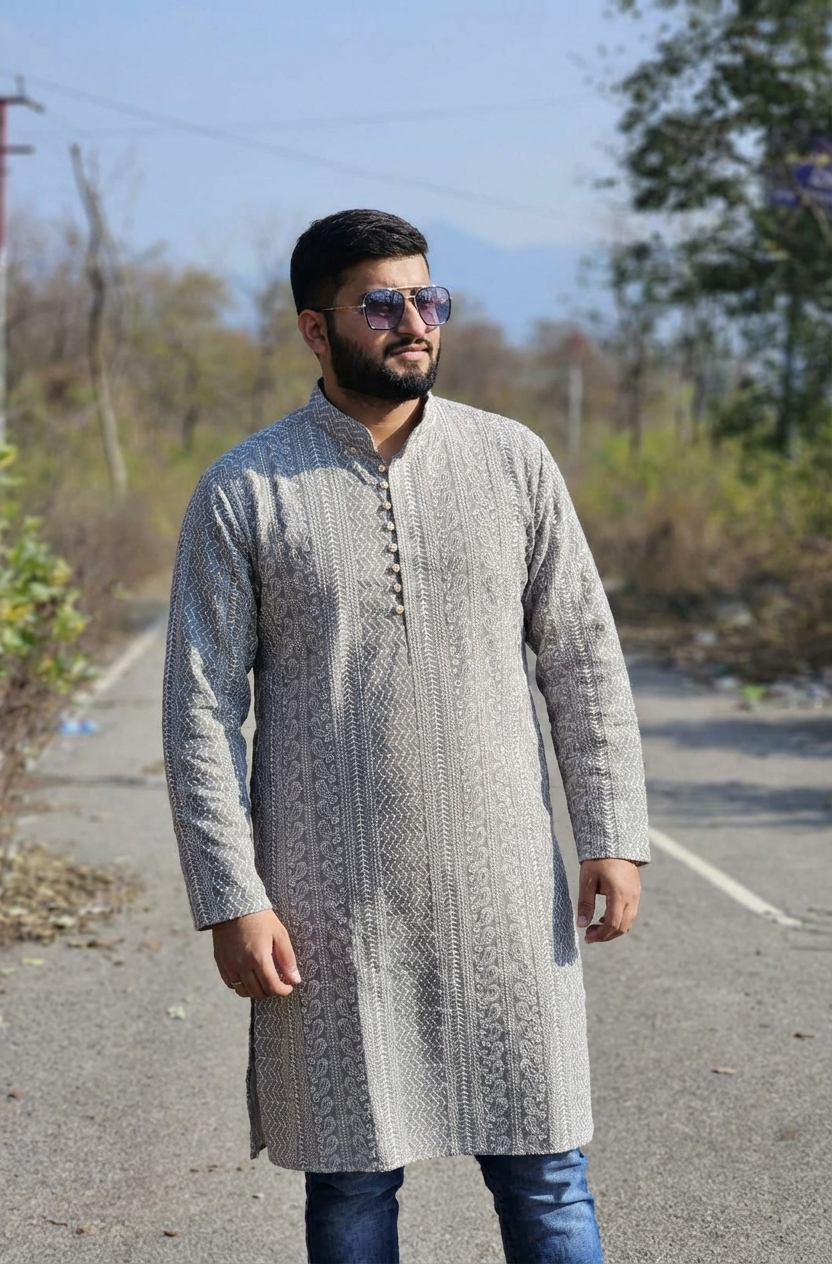
Thinking Process
PHASE 1: VISUAL DECONSTRUCTION
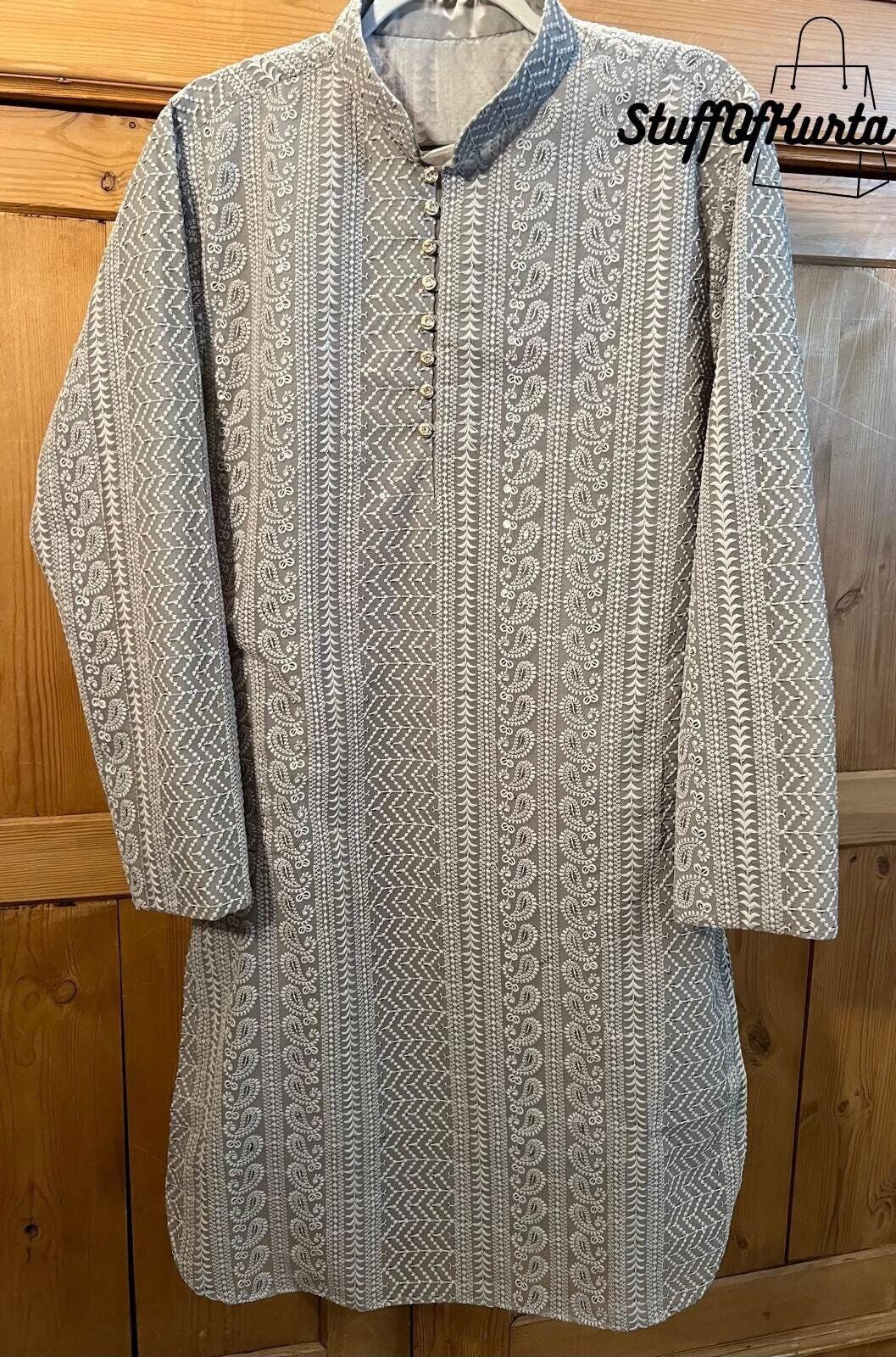
- **Fabric Physics:** The source garment is a structured cotton or cotton-blend Kurta with heavy embroidery (Chikankari style). It has medium weight due to the thread work and low elasticity. It is not flowy like silk; it holds a structural shape but drapes vertically. The surface has a matte finish, but the small embedded sequins/mirrors inside the embroidery patterns must reflect high-intensity specular highlights from the outdoor sun.
- **Key Features:**
- The Mandarin collar and the vertical button placket with distinct buttons.
- The specific alternating vertical patterns (paisley motifs vs. geometric chevron/zig-zag lines).
- The "Stuff of Kurta" watermark and hanger must be removed.
- The cuff hem detailing and the side slits (common in Kurtas) must be generated if not fully visible, ensuring the garment doesn't look like a solid tube.
PHASE 2: FIT & DRAPE SIMULATION
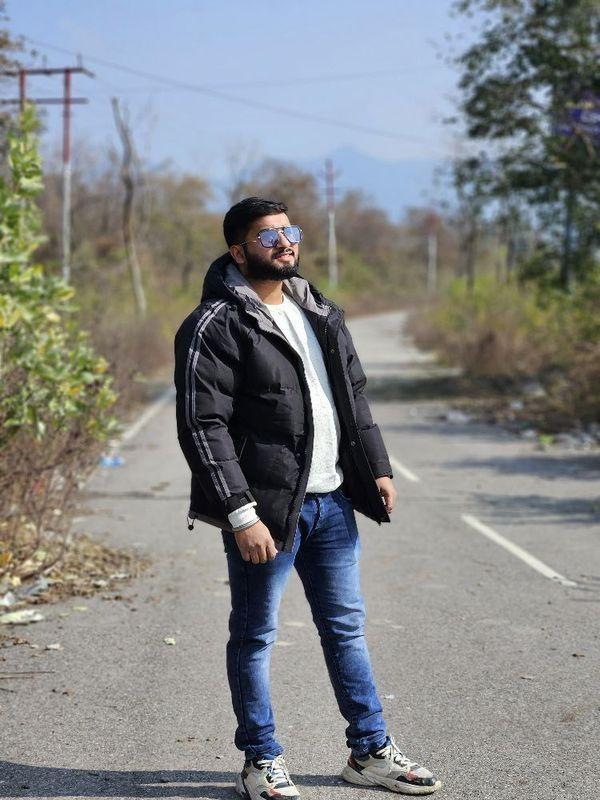
- **Body Mapping:** The current User Image features a bulky puffer jacket. The simulation must *ignore* the volume of the puffer jacket and infer the user's actual anatomical shoulder and chest width beneath it. The Kurta is a tunic style; it must fall past the waist to the mid-thigh area, covering the belt line and upper portion of the jeans. It should hang straight from the broadest part of the chest, creating vertical drag lines, rather than clinging to the torso.
- **Occlusion Handling:**
- **Beard/Jawline:** The user has a beard that may graze the collar area; the Kurta collar must sit *under* the beard line.
- **Hands:** The user's hands are visible. The long sleeves of the Kurta must end at the wrists, replacing the puffer jacket cuffs, without obscuring the hands.
- **Pants:** The Kurta is an over-garment; the bottom hem must be layered *over* the blue jeans.
PHASE 3: ENVIRONMENT & LIGHTING
- **Light Match:** The User Image is shot outdoors in bright daylight with a strong light source coming from the upper left (creating shadows to the user's right). The flat, warm indoor lighting of the Cloth Image must be replaced with high-contrast, cool-toned natural sunlight.
- **Shadows:** Hard shadows must be cast by the collar onto the neck, and by the sleeve folds. Crucially, the embroidery texture (bump map) needs to cast micro-shadows to show depth in the harsh sunlight.
- **Color Calibration:** The source garment appears to have a warm cast from indoor lighting. It must be color-corrected to a cooler, neutral tone to match the outdoor daylight (approx 5500K-6000K). The white embroidery must appear bright white/silver under the sun, not yellowish.
PHASE 4: IDENTITY PROTECTION
- **Facial Lock:** The user's entire head, including hair, forehead, sunglasses, nose, beard, and ears, must remain pixel-frozen. The boundary between the neck and the new Mandarin collar requires precise masking.
- **Body Integrity:** While the bulky puffer jacket is being removed, the user's underlying shoulder width and posture must be preserved. Do not artificially slim the user's skeletal frame, but accurately represent the reduction in bulk by switching from a down jacket to a cotton Kurta. The lower body (jeans, legs, sneakers) must remain untouched.