Thinking Process
PHASE 1: VISUAL DECONSTRUCTION
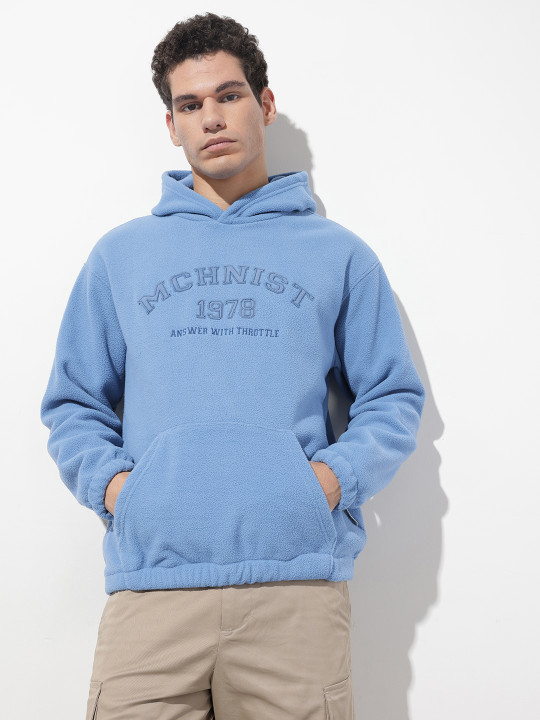
- **Fabric Physics:** The source garment is a high-pile fleece or sherpa material. It possesses high volume and thickness with a matte finish. Unlike the user's current thin cotton t-shirt, this material absorbs light and creates soft, fuzzy micro-shadows rather than specular highlights. It resists sharp creasing, instead forming soft, rolling folds due to its structural thickness.
- **Key Features:** The central chest embroidery ("MCHNIST 1978" and subtext) is the focal point and must maintain vector alignment relative to the chest angle. The hood structure around the neck, the kangaroo pocket volume, and the elasticated ribbed hem and cuffs are critical geometry that must be generated, replacing the thin silhouette of the current t-shirt.
PHASE 2: FIT & DRAPE SIMULATION
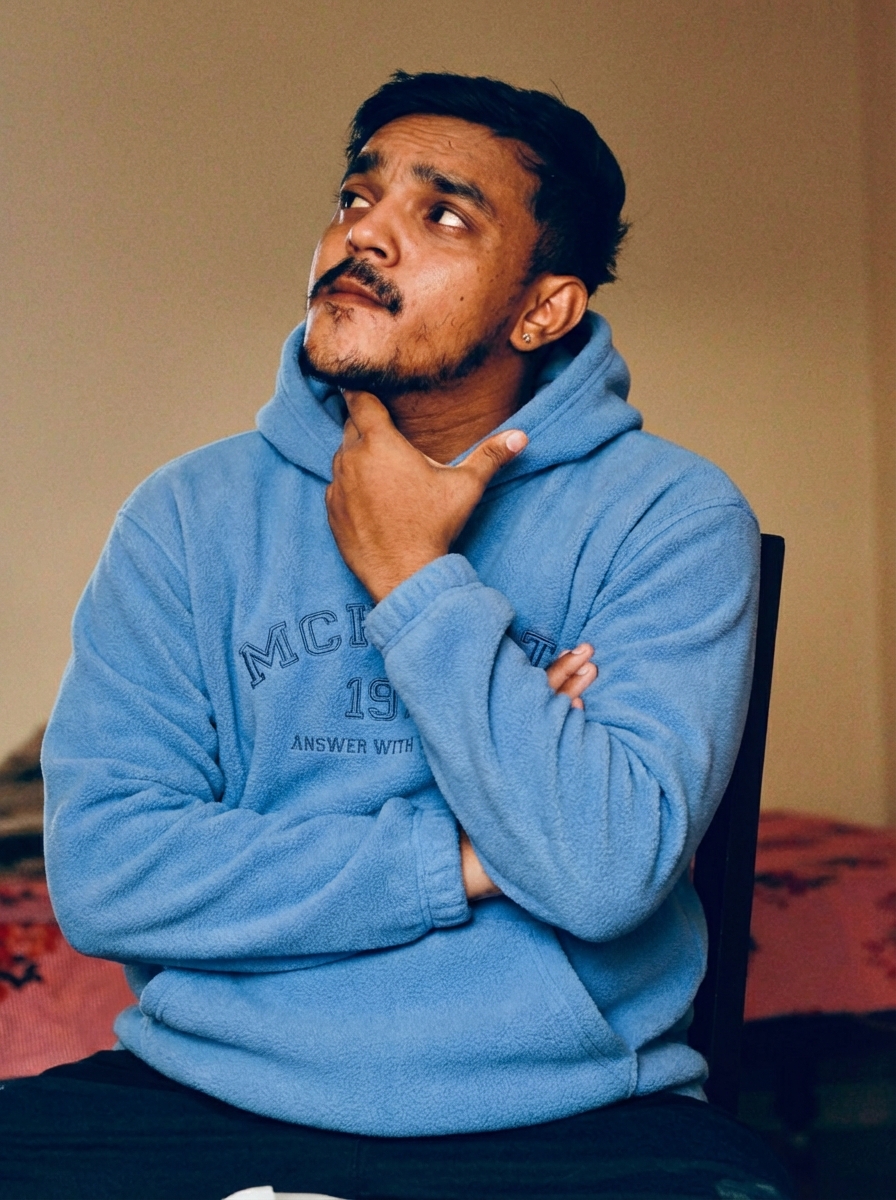
- **Body Mapping:** Due to the user's seated, cross-armed, hand-on-chin pose, the hoodie must exhibit compression mapping. The fabric needs to bulge slightly around the biceps due to the fleece thickness. The hood needs to bunch realistically around the trapezius muscles, sitting significantly higher than the current crew neck. The torso section must fold horizontally across the midsection where the user is leaning forward slightly.
- **Occlusion Handling:**
1. **Right Hand & Wrist:** The user's right hand (resting on the chin) and the exposed wrist are the primary foreground layers. The hoodie's collar and upper chest fabric must render *behind* this hand.
2. **Left Forearm:** The left forearm crosses the body; the hoodie's torso fabric must sit behind this arm, while the left sleeve must conform to the arm itself.
3. **Chin/Beard:** The high collar of the hoodie may interact with the bottom of the beard; the beard must layer over the fabric.
PHASE 3: ENVIRONMENT & LIGHTING
- **Light Match:** The user's environment features a strong, warm directional key light coming from the user's right (viewer's left), casting deep shadows on the user's left side. The flat studio lighting of the blue hoodie must be relighted to match this high-contrast scenario. The "fuzzy" texture of the fleece requires ambient occlusion rendering to capture the depth of the fabric pile in this lighting.
- **Color Calibration:** The user's photo has a warm, indoor tungsten cast. The cool blue of the source hoodie must be color-graded with a subtle warm overlay to integrate it into the room's atmosphere, preventing it from looking "superimposed" or too cool in temperature.
PHASE 4: IDENTITY PROTECTION
- **Facial Lock:** The user's entire head structure, including the specific angle of the gaze, the mustache/beard grooming, the ears, and the hairstyle, must remain pixel-perfectly frozen.
- **Body Integrity:** The simulation must add the *volume* of the hoodie on top of the user's existing frame, but it is strictly forbidden to slim down the arms or alter the shoulder width to fit a standard model size. The user's natural seated posture and arm thickness must dictate the garment's shape, not the other way around.