Thinking Process
PHASE 1: VISUAL DECONSTRUCTION
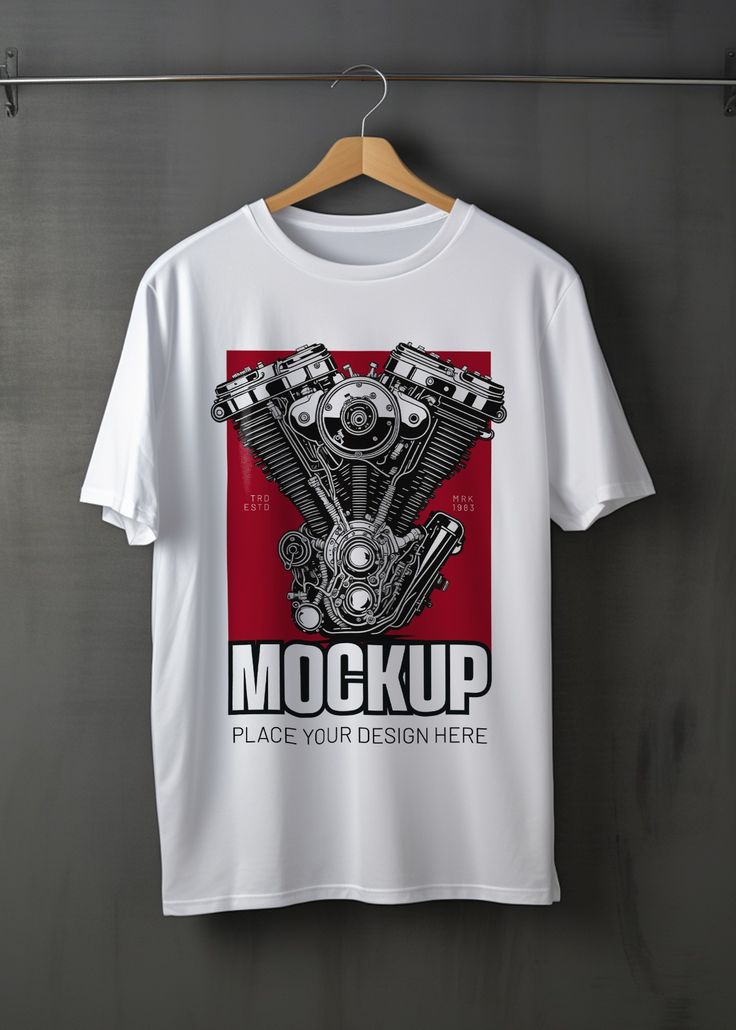
- **Fabric Physics:** The source is a standard cotton jersey knit. It possesses a matte finish with diffuse light scattering (no specular highlights). It is significantly lighter and has less volume than the target's current heavy knitted hoodie. The simulation must account for lower structural rigidity, meaning more micro-folds and a closer drape to the skin compared to the current bulky garment.
- **Key Features:** The large central graphic (V-twin engine) with the red background block and specific typography ("MOCKUP", "PLACE YOUR DESIGN HERE") must be preserved without distortion that renders the text unreadable. The ribbed crew neckline and the double-stitched hem of the sleeves and waist are essential structural details to maintain realism.
PHASE 2: FIT & DRAPE SIMULATION
- **Body Mapping:**
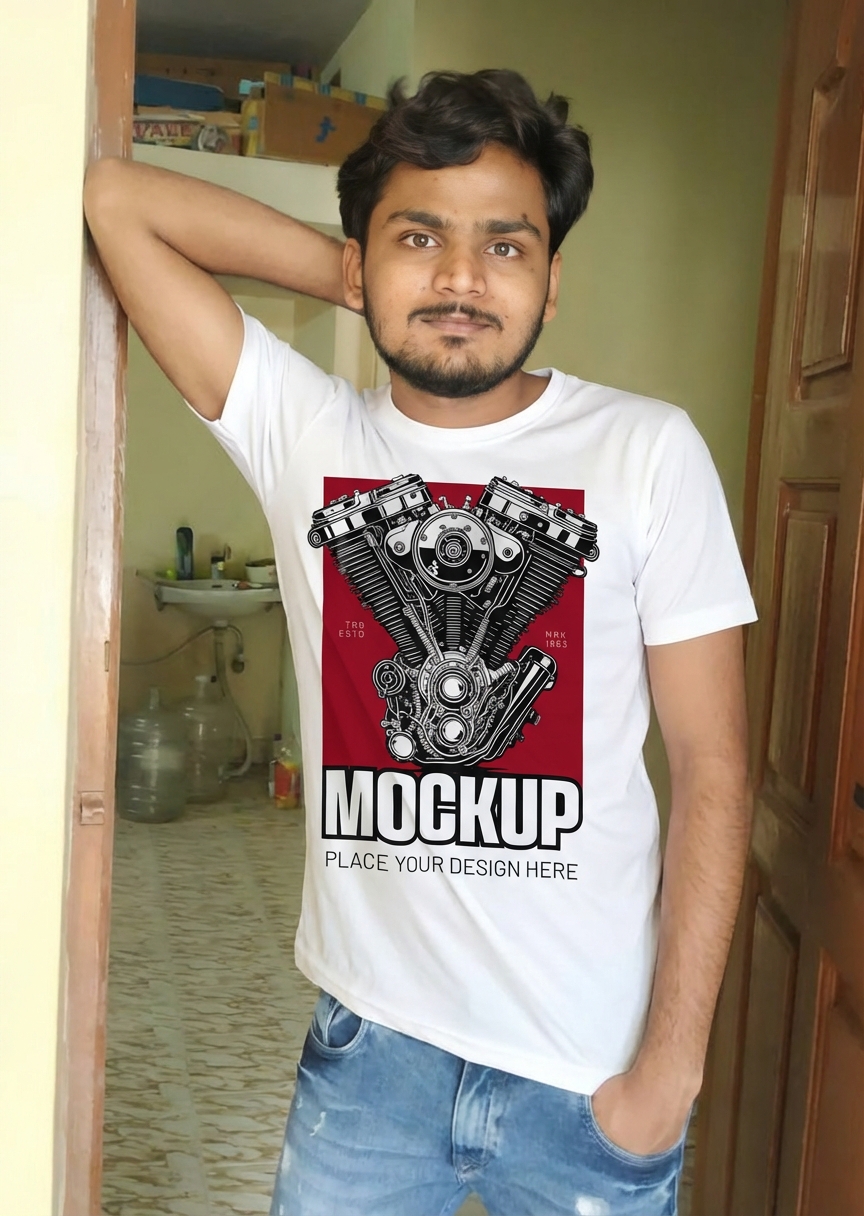
- **Right Arm (Raised):** Due to the arm being raised behind the head, the right sleeve of the t-shirt must retract toward the shoulder/axilla, creating tension lines across the upper chest and bunching slightly at the shoulder seam. The fabric on the right side of the torso should be pulled taut upwards.
- **Left Side (Leaning):** As the user leans right, the fabric on the left torso should hang straight down due to gravity, creating vertical fold lines, while possibly bunching slightly where the hip makes contact with the doorframe.
- **Sleeve Length Transition:** Since the source is short-sleeved and the target is long-sleeved, the simulation must accurately terminate the fabric mid-bicep.
- **Occlusion Handling:**
- **Left Hand (In Pocket):** The left hand is inserted into the jeans pocket. The t-shirt hemline must interact with this; it should either drape naturally *over* the wrist/forearm entering the pocket or appear tucked/pushed back by the wrist. It cannot simply render over the hand as a flat layer.
- **Waistline:** The current hoodie is bunched at the waist; the t-shirt should hang looser and flatter, potentially overlapping the top edge of the jeans belt loops.
PHASE 3: ENVIRONMENT & LIGHTING
- **Light Match:** The target environment has soft, diffuse indoor daylight coming from the user's right (image left), casting soft shadows to the user's left and behind. The white t-shirt must accept this lighting model, showing brightness on the right chest/shoulder and graduating to soft shadows under the raised right arm and along the left flank.
- **Color Calibration:** The source garment is bright white. To sit naturally in the room, the white point must be warmed slightly to match the ambient room tone (yellow/beige walls) and floor reflection. It should not appear as a "super-white" digital overlay but rather a "fabric white" influenced by the indoor atmosphere.
PHASE 4: IDENTITY PROTECTION
- **Facial Lock:** The user's face, beard, and neck structure must remain absolutely pixel-perfect frozen. The hairline must be segmented cleanly from the background doorframe.
- **Body Integrity:** While the t-shirt is thinner than the hoodie, the user's underlying skeletal structure and shoulder width must not be altered. The simulation must replace the *volume* of the hoodie with the volume of the t-shirt, but the user's actual torso breadth and arm thickness must remain consistent; do not slim the user to fit the "mockup" aesthetic.