Thinking Process
PHASE 1: VISUAL DECONSTRUCTION
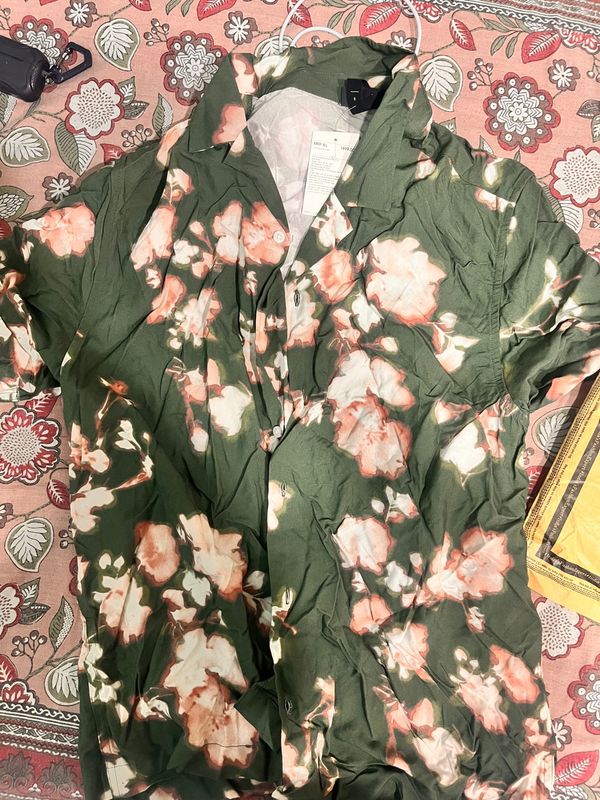
- **Fabric Physics:** The source garment appears to be a lightweight Viscose, Rayon, or soft Cotton blend. It lacks structural rigidity and has a high drape coefficient. Unlike the stiff cotton of a dress shirt, this material is fluid and susceptible to micro-wrinkling. It has a low-to-medium specular highlight (matte finish but catches soft light on folds).
- **Key Features:**
- **Camp Collar:** The open, notched lapel style (cuban collar) is distinct and must replace the crew neck of the current t-shirt.
- **Floral Print:** The organic peach/white floral pattern on the olive green base must be preserved without distortion.
- **Placket:** The button line is soft/unstructured; it should not appear as a rigid vertical line but follow the curvature of the torso.
PHASE 2: FIT & DRAPE SIMULATION
- **Body Mapping:**
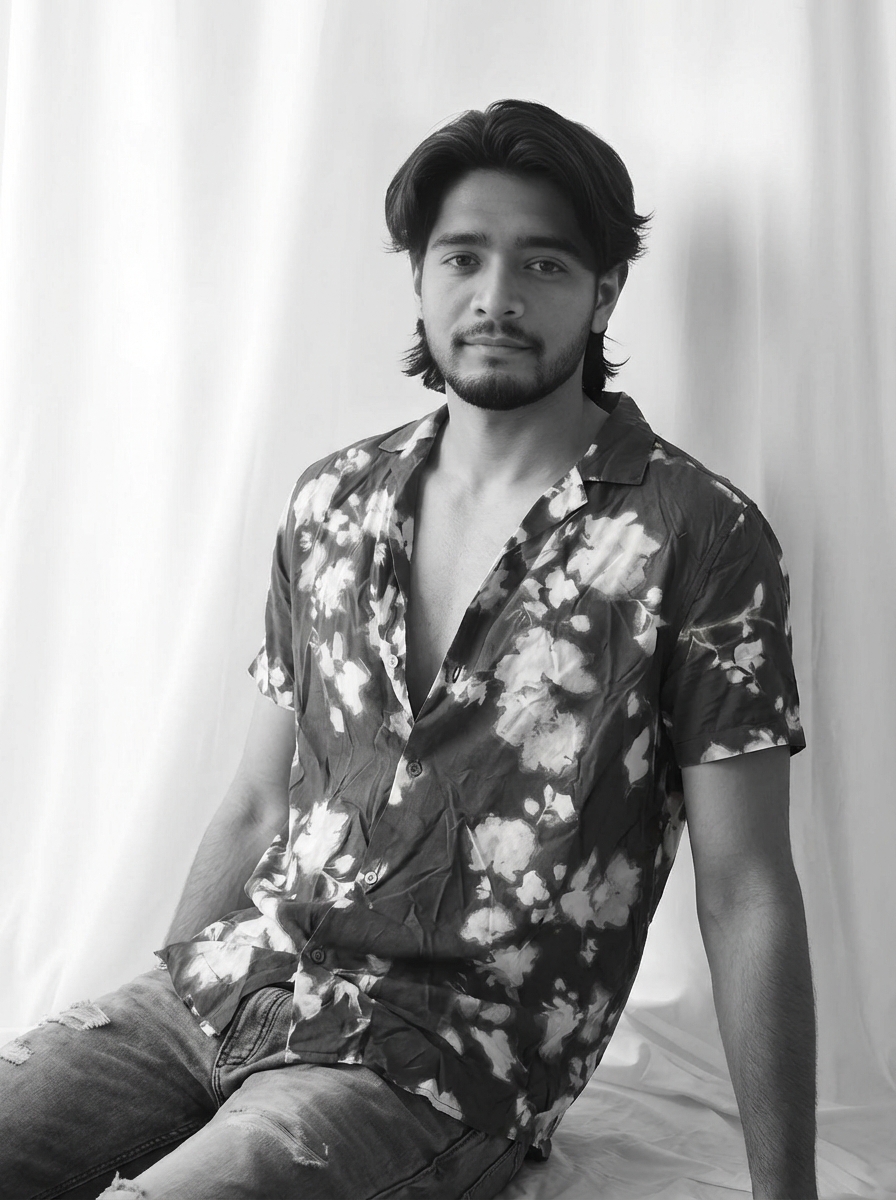
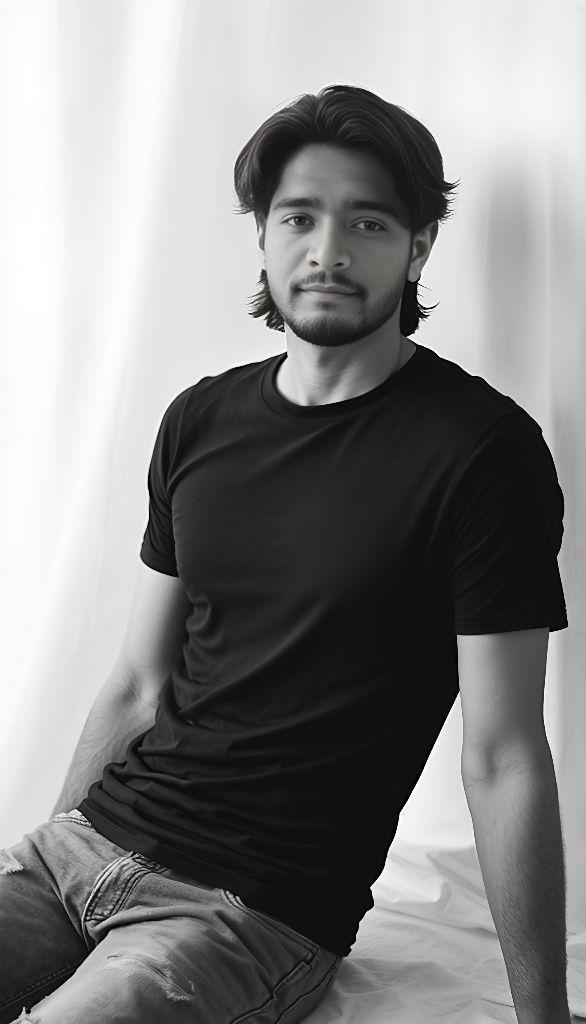
- **Gravity & Pose:** The user is leaning back, supported by arms behind the torso. The virtual garment must not cling to the abdomen like the current t-shirt. Instead, gravity will pull the fabric vertically down towards the hips, creating a "bridge" gap between the chest and the waist.
- **Shoulder/Armpit Interaction:** Because the arms are rotated backward to support weight, the fabric must bunch significantly at the anterior axillary fold (front armpit) and pull tight across the clavicles.
- **Sleeve Volumetrics:** The source sleeves are wider than the user's current fitted sleeves. They should hang somewhat loosely around the biceps, creating a gap between skin and cloth.
- **Occlusion Handling:**
- **Hair:** The user's hair at the nape of the neck and behind the ears must be layered *over* the new collar.
- **Jeans:** The hem of the new shirt (likely worn untucked for this style) will overlap the waistband of the jeans. Shadows must be cast *onto* the jeans.
- **Arms:** The user's forearms and elbows remain original; the shirt sleeve replaces the t-shirt sleeve but must terminate naturally mid-bicep.
PHASE 3: ENVIRONMENT & LIGHTING
- **Light Match:**
- **Directionality:** The user is lit by a large, soft source from the viewer's left (User's right). This creates a strong highlight on the right pectorals and shoulder, and deep shadows on the viewer's right.
- **Shadow Mapping:** The new garment must replicate this high-contrast lighting. Deep folds in the loose fabric on the shadowed side (viewer's right) must be nearly black to match the tonal range of the original photo.
- **Color Calibration:**
- **Grayscale Conversion:** The target image is monochromatic (B&W). To create a photorealistic composite, the source garment (Olive Green/Pink) must be desaturated and tone-mapped to grayscale. The "Olive" base should translate to a dark grey (Zone 3-4), and the floral "Pink/White" should translate to light grey/white (Zone 7-9). *Do not composite a colored shirt onto a black-and-white photo.*
PHASE 4: IDENTITY PROTECTION
- **Facial Lock:** The user's eyes, nose, mouth, facial hair (beard/stubble), and jawline are strictly protected. The boundary where the neck meets the new open collar requires precise blending to match skin tone/grain.
- **Body Integrity:** The user has a lean/athletic build. Do not use the loose fit of the floral shirt to imply a larger body mass. The simulation must show the fabric is loose, not that the body has expanded to fill it. No pixel warping of the arms or face is permitted.