Thinking Process
PHASE 1: VISUAL DECONSTRUCTION
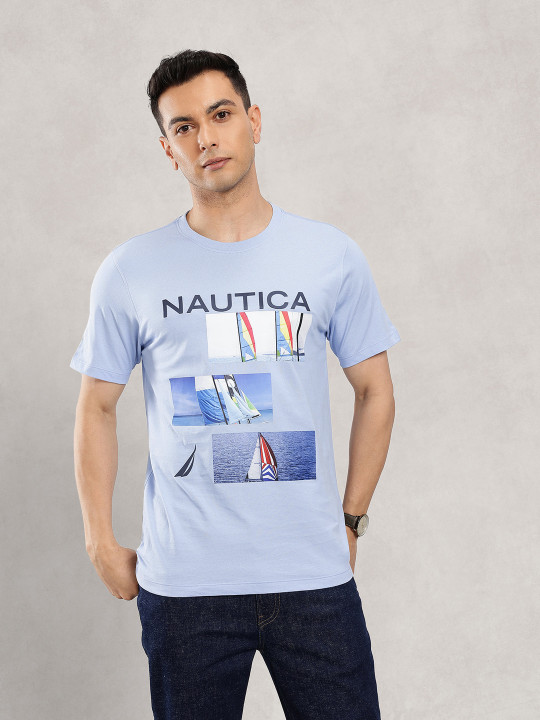
- **Fabric Physics:** The source garment is a cotton jersey knit. It possesses medium weight with a low sheen (matte finish). The physics engine must treat this as a pliable material that is prone to soft, rounded folding rather than sharp creases. Light reflection should be diffuse, absorbing ambient light rather than reflecting it speculatively.
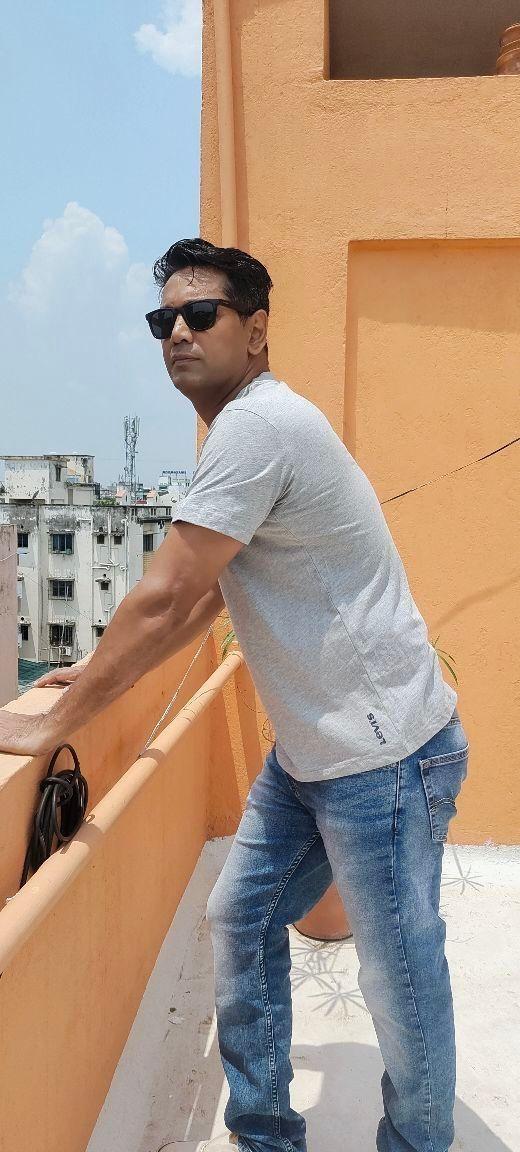
- **Key Features:** The central chest graphic consisting of the "NAUTICA" text and the three distinct rectangular photo-prints (sailboats) is the primary focal point and must maintain aspect ratio despite the body angle. The secondary "sail" logo on the lower left abdomen area must be preserved. The crew neckline ribbing structure must replace the existing grey collar exactly.
PHASE 2: FIT & DRAPE SIMULATION
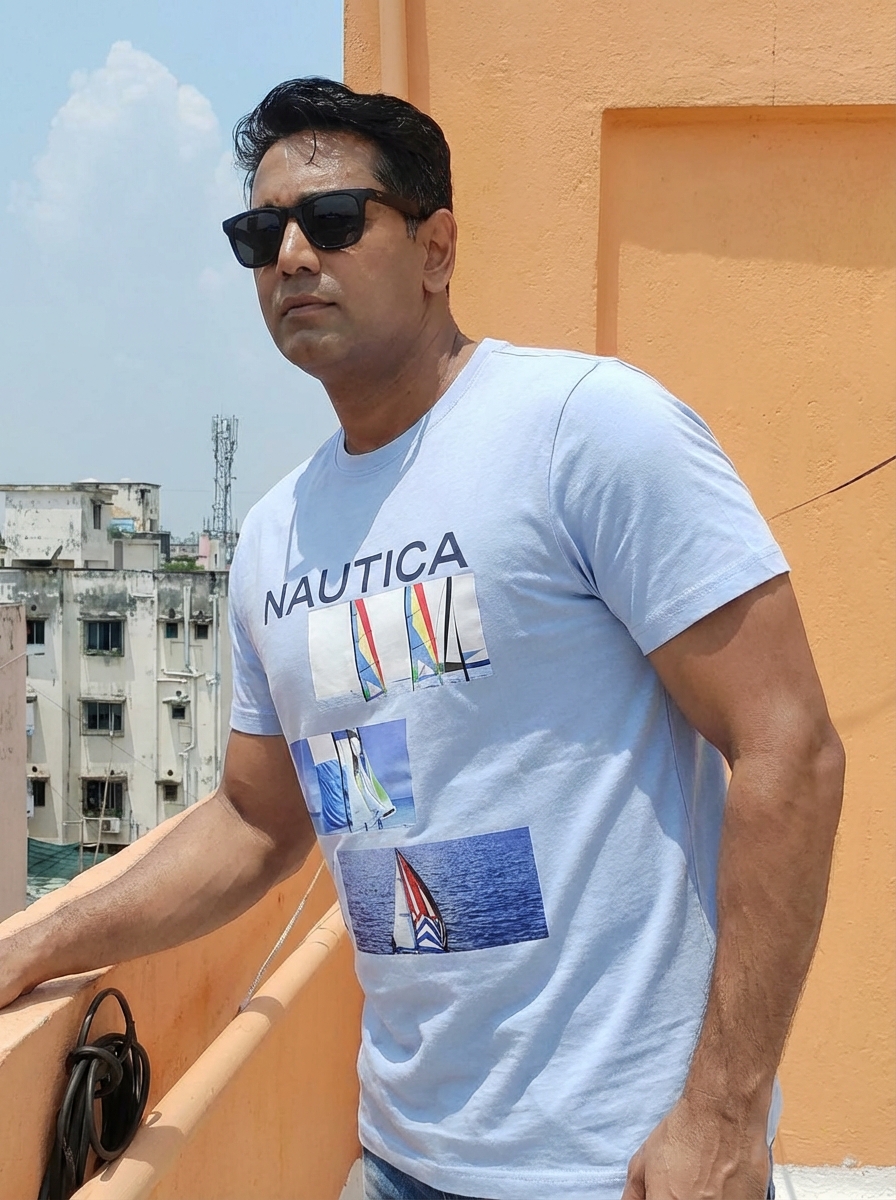
- **Body Mapping:** Due to the user's leaning, side-profile pose, gravity dictates that the front of the garment will hang vertically, separating slightly from the abdomen/lower stomach, while the fabric across the upper back and shoulders will be pulled taut. Significant compression wrinkles must be generated at the right axilla (armpit) where the arm meets the torso. The right sleeve needs to contour around the user's developed bicep, likely sitting higher and tighter than on the source model.
- **Occlusion Handling:** The user's right arm and hand are the primary foreground elements; the shirt torso must be rendered *behind* the inner arm if visible, but the sleeve must enclose the shoulder. The railing serves as a hard stop for the lower hem of the garment—if the shirt length extends to the railing, the fabric must collide and fold against the concrete edge, not clip through it.
PHASE 3: ENVIRONMENT & LIGHTING
- **Light Match:** The target environment utilizes harsh, high-noon natural sunlight coming from the upper left (zenith). The simulation must strip the flat, diffuse studio lighting from the source cloth and apply hard, high-contrast shadows. Specifically, the chest pectorals should cast a slight downward shadow on the graphic, and the fold of the armpit needs a deep shadow core.
- **Color Calibration:** The source shirt is cool-toned (light blue). To integrate into the target image, the white point must be shifted warmer. Crucially, the garment needs to receive "bounce light" (Global Illumination) from the surrounding orange/terracotta walls, slightly tinting the shadowed areas of the blue shirt with a warm orange hue.
PHASE 4: IDENTITY PROTECTION
- **Facial Lock:** The user's entire head, including the specific hairstyle, sunglasses, facial structure, and neck area above the collarbone, must remain pixel-perfectly frozen.
- **Body Integrity:** The user's muscular arm definition and shoulder width must be preserved. The warp mesh must adapt the shirt to the user's existing volume, strictly forbidding any slimming or morphing of the user's underlying anatomical mesh to match the slimmer source model.