Thinking Process
PHASE 1: VISUAL DECONSTRUCTION
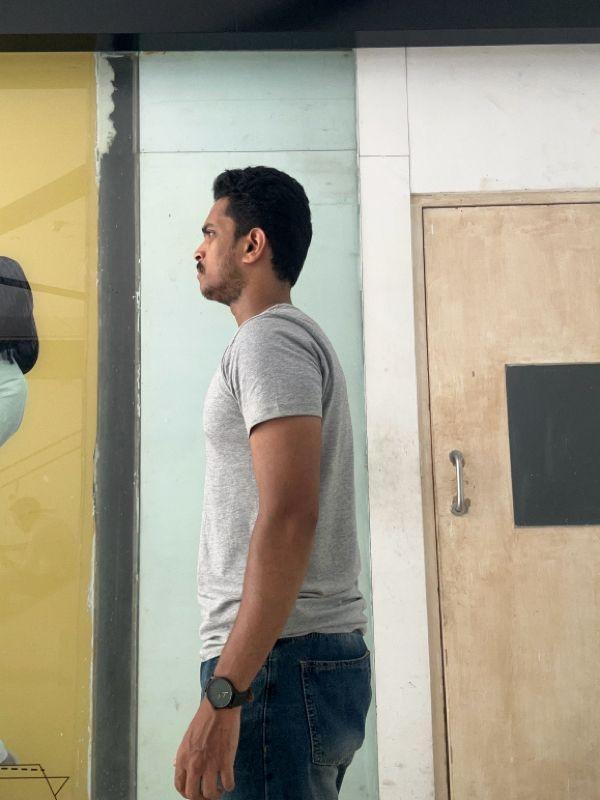
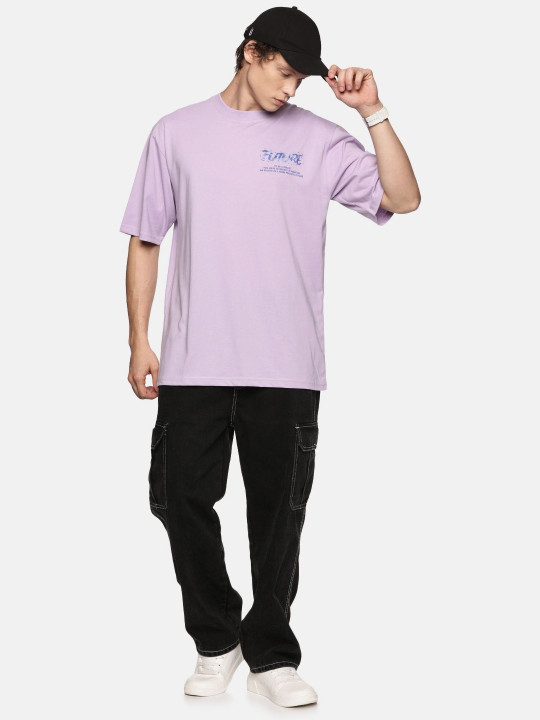
- **Fabric Physics:** The source garment is a medium-weight cotton jersey with a matte finish. It exhibits low reflectivity and high flexibility. Unlike the user's current tight grey shirt, the source material has a structural stiffness that supports an "oversized" silhouette; it should not cling to musculature but rather drape vertically from the contact points (shoulders/chest).
- **Key Features:**
- The "FUTURE" text graphic and blue abstract art on the upper chest.
- The drop-shoulder seam construction (crucial for the relaxed fit aesthetic).
- The ribbed crew neck collar.
- The longer hemline and looser sleeve cuffs compared to the user's current garment.
PHASE 2: FIT & DRAPE SIMULATION
- **Body Mapping:**
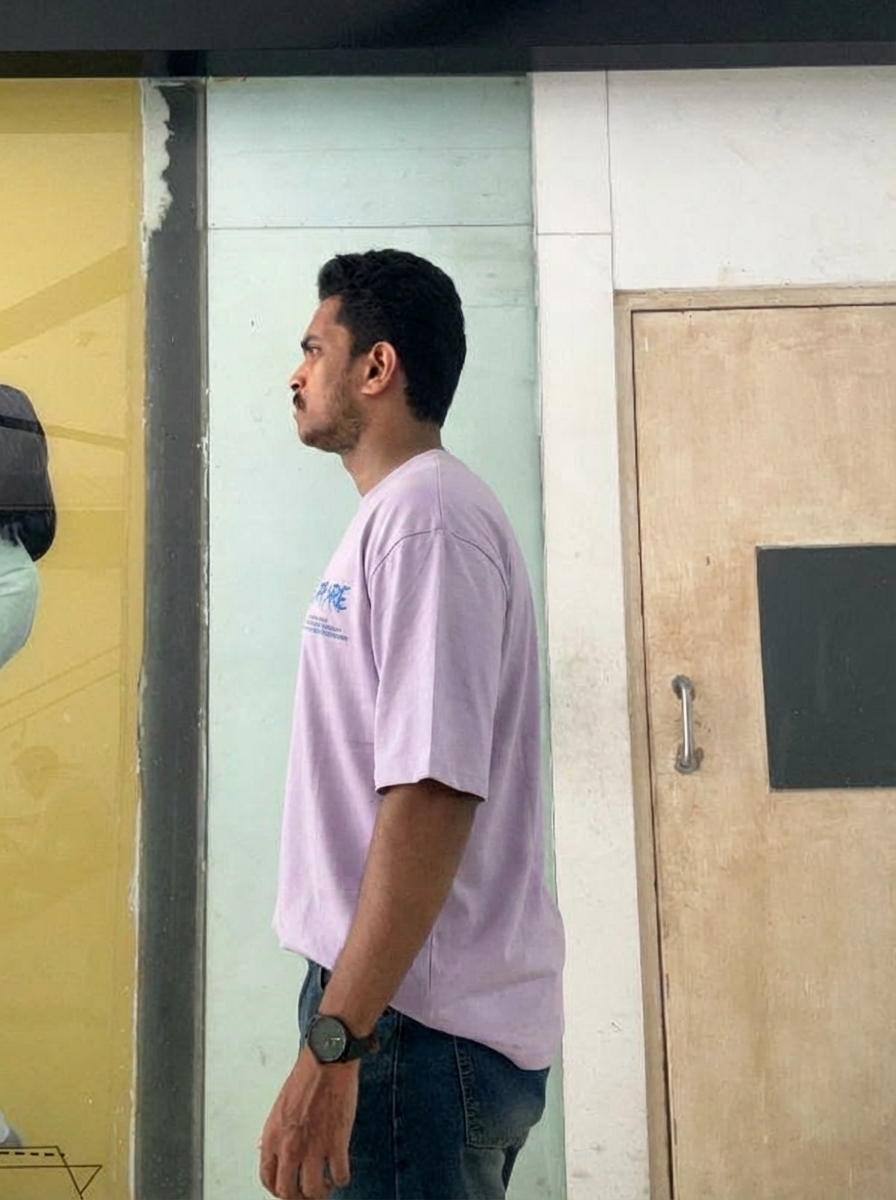
- **Perspective Transformation:** The source is frontal, but the user is in a pure profile view. The "FUTURE" graphic must be heavily foreshortened and wrapped around the curve of the pectorals to match the side angle.
- **Silhouette Adjustment:** The simulation must expand the bounding box of the user's torso. The fabric should bridge the gap between the shoulder blades and the lower back (hanging straight down) rather than following the curve of the spine like the current tight shirt.
- **Gravity:** The sleeve on the visible (left) arm needs to hang loosely with an open gap at the cuff, not hugging the bicep.
- **Occlusion Handling:**
- The user's left arm (from shoulder to hand) completely occludes the side seam of the torso. The garment must be rendered *behind* the arm.
- The wristwatch on the left wrist must remain the top-most layer, unaffected by the garment transfer.
- The waistband of the blue jeans acts as a collision object; the shirt hem should fall over the jeans, not tuck in.
PHASE 3: ENVIRONMENT & LIGHTING
- **Light Match:** The user image features diffuse, likely fluorescent indoor lighting coming from above and slightly in front (judging by the forehead reflection). The new garment must shed the high-contrast studio lighting of the source image. Shadows must be generated under the armpit area and where the sleeve overhangs the arm.
- **Color Calibration:** The source lilac (light purple) is bright and clean. It must be slightly desaturated and subjected to a mild noise filter to match the grain and lower dynamic range of the user's photo (which has a slightly yellow/warm cast from the room).
PHASE 4: IDENTITY PROTECTION
- **Facial Lock:** The user's profile profile—specifically the hair texture, ear structure, beard line, nose bridge, and jawline—must be masked and frozen completely.
- **Body Integrity:** The user's arm musculature and posture must remain unaltered. While the *clothing* adds volume, the underlying biological mesh (arm thickness, neck width) must not be slimmed or warped to fit the clothing asset.