Thinking Process
PHASE 1: VISUAL DECONSTRUCTION
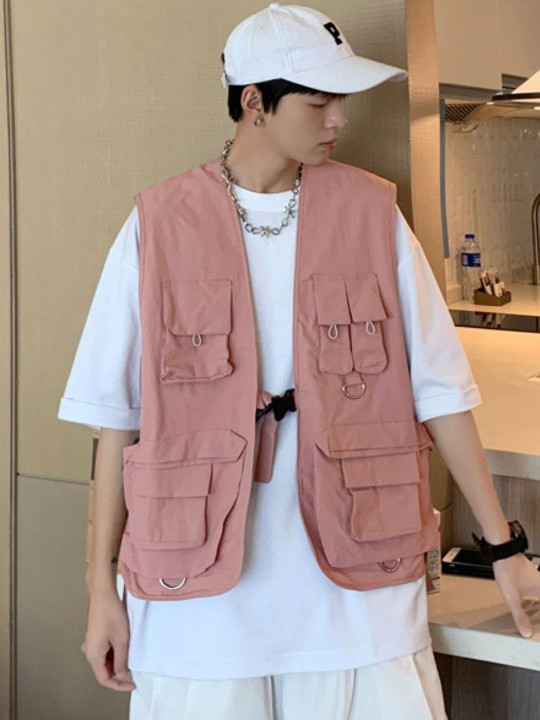
- **Fabric Physics:** The source garment is a two-piece ensemble consisting of an oversized cotton jersey t-shirt and a structured utility vest (likely canvas or heavy cotton drill). The vest has high structural rigidity; it should not cling to the body but rather sit with boxy volume. The pocket flaps and straps add significant weight, minimizing flutter in the wind. The t-shirt underneath is softer and should exhibit typical jersey folding behavior.
- **Key Features:** The visual hierarchy must preserve the pink vest's multiple 3D cargo pockets, the metal D-rings attached to the pocket flaps, and the black central buckle/strap connecting the vest sides. The crew neckline of the underlying white t-shirt must be visible. The "salmon/dusty pink" hue must remain distinct from the stark white of the tee.
PHASE 2: FIT & DRAPE SIMULATION
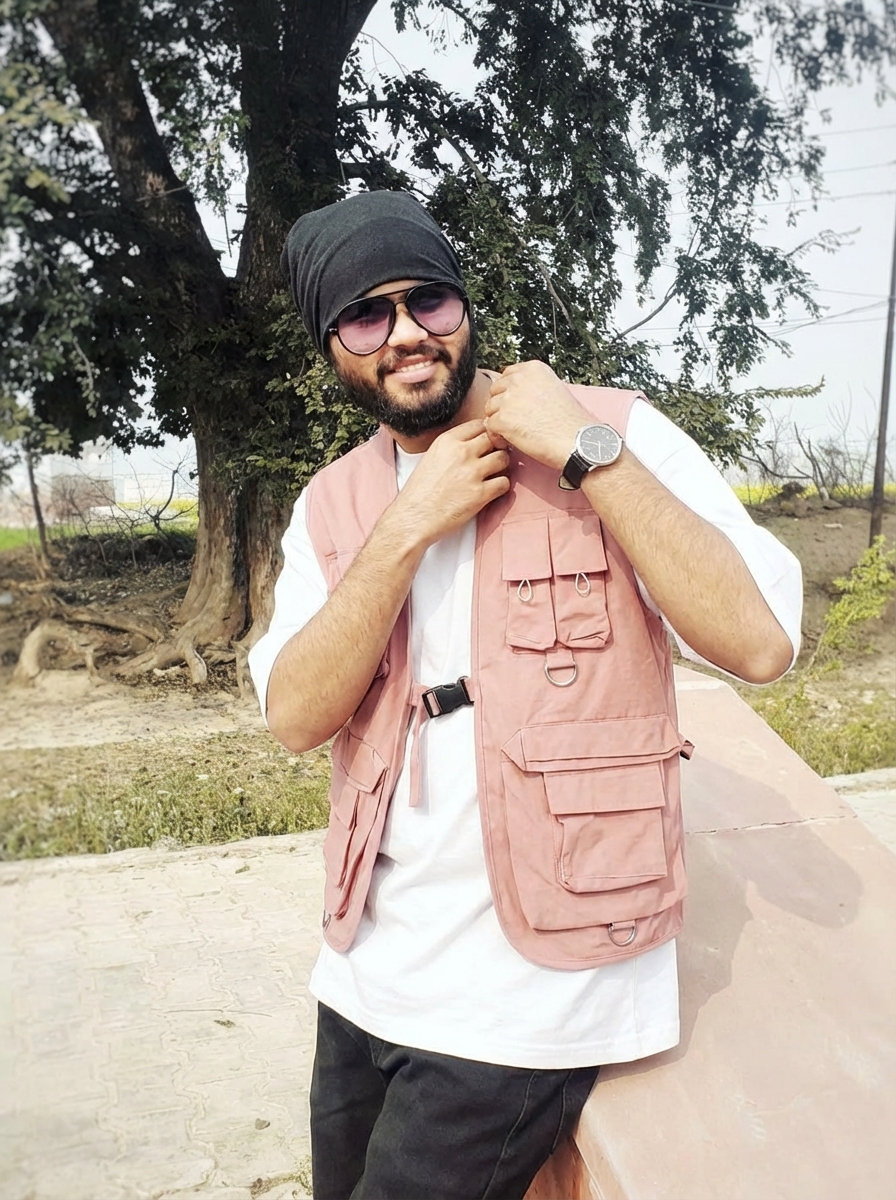
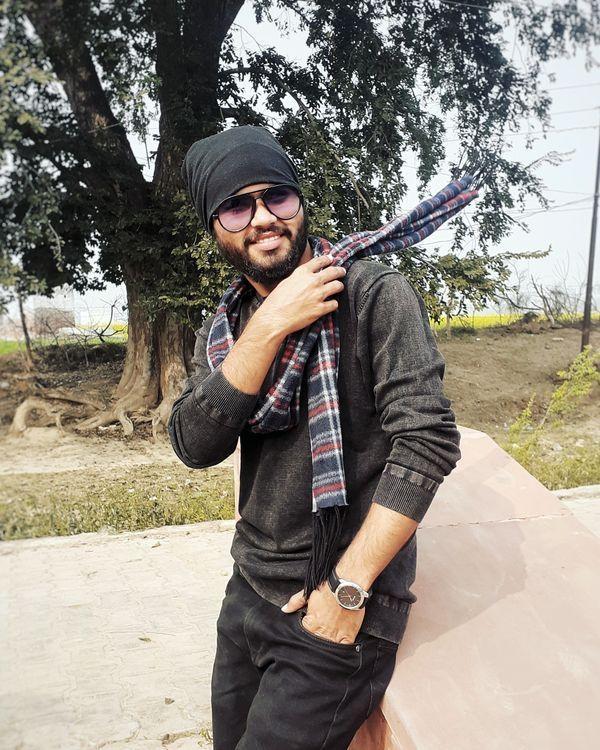
- **Body Mapping:** The user is leaning back and to his right against a structure. The new garment must respect gravity, hanging vertically rather than aligning with the angled torso. This means the white t-shirt hem will likely swing slightly away from the user's left hip. The vest must sit squarely on the shoulders; given the user's relaxed posture, the collar of the vest should not ride up. The shoulders of the new garment need to be warped to match the user's slight hunch/relaxed shoulder line.
- **Occlusion Handling:**
1. **Left Hand:** The user's left hand is interacting with his current scarf near the neck/chest. This is a critical high-precision mask. The fingers and wrist (including the watch) must be segmented and layered *over* the new vest/t-shirt combo.
2. **Scarf Removal:** The existing plaid scarf is an obstruction. It should be digitally removed to reveal the new garment. The hand position will remain, now appearing to adjust the collar of the new white t-shirt or the vest strap.
3. **Beanie:** The beanie stays. The new garment's neckline must tuck naturally under the beard line without clipping into the beanie or chin.
PHASE 3: ENVIRONMENT & LIGHTING
- **Light Match:** The target environment is high-contrast outdoor daylight (sunlight coming from above and slightly to the left). The source image is soft indoor studio lighting. We must introduce hard shadows to the new garment: specifically, the pocket flaps of the vest must cast sharp downward shadows onto the vest itself to simulate the outdoor sun. The beanie/head will cast a shadow onto the upper chest/neckline of the new white tee.
- **Color Calibration:** The indoor "warm" tone of the source image needs to be neutralized to match the cooler, blue-biased outdoor daylight. The white t-shirt must be exposure-matched to the bright outdoor scene without blowing out the highlights. The pink of the vest should appear slightly desaturated due to the bright sunlight intensity.
PHASE 4: IDENTITY PROTECTION
- **Facial Lock:** The user's entire head region above the neck—including the beard, sunglasses, nose, cheeks, and the black beanie—must be frozen and pixel-preserved. The transition line between the beard and the new t-shirt collar is the critical anchor point.
- **Body Integrity:** The user has a broader, more muscular build than the slender source model. The source garment mesh must be expanded laterally to fit the user's torso width. Do not slim the user or alter the arm thickness to match the source model. The relaxed, leaning posture must be maintained; do not straighten the user's spine.