Thinking Process
PHASE 1: VISUAL DECONSTRUCTION
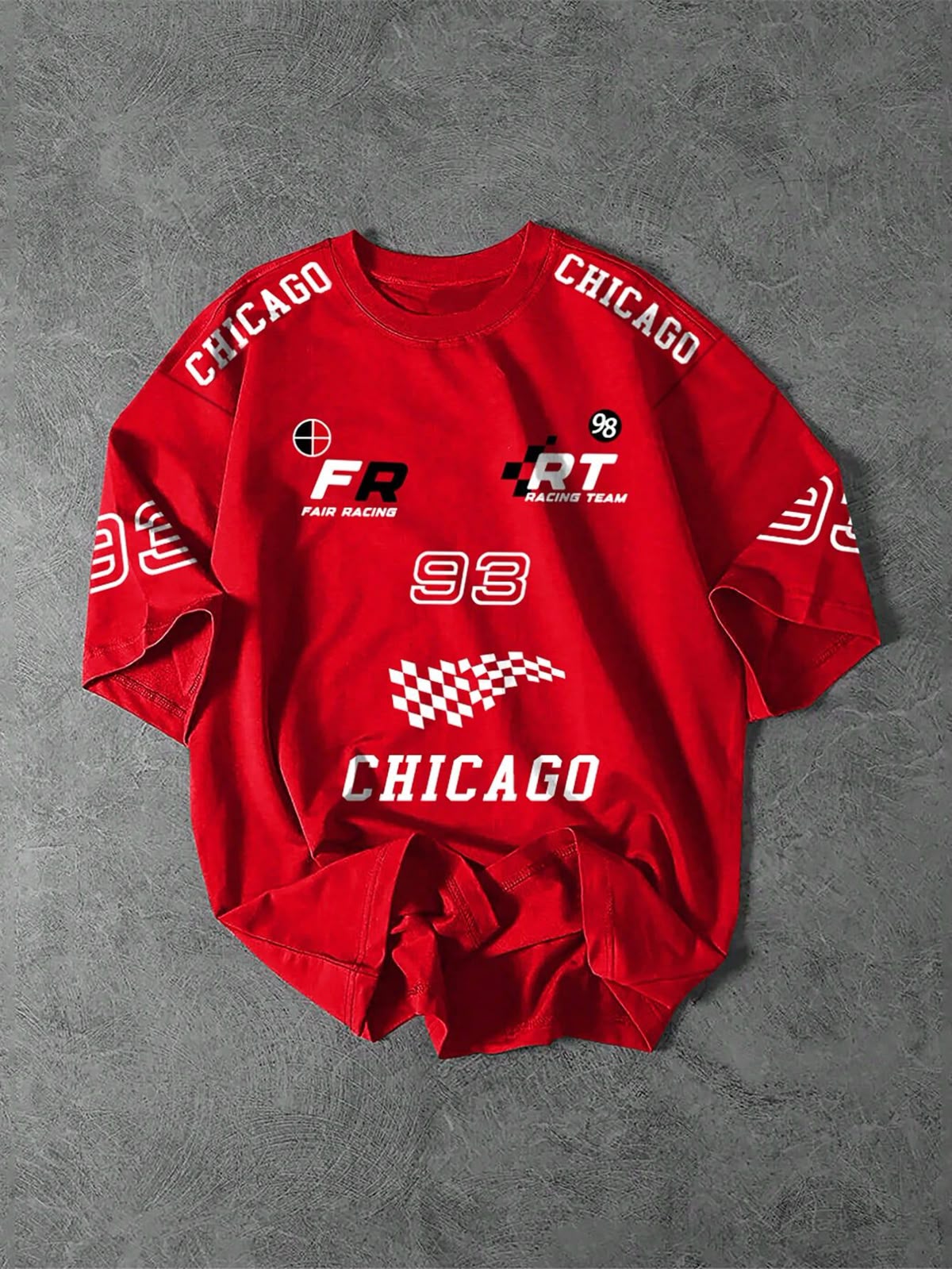
- **Fabric Physics:** The source garment appears to be a medium-weight cotton jersey (typical of oversized racing tees). It possesses a matte finish with low specularity. The simulation must treat the fabric as pliable but with enough structure to hold the "drop shoulder" shape without clinging excessively to the skin. It absorbs light rather than reflecting it.
- **Key Features:** The graphic placement is critical and dense. The "CHICAGO" text on the shoulders, the "FR/RT" logos on the upper chest, the central "93", and the checkered flag motif must be preserved. The bottom "CHICAGO" text must be included but warped to match the drape. The ribbed crew neck collar thickness must be rendered accurately, replacing the user's current open collared shirt.
PHASE 2: FIT & DRAPE SIMULATION
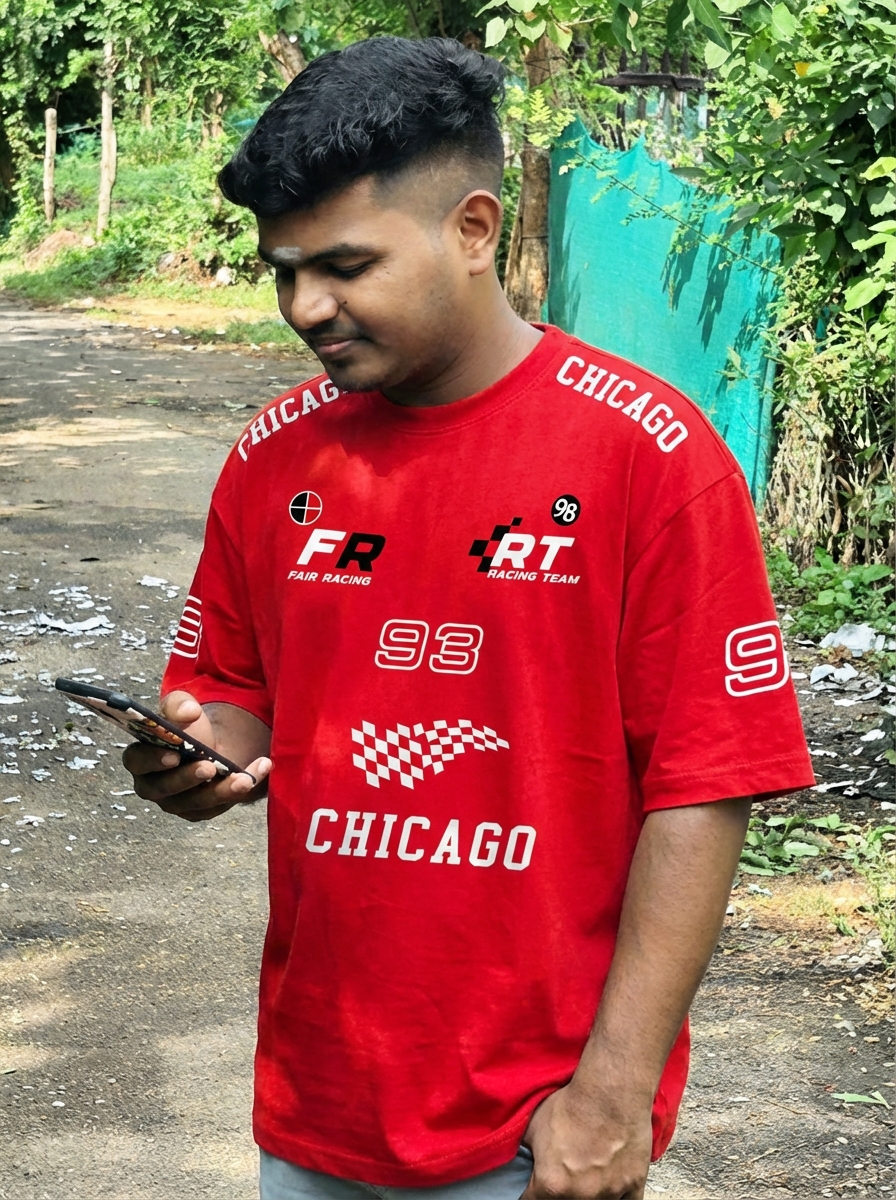
- **Body Mapping:** The user is standing in a 3/4 profile view with head tilted down. The oversized tee should drape vertically from the shoulders, avoiding the "tapered" look of the user's current button-down. Since the user's current sleeves are rolled to the elbow, and the source tee has wide half-sleeves, the simulation must generate/inpaint natural skin texture on the forearms where the old cuffs are removed. The shoulder seam of the new garment should fall lower on the arm (drop shoulder) compared to the user's current fitted seam.
- **Occlusion Handling:**
1. **Hand & Phone:** The user's left hand and the smartphone are positioned in front of the lower abdomen. These are hard occlusions; the red shirt fabric must pass *behind* the hand and phone.
2. **Chin/Jawline:** The user is looking down; the new crew neckline must sit naturally under the jaw shadows without intersecting the chin.
PHASE 3: ENVIRONMENT & LIGHTING
- **Light Match:** The target environment is outdoors with natural, dappled sunlight coming from above and slightly to the right (screen right). The red shirt is currently flat-lit studio style. The VTO render must introduce high-contrast shading: bright natural highlights on the right shoulder and chest, with deep, cool-toned shadows on the left side (screen left) and within the fabric folds to match the contrast on the user's face and arms.
- **Color Calibration:** The source red is highly saturated. To integrate with the outdoor environment, the red luminance needs to be adjusted to account for atmospheric scattering—slightly less vibrant in the shadows and warmer in the highlights to match the sunlight temperature.
PHASE 4: IDENTITY PROTECTION
- **Facial Lock:** The user's entire head, including the specific fade haircut, ear structure, facial hair, and the downward gaze, must be frozen. The neck area above the clavicle must remain untouched.
- **Body Integrity:** The user's physical volume (shoulder width and torso depth) must be maintained. Do not slim the user to fit the "flat lay" proportions; the garment must expand to fit the user's build. The arm thickness must remain consistent with the visible skin tone.