Thinking Process
PHASE 1: VISUAL DECONSTRUCTION
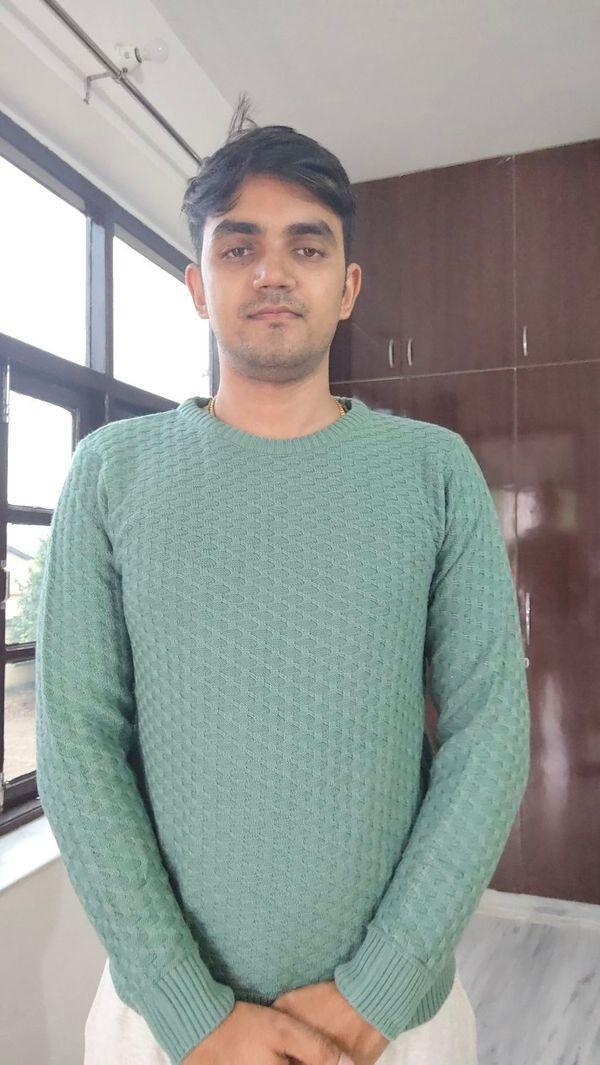
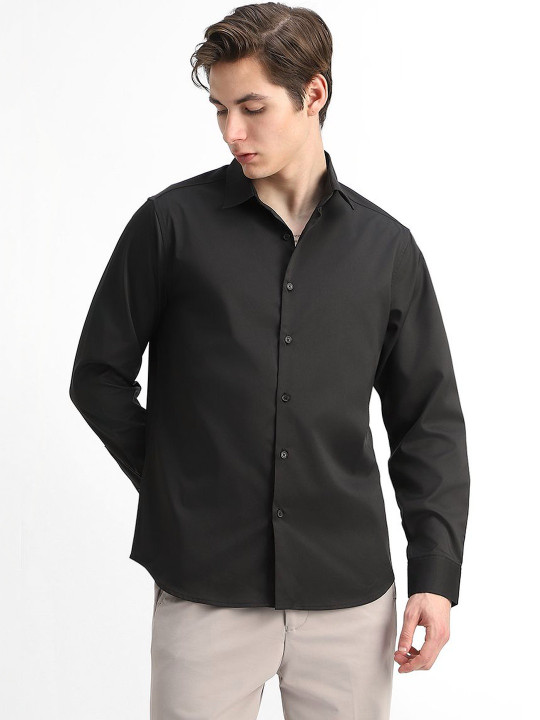
- **Fabric Physics:** The target garment is a woven cotton poplin or broadcloth shirt. Unlike the user's current knitted sweater, this material has high structural rigidity (stiffness) in the collar and cuffs. It has a semi-matte finish with anisotropic specular highlights—meaning light should streak across tension points rather than diffusing softly. It must not stretch like the sweater; it must fold and crease sharply.
- **Key Features:** The sharp point collar must replace the current crew neck silhouette completely. The vertical button placket (center front) must remain straight down the sternum but curve naturally with the torso's volume. Cuffs with visible button closures and the curved "shirttail" hemline are critical details to preserve.
PHASE 2: FIT & DRAPE SIMULATION
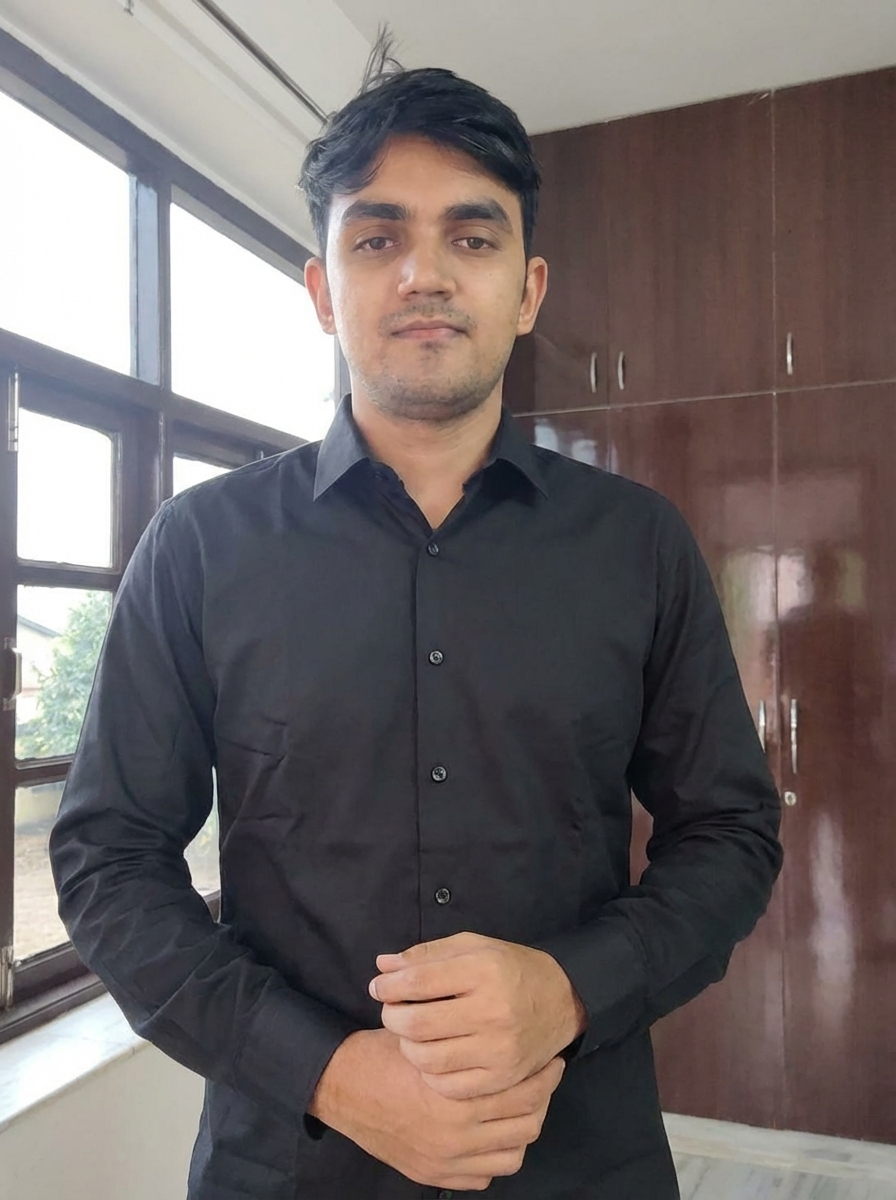
- **Body Mapping:** The user is standing with arms relaxed but hands clasped at the groin level. Consequently, the sleeves must extend fully down the arm, showing compression wrinkles at the inner elbow and bunching slightly at the wrists above the clasped hands. The shirt should have a "Regular Fit" profile—it should not cling to the torso like the sweater, but rather drape vertically from the chest to the hips, bridging the hollow of the lower back.
- **Occlusion Handling:** The user's clasped hands are the primary occlusion layer; the shirt's lower hem and cuff areas must be rendered strictly *behind* the fingers and wrists. The gold necklace currently visible is likely to be covered by the higher collar of the button-down; however, if the top button is simulated as open, the necklace geometry must be preserved or logically occluded. The hair wisps at the crown are safe, but any hair touching the nape of the neck must layer over the new collar.
PHASE 3: ENVIRONMENT & LIGHTING
- **Light Match:** The user is illuminated by a strong, cool daylight source from a large window on the specific Left (viewer's left). The simulation must generate high-contrast shadows on the Right side of the shirt (the side facing the wooden wardrobe). The left shoulder and sleeve must feature bright, cool-toned highlights to match the exposure on the user's face.
- **Color Calibration:** The source black shirt must absorb the scene's ambient light. It should not appear as "void black" (RGB 0,0,0) but rather a dark charcoal with slight cool blue-tinted highlights from the window and warm brown reflections on the shadowed side to integrate with the wooden background.
PHASE 4: IDENTITY PROTECTION
- **Facial Lock:** The entire head region above the hyoid bone—including the jawline, ears, hairline, and facial expression—is a strict exclusion zone. No pixels in this region may be altered.
- **Body Integrity:** The user's shoulder width and torso volume must dictate the garment size. Do not impose the V-taper physique of the source model onto the user. The simulation must respect the user's natural posture (slight forward shoulder roll) and not artificially straighten the spine or slim the waist.