Thinking Process
PHASE 1: VISUAL DECONSTRUCTION
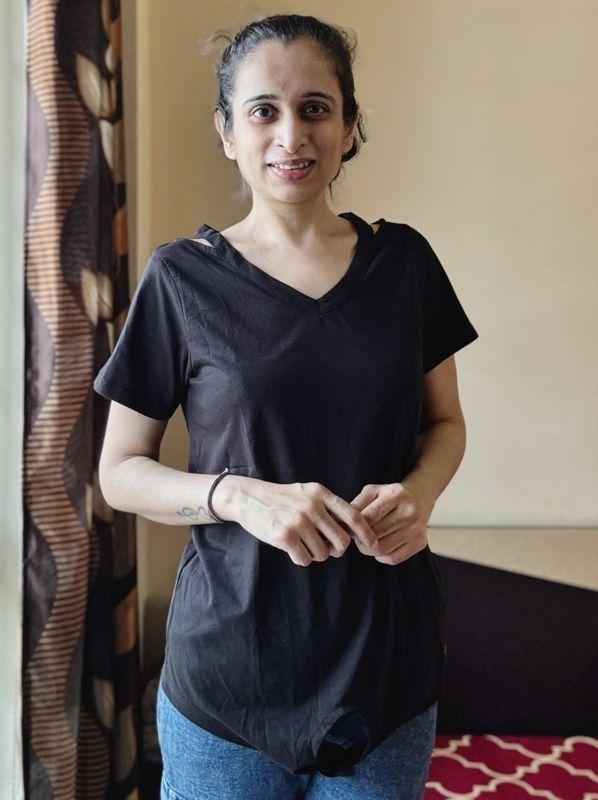
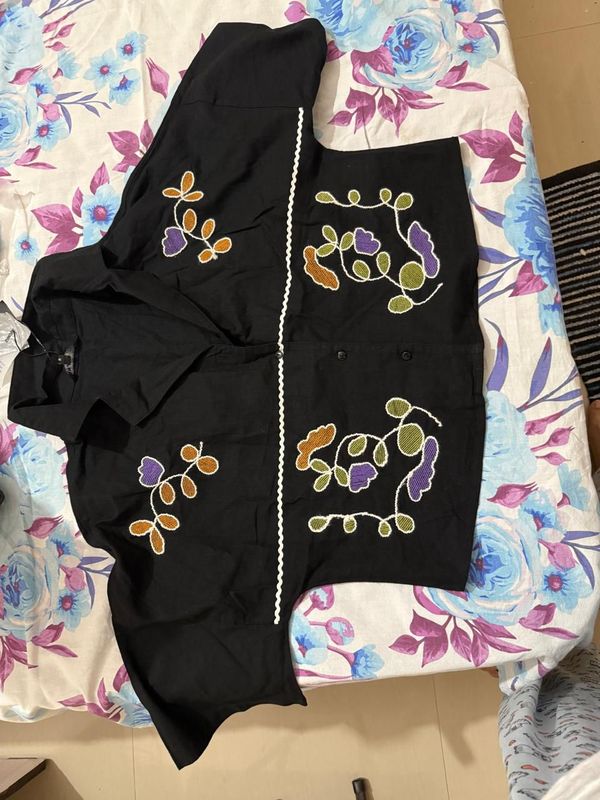
- **Fabric Physics:** The source garment appears to be a lightweight woven cotton or rayon blend. Unlike the user's current knit t-shirt, this material has structural rigidity at the collar and placket but drapes softly elsewhere. It has a matte finish with very low specularity; light should diffuse across the surface rather than creating sharp highlights.
- **Key Features:**
- The white "ric-rac" (zigzag) vertical trim down the center placket is the primary anchor point and must remain centered.
- The four distinct embroidered floral motifs (purple, green, brown) must preserve their thread texture and not appear as flat prints.
- The structural collar must be generated in 3D around the neck, replacing the current flat neckline.
- Black buttons along the placket must be preserved.
PHASE 2: FIT & DRAPE SIMULATION
- **Body Mapping:** The garment is a button-down shirt, implying a looser fit than the user's current tight t-shirt. The fabric should bridge the gap between the bust and waist rather than clinging to the skin. Gravity will pull the fabric straight down from the bust apex. Tension wrinkles should radiate slightly from the button closures if the fit is simulated as "true-to-size."
- **Occlusion Handling:**
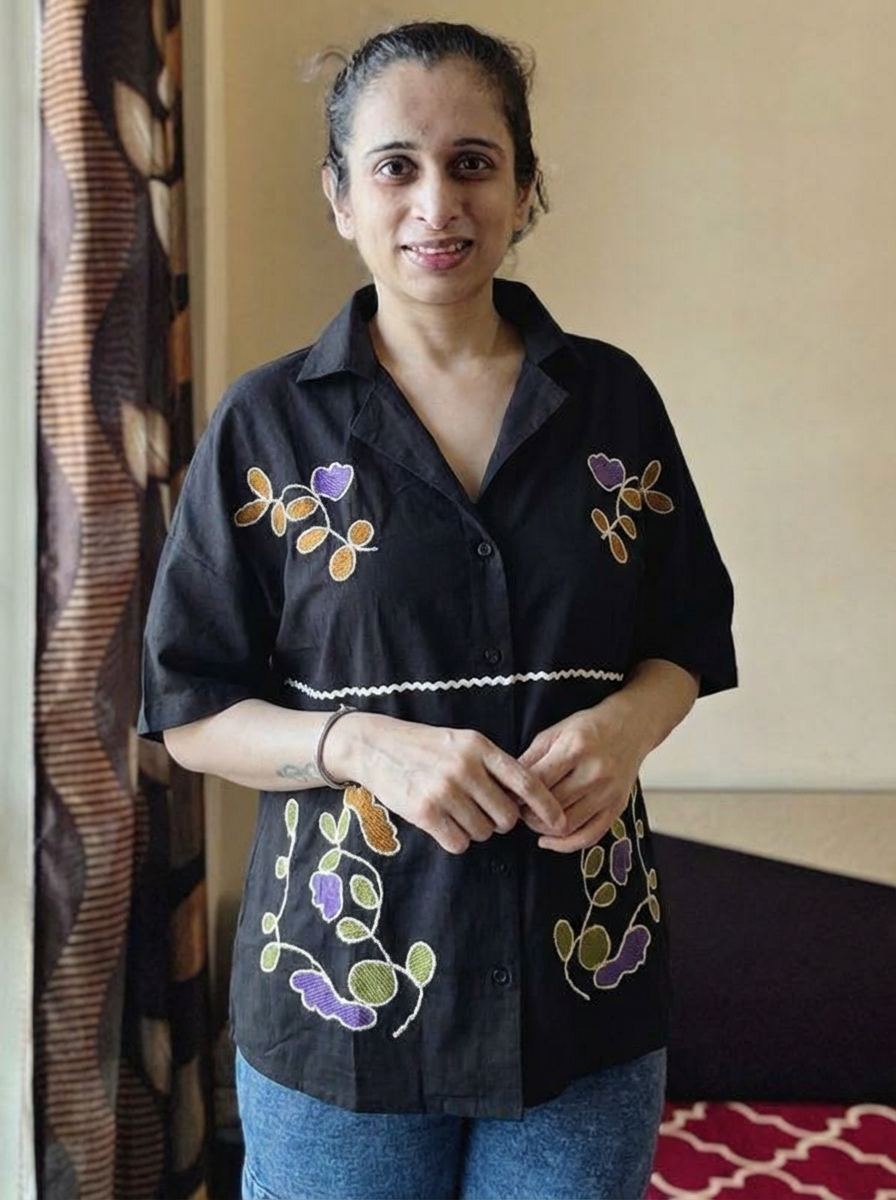
- **CRITICAL:** The user's clasped hands and the silver bracelet on the right wrist are positioned over the lower stomach. The new garment's hemline and lower fabric MUST be masked *behind* the hands and arms.
- The user's neck area needs precise segmentation to replace the current shoulder cut-outs with the new collared neckline without creating artifacts on the skin.
PHASE 3: ENVIRONMENT & LIGHTING
- **Light Match:** The user is illuminated by a strong natural light source from the left (window side), creating a gradient to shadow on the right. The new black fabric must replicate this dynamic range: the left side of the shirt should show fabric grain, while the right side should fall into deep shadow to match the room's contrast.
- **Color Calibration:** The source image has a warm/yellow cast (likely artificial light). The target image is cooler (daylight). The black point of the source shirt must be color-corrected to cool down the warm tones so it matches the neutral/cool black levels of the user's current environment.
PHASE 4: IDENTITY PROTECTION
- **Facial Lock:** The user's entire head, including the hairline, ears, jawline, and facial expression, must remain pixel-locked and untouched.
- **Body Integrity:** The user's arm thickness, shoulder width, and torso curvature must be preserved. Do not apply "slimming" filters or alter the waistline to fit the garment; the garment must warp to the body, not the body to the garment. The visible portion of the blue jeans must remain unaltered.