Thinking Process
PHASE 1: VISUAL DECONSTRUCTION
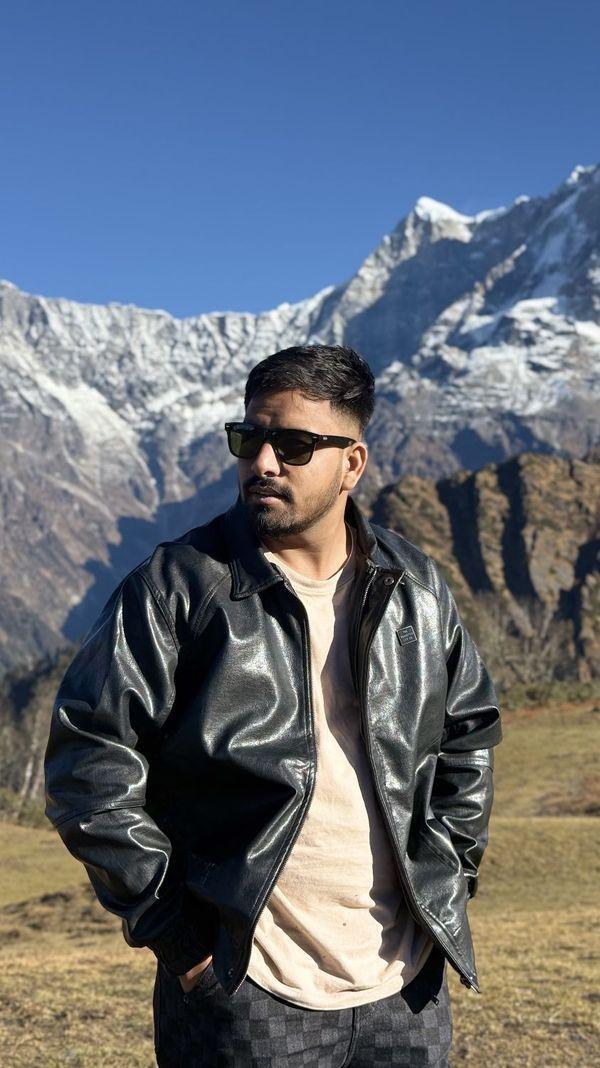
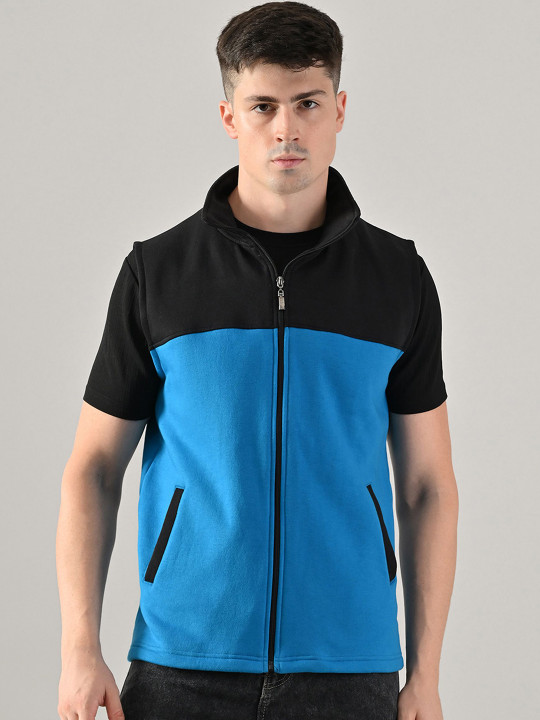
- **Fabric Physics:** The source garment appears to be a composite: a soft-shell or fleece vest (matte, high-roughness texture, light-absorbing) with black cotton t-shirt sleeves. Unlike the target user’s current high-gloss leather jacket, the new garment must exhibit low specularity and soft, diffuse light scattering.
- **Key Features:**
- The specific horizontal color-blocking line (Black yoke vs. Cyan/Blue torso) must remain crisp.
- The central silver zipper pull and the vertical zipper track.
- The two slanted black welt pockets on the lower torso.
- The structural collar which stands upright but is softer than the current leather collar.
PHASE 2: FIT & DRAPE SIMULATION
- **Body Mapping:**
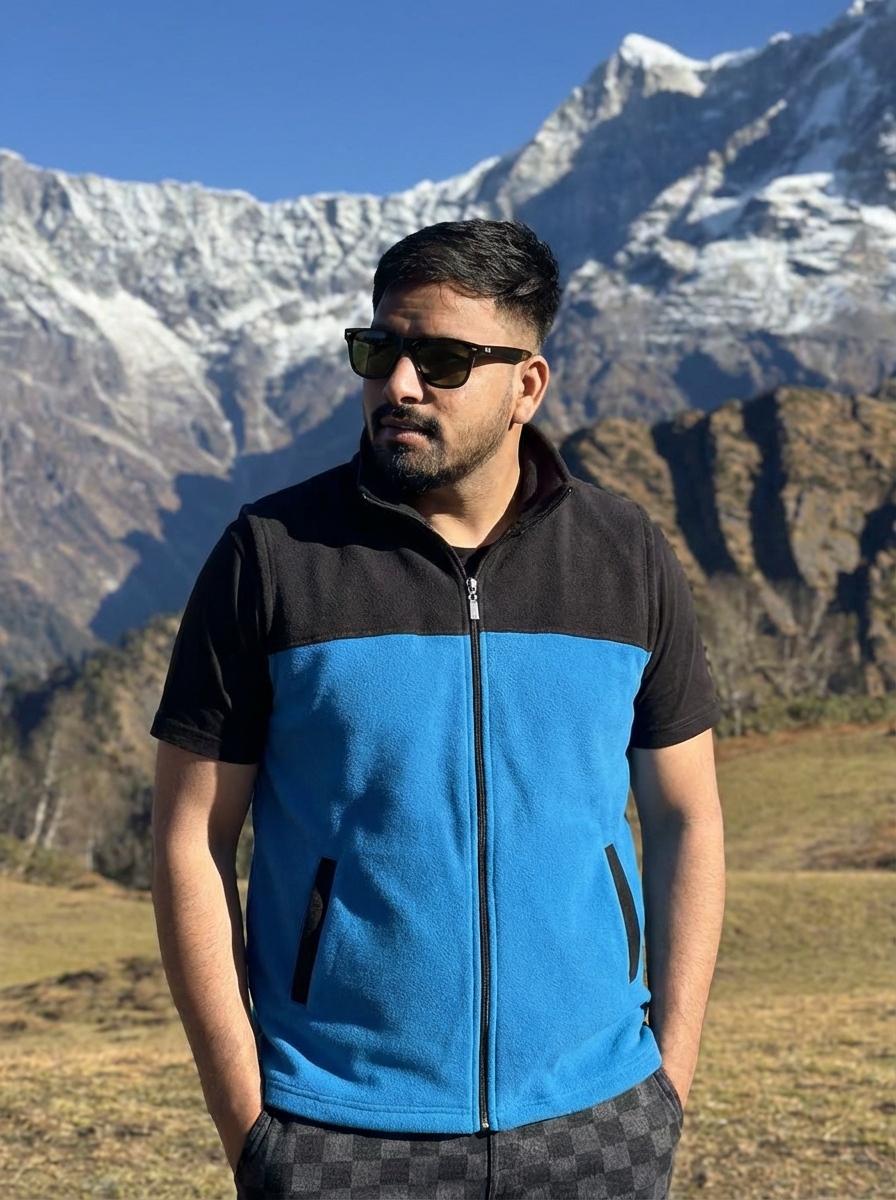
- **Waist Tension:** The user has hands placed inside pockets (or resting low on hips). The new garment's hemline must deform around the wrists/forearms, creating tension wrinkles radiating from the pocket entry points upward toward the zipper.
- **Torso Curve:** As the user is leaning slightly backward/relaxed, the central zipper line should not be perfectly vertical; it must follow the curvature of the chest and abdomen.
- **Volume Adjustment:** The current leather jacket adds significant bulk. The simulation must reduce the silhouette volume to match the thinner fleece material of the source garment while maintaining the user's underlying shoulder width and chest measurements.
- **Occlusion Handling:**
- **Beard:** The user’s beard is prominent. The top of the new garment's collar must be masked *behind* the beard hair to ensure depth integration.
- **Wrist/Hands:** Since the user's hands are hidden/interacting with the pants, the sleeve cuffs of the new garment must terminate naturally at the forearm or interact with the pocket entry, ensuring the hands remain "inside" or obscured by the new geometry.
PHASE 3: ENVIRONMENT & LIGHTING
- **Light Match:**
- **Direction:** The target environment features harsh, high-altitude sunlight coming from the viewer's right (User's left), creating hard shadows.
- **Shadow Casting:** The new garment must cast a self-shadow on the user's right side (viewer's left). The collar must cast a shadow onto the clavicle area.
- **Texture Definition:** The "fleece" texture needs strong normal mapping to catch the grazing sunlight, preventing it from looking like flat blue plastic.
- **Color Calibration:**
- **Atmospheric Perspective:** The bright blue cyan of the source garment must be slightly desaturated or cooler in the shadow areas to match the strong blue ambient light from the sky/snow reflection.
- **Exposure:** The source image is studio-lit and flat. The target is high-dynamic-range. The black upper portion of the vest must be lifted slightly in direct sun (dark grey) and crushed in shadows to match the contrast of the user's sunglasses.
PHASE 4: IDENTITY PROTECTION
- **Facial Lock:** Absolute freeze required on the user's face, specifically the beard line, nose, and the sunglasses. The hairline must remain untouched.
- **Body Integrity:** Do not slim the user. While the jacket is less bulky than the original leather, the user's shoulder span and chest breadth must remain consistent with the original image to maintain anatomical realism. Do not alter the checkered pants or the background scenery.