Thinking Process
PHASE 1: VISUAL DECONSTRUCTION
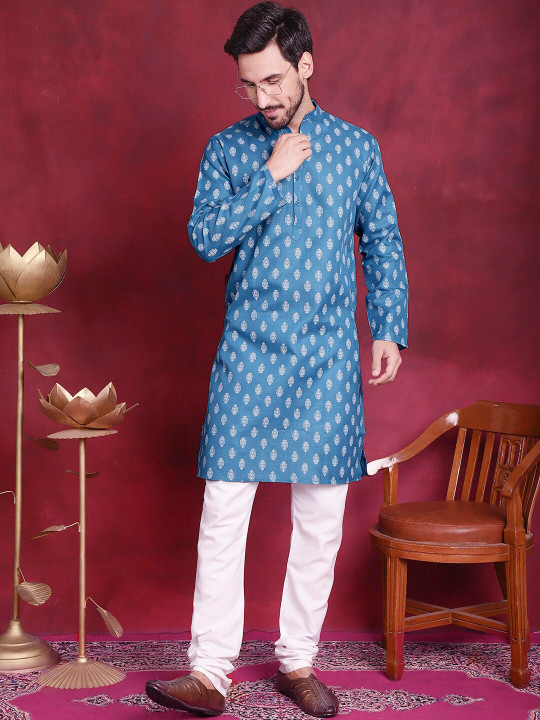
- **Fabric Physics:** The source garment is a patterned Kurta, likely made of cotton or a cotton-silk blend. It exhibits a medium-weight drape—heavier than a t-shirt but lighter than a jacket. It has a semi-matte finish with a subtle sheen that catches the light on the high points of folds. The physics engine must treat this as a structured woven fabric, meaning it will fold rather than stretch.
- **Key Features:** The intricate white/silver ornamental print pattern must remain crisp and undistorted. The Mandarin collar (band collar) structure is rigid and must stand upright around the neck. The front button placket and the tunic length (extending past the waist to the upper thighs) are critical silhouette markers that define this specific garment type.
PHASE 2: FIT & DRAPE SIMULATION
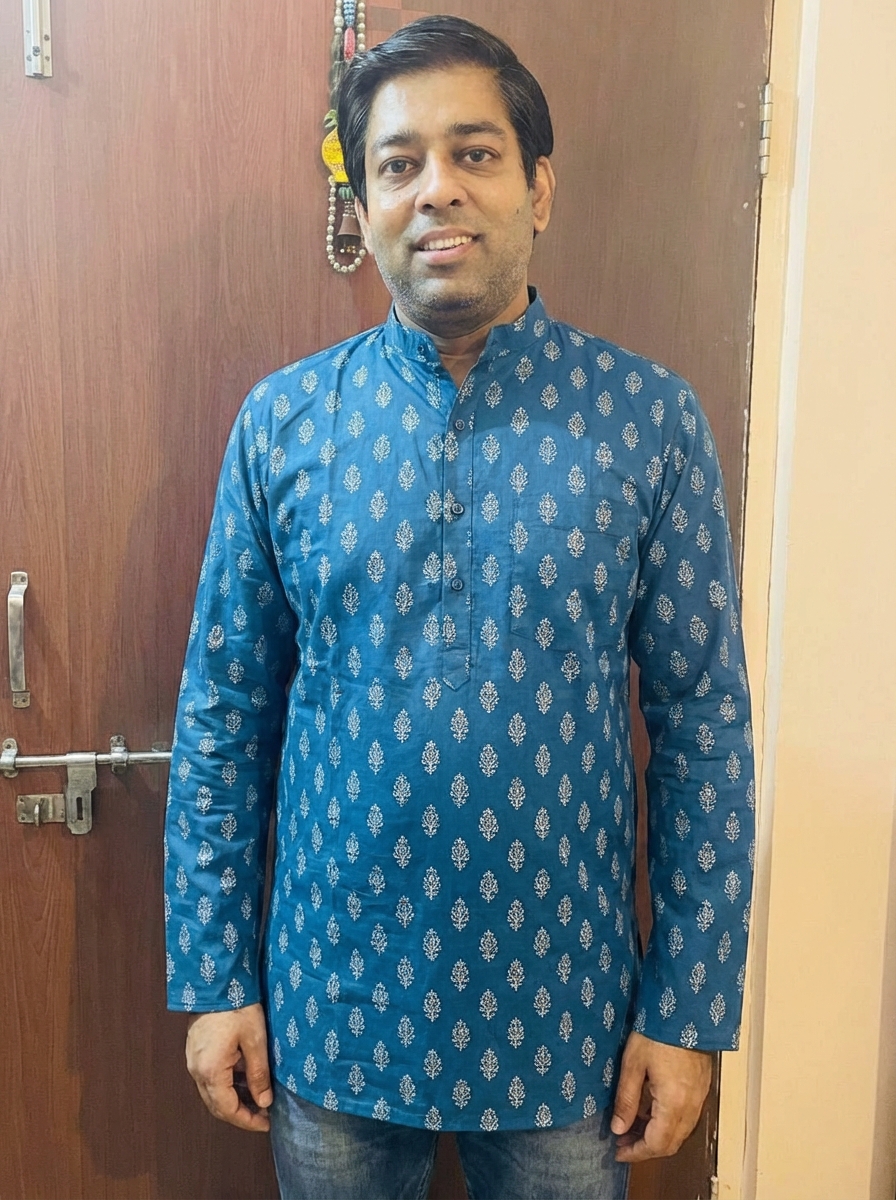
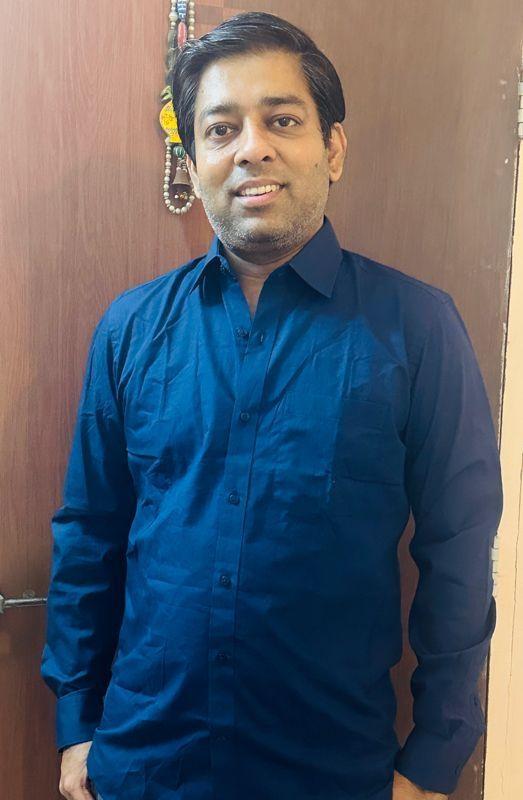
- **Body Mapping:** Unlike the user's current tucked-in/short shirt, the Kurta acts as a tunic. The simulation must extend the hemline downward, draping loosely over the user's waist and hips, overriding the current waistband visual. The shoulders should align with the user's natural shoulder seam, with the fabric falling vertically due to gravity, creating mild vertical column folds at the torso rather than tight horizontal tension lines. Sleeves should stack slightly at the wrists if the length exceeds the arm span.
- **Occlusion Handling:** The user's hands are positioned low at the sides; the cuff termination point must be calculated precisely at the wrist bone to avoid "ghost hands." The user's short hair does not interfere, but the neck region requires precise masking where the new Mandarin collar will sit higher and tighter than the current open-collar shirt.
PHASE 3: ENVIRONMENT & LIGHTING
- **Light Match:** The user is standing under overhead, artificial indoor lighting (evident by the specular highlight on the forehead and nose). The target garment must generate downward-casting shadows, particularly under the collar and button placket. The "studio flat" lighting of the source cloth must be re-rendered to include a top-down highlight gradient to match the user's environment.
- **Color Calibration:** The user's environment has a warm/yellowish color temperature (incandescent or warm white bulb). The source Kurta is shot in neutral/cool studio light. A warm filter (approximately 2800K-3200K tint) must be applied to the blue Kurta to integrate it into the room's ambience, preventing it from looking like a pasted "sticker."
PHASE 4: IDENTITY PROTECTION
- **Facial Lock:** The entire head region, specifically the jawline, chin, mouth, nose, eyes, and hair, must be strictly frozen. The boundary between the neck and the new collar is the critical no-change zone.
- **Body Integrity:** STRICT PROHIBITION on warping the user's body shape to match the taller, slimmer fashion model. The Kurta must be expanded width-wise to wrap naturally around the user's actual torso and stomach circumference, preserving his natural stance and build.