
Thinking Process
PHASE 1: VISUAL DECONSTRUCTION
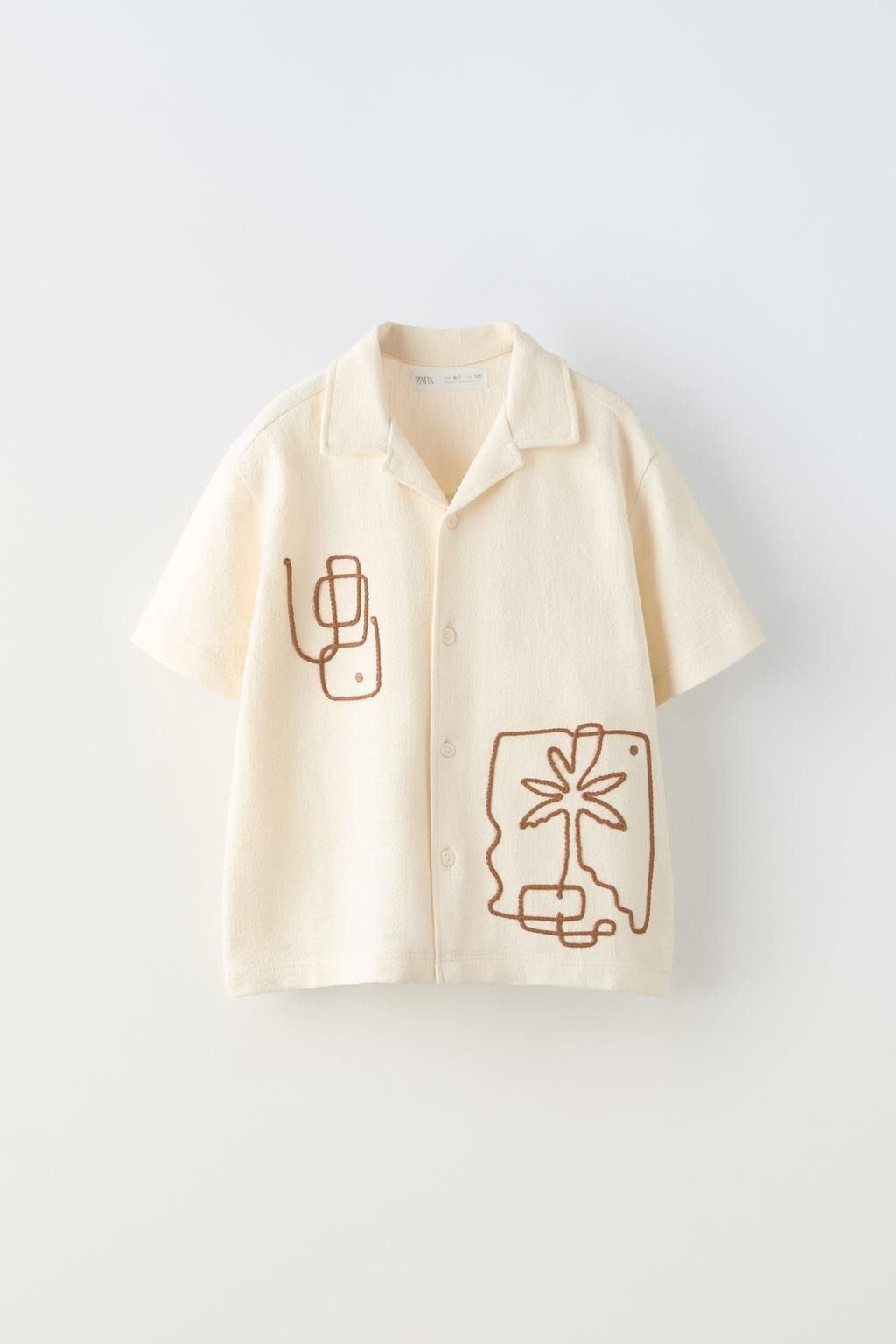
- **Fabric Physics:** The source garment appears to be a textured, heavyweight cotton blend or terry-cloth material with a matte finish. It possesses high structural integrity and low elasticity. Unlike the user's current knit sweater, this fabric will not cling to the torso; it creates semi-rigid folds rather than soft drapes. Light diffusion must be soft with no specular highlights, emphasizing the "fuzzy" surface texture.
- **Key Features:**
- **Embroidery:** The abstract brown line art (geometric shape on the right breast, palm tree/box motif on the left lower quadrant) must remain vector-sharp and undistorted by the fold algorithms.
- **Camp Collar:** The open, notched lapel structure is critical and must replace the current high-neck button placket.
- **Texture:** The towel-like, granular surface of the fabric must be rendered to distinguish it from a flat cotton print.
- **Buttons:** Three visible brown buttons must maintain their rigid geometry.
PHASE 2: FIT & DRAPE SIMULATION
- **Body Mapping:**
- **Selfie Pose Adaptation:** The user's right shoulder is elevated and rotated forward due to holding the camera. The virtual garment must bunch slightly at the right trapezius and pull tight across the right axilla (armpit).
- **Volume Replacement:** The user is currently wearing a thick sweater. The simulation must strip the volume of the sweater to map the new shirt closer to the actual skin surface, ensuring the user does not look artificially bulky.
- **Sleeve Transition:** The source is short-sleeved, while the user wears long sleeves. The simulation requires generative inpainting to render realistic skin tone and forearm anatomy for the exposed lower arms, matching the complexion of the face.
- **Occlusion Handling:**
- **Beard/Jawline:** The user’s beard obscures the neck area. The new camp collar must be layered *underneath* the beard line, with a slight cast shadow from the chin onto the fabric.
- **Left Hand:** The user's left hand is visible at the bottom right. The shirt hemline must interact naturally here, likely terminating just above the wrist/hand area without visual clipping.
PHASE 3: ENVIRONMENT & LIGHTING
- **Light Match:** The user image features overhead, slightly diffuse indoor lighting (likely LED) creating soft shadows under the brow ridge and nose. The new garment must cast a downward shadow from the collar onto the chest and from the sleeves onto the arms. The lighting intensity on the shirt must match the exposure of the user's face to avoid a "sticker" effect.
- **Color Calibration:** The room has yellow/cream walls which cast a warm ambient fill. The cream color of the source shirt must accept a subtle warm tint from the environment to sit naturally in the scene, while ensuring the brown embroidery maintains high contrast.
PHASE 4: IDENTITY PROTECTION
- **Facial Lock:** The region from the hairline to the chin, including the ears and the specific grooming of the beard, must remain frozen. The angle of the gaze and the expression must not be altered.
- **Body Integrity:** Strictly prohibit body morphing or slimming algorithms. The user's shoulder width and torso mass must correspond to the input image, only adjusting for the difference in fabric thickness (removing the sweater's bulk) to maintain a realistic physique.